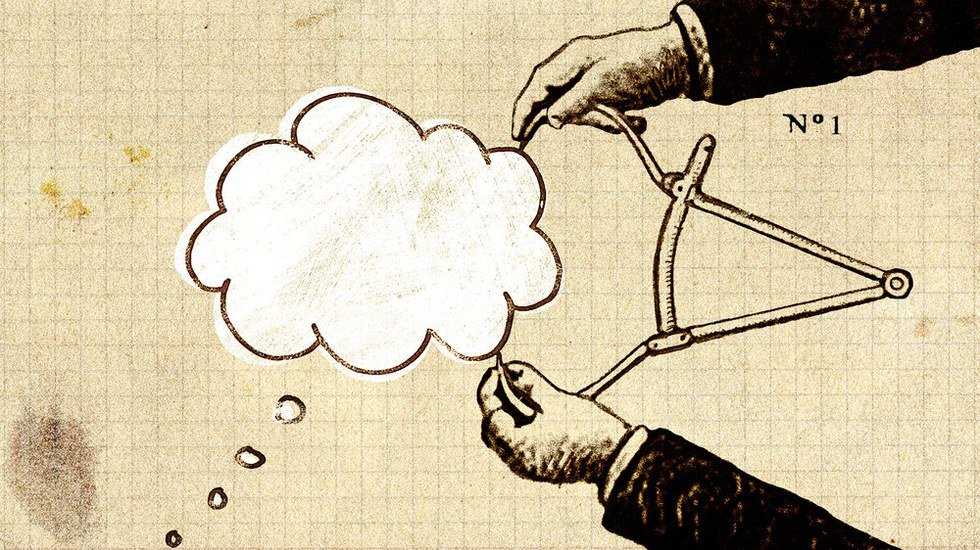
Here I am again, suspended between thought and action.
“Jessica is worthless,” my self-critic argues, blaring like an alarm in my head.
“Jessica can’t write,” the critic continues, “she is incapable of producing anything useful or interesting. Maybe she should give up.”
As these thoughts continue to sound, they begin to swell into feeling. They become the pang of dread and insecurity in my gut and the redness in my face. What were initially events in my head have come to feel like conditions, as if I myself have become dread and insecurity. From here, the thoughts begin to change.
“I am worthless,” I start to say to myself, “I can’t write — I am incapable of producing anything useful or interesting. Maybe I should just give up.”
As I am moved into this narrative, I begin to feel my thoughts even more. Ultimately, I come to believe them. I think to myself, “Perhaps what I feel is true.”
Thinking this, in this situation, feels as real as knowing it. From here, I feel myself slipping and try whatever mental gymnastics I need to retrieve myself. This feeling moves me into a perpetual cycle of deliberate thinking. I start trying to call-up “good thoughts,” thoughts that make me feel invigorated, inspired and capable. I do this repetitively for some time. The “bad thoughts,” however, keep regenerating, and I’m stuck hopelessly arguing with my brain.
In my last article I included a similar narrative on perfectionism in Obsessive Compulsive Disorder (OCD). I illustrated OCD as an illness that can suspend an individual between thought and action. In this position an individual, with or without OCD, is tasked with the responsibility of choosing how to respond to their thoughts, feelings and accompanying physical sensations. This process of choosing is oftentimes a terrifying responsibility for the person with OCD and is, therefore, elongated. When I’m between thought and action, I ask myself the same questions repeatedly until they begin to feel more like mantras.
“Do I take a risk for myself, accept the possibility that something bad might happen and do what I want to do,” I ask, “or do I sacrifice my power to my OCD, treat the possibility of a bad consequence as a probability, and do what feels safe?”
This space between thought and action is a subtle but crucial part of OCD. Because of its subtlety, this space is often overlooked when OCD is discussed and defined. Even the National Institute of Mental Health (NIMH) neglects to acknowledge this space. The NIMH defines Obsessive Compulsive Disorder as “a common, chronic, and long-lasting disorder in which a person has uncontrollable, recurring thoughts (obsessions) and behaviors (compulsions) that he or she feels the urge to repeat over and over.”
This definition does a nice job of explaining the larger dynamic of OCD — the recurrence of unwanted thoughts — what it looks like, and what its major components are (i.e. obsessions and compulsions). What it doesn’t do, however, is address what perpetuates this dynamic, what occurs in the “space” between thought and action that stimulates the recurrence of thoughts. This definition also seems to suggest that one should be able to control their thoughts. The issue here is that thoughts, in any brain, are uncontrollable, and the recurrence of thoughts in a brain with OCD is an outgrowth of how the person with OCD chooses to relate to their thoughts. What makes OCD unique, therefore, is not the occurrence of “uncontrollable, recurring thoughts,” but rather, how one thinks and, ultimately responds to their thoughts. The thoughts themselves are offshoots of a deeper and more complicated relationship that causes the person with OCD to lose sight of the fact that they are not their brain and that they can, in turn, chose how to respond to their brains.
The recurrence of self-critical thoughts in the personal narrative at the start of this article, for instance, was not solely perpetuated by the thoughts themselves. The recurrence of these critical thoughts was sparked by a pattern of responses on my part. I took my brain too seriously, so seriously that the thought “Jessica can’t write,” very quickly became the belief that “I can’t write.” Ultimately, I let my brain write my story in that moment. With this example, I don’t mean to imply that my symptoms are my fault — symptoms, like thoughts and feelings, come and go uncontrollably. What I mean to suggest is that, in the face of my symptoms and my thoughts and my feelings, I have the power to behave as I chose, to act on behalf of myself or my OCD.
This power is incredibly subtle, almost totally overshadowed by the charisma of our thoughts and the resonance of our feelings. This is because we often believe that we are our thoughts, our feelings and our brains. When I had the thought “I can’t write,” I believed in it very quickly.
“If I’m having this thought,” I said to myself, “then it must be true. If it feels, then it must beI.”
What if, in response to my thought, I instead said, “I’m having the thought that I can’t write. The thought makes me feel a sense of dread. Perhaps I’ll keep writing.”
With this response, I am not reacting to the thought as if it is mine. Rather, I am reacting to it as if it were an occurrence in space. I am noticing rather than believing in the thought and acknowledging how it makes me feel. To move on from the thought, I have to accept it. Though this causes the feelings of dread, disappointment, and anxiety that accompany the thought to mount in me for a time, they will ultimately become background noise if I keep accepting them rather than believing them. Believing would make the feelings truly dreadful, truly disappointing, truly anxious. Thoughts aren’t inherently what they claim to be. They are not inherently anything for that matter. They are merely occurrences in the brain that are what you make of them. Therefore, the issue with OCD and seemingly “bad” thoughts in general is not what the thoughts are, but rather, what they have the potential to become.