(DISCLAIMER: I would like to emphasize that it is not only women who might seek out abortions. Transgender men and non-binary individuals with the ability to reproduce may also have abortions, so as a general rule of thumb, I am utilizing gender-neutral terminology in order to be inclusive of them.)
It was probably about three years ago that I first stumbled upon an article entitled "How I Lost Faith in the 'Pro-Life' Movement," written by blogger Libby Anne on her Patheos blog Love, Joy, Feminism, about how she started out as an anti-abortion activist, and gradually came to consider herself pro-choice. At the time, my position was firmly on the "pro-life" side of the abortion debate, and I always read the article with a feeling of unease, often venturing onto Google in a frantic quest for confirmation bias of my anti-abortion views. I successfully maintained that confirmation bias for two years, immersing myself in anti-abortion activism.
As I began to question, and eventually become disillusioned with, certain views held widely among the anti-abortion crowd that didn't explicitly have to do with abortion, I found myself resonating more and more with Libby Anne's article. Now that I have planted myself firmly in the pro-choice camp, I read the article again and am struck by how much I relate to Libby Anne's experiences and frustrations with the American movement to criminalize abortion in the United States.
Like Libby Anne, I started out strongly, and actively, anti-abortion, and gradually came to favor the right to a safe and legal abortion. This is my story of how my position on abortion gradually evolved to where it is now.
Background as an anti-abortion activist
I got my start in anti-abortion activism at the beginning of my freshman year of college, when I attended Lansing Community College. I partook in 40 Days for Life, a nationwide anti-abortion network which holds two 40-day periods every year--one in the fall, and one in the spring--of prayer, fasting, and picketing abortion clinics, with a chapter in Lansing. I still remember the first day I stood in front of a clinic in Lansing (which is no longer in existence), holding a sign with an anti-abortion message and image of a baby. It was my first-ever experience in political activism.
Over time, I got to know some of the other active participants in the Lansing chapter of 40 Days for Life. Many were senior citizens, and I wouldn't be surprised if I was the only non-denominational Christian involved in a group that was probably 99 percent Catholic. Those who participated unashamedly enmeshed their activism with the Christian faith, walking up and down the sidewalk outside the clinic reciting the rosary with beads in their hands, believing that they were called by God to protest the inhumane act of abortion.
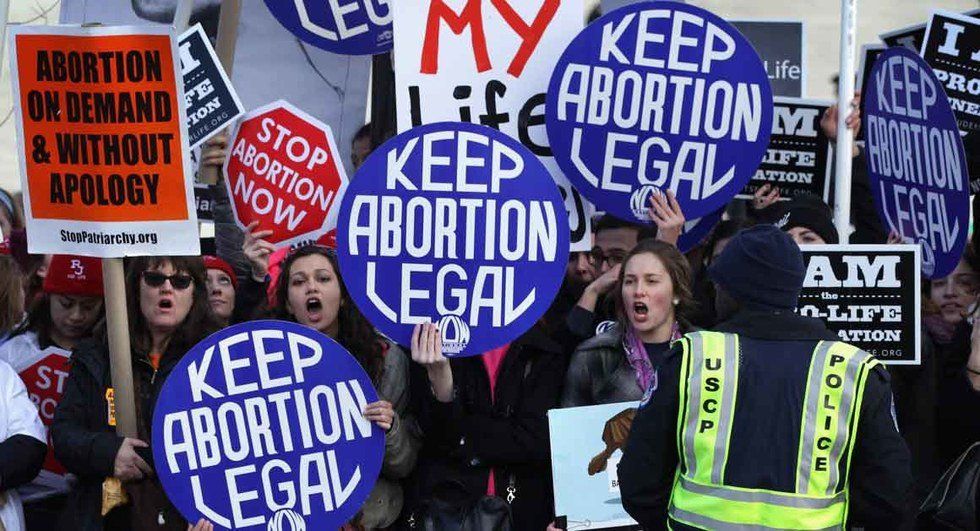
Through 40 Days for Life, I came in contact with the then-President of Students for Life at Michigan State University, who said I was welcome to attend their meetings despite not being an MSU student at the time. My involvement with the anti-abortion movement shifted from 40 Days for Life to MSU Students for Life. During my sophomore year of college, I was on the executive board for MSU Students for Life, manning their social media accounts. I spent that year heavily involved with promoting their message on MSU campus, including hosting anti-abortion activist Alveda King (niece of Dr. Martin Luther King, Jr.), and hosting the Genocide Awareness Project, which involved erecting a large, graphic image of what was supposedly an aborted fetus by a public sidewalk on MSU campus, and equating abortion to the Holocaust. My most memorable experience was when MSU Students for Life traveled to Washington, D.C., and joined 500,000 other anti-abortion individuals in the March for Life, which remains one of the most exhilarating experiences of my life.
When I was anti-abortion, my more nuanced position was that I believed that abortion should be illegal except in cases when the life of the mother was threatened. I was always tenuous about cases of rape, but tended to err more toward abortion not being allowed in those cases. But my opposition was genuine, and I was legitimately saddened by the idea of abortion. Being part of this movement gave me something meaningful in my life, and felt like I was part of something bigger than myself. I made many connections and long-lasting friendships that still exist today.
Questioning the movement, and cracks in the brick wall
When my position on an issue changes (and I wouldn't be surprised if nearly all of them have changed since I began developing them), it seldom happens in the form of an epiphany, but gradual evolution. That's how my disillusionment with the anti-abortion movement came about; it was not immediate, but happened over time.
My initial problems with the anti-abortion movement often didn't have to do explicitly with their position on abortion. For starters, many abortion opponents have a tendency to routinely spread misinformation, either via crisis pregnancy centers or TRAP laws mandating that abortion providers tell their patients unfounded claims about abortion. Examples of such misinformation include portraying abortion as dangerous and emphasizing the risks, when it is among the safest medical procedures available; and purported links between abortion and breast center, which has no medical evidence to back it up.
In addition, I came to find the views on contraception among many abortion opponents incredibly problematic. Though some polls have found that a sizable number of abortion opponents have no moral qualms with contraception, there is also an influential faction among the movement who vehemently oppose contraception, for a myriad of reasons.
Many Catholics object to hormonal contraception in particular because of its purported potential to intercept a fertilized egg (which they believe to have the same intrinsic worth as a human being) before it is implanted in the uterus. I find this very lacking in prioritization, as roughly half of fertilized eggs fail to implant in the uterus and never become full-grown humans. Furthermore, the statement, "May prevent implantation," on FDA labels of oral contraceptives seems to have been made out of pure speculation, as actual studies have found no evidence that oral contraceptives can inhibit a fertilized egg from implanting in the uterine wall.
This view is especially problematic when certain abortion opponents attempt to legislate it in various ways. This was Hobby Lobby's basis for objecting to having to provide their employees insurance plans that cover certain oral contraceptives, an objection they took to the Supreme Court, which sided with them in a landmark ruling in 2014. I came to object to this ruling, as such a precedent might result in employees being cut off from access to birth control, which is especially problematic when they use it for non-contraceptive purposes, like managing periods or various reproductive health issues. My view was cemented when I first watched Sandra Fluke's testimony before a congressional committee, in which she described the implications of Georgetown University's denial of birth control coverage to students who needed it, including one woman who developed early menopause and became infertile as a result of hormonal birth control prescribed by her doctor not being covered by her university's insurance plan.
Add this to the fact that greater access to contraception has been linked to reduced abortion rates, and abortion opponents' opposition to oral contraception, and knee-jerk refusal to have anything to do with providing it, seems to run contrary to their mission of valuing human life at all stages and ending abortion in the United States.
The vehement efforts to defame and defund Planned Parenthood by abortion opponents further calls their priorities into question. They made some noise with videos purportedly showing Planned Parenthood employees admitting to "selling baby parts." In reality, what was being described was donating tissue of aborted fetuses to organizations who would then use it for medical research, for which the only money Planned Parenthood receives is reimbursements for the expenses of transporting the tissue. None of this is illegal, and subsequent investigations of Planned Parenthood in select states, usually at the request of Republican lawmakers, found no evidence of illegal activity on the part of Planned Parenthood.
This isn't the first time that abortion opponents have released "smoking gun" videos portraying Planned Parenthood as a corrupt, evil organization. Anti-abortion activist Lila Rose and her organization Live Action have been putting out those kinds of videos for years, portraying Planned Parenthood employees supposedly covering up human trafficking or other crimes. Often the claims made in the videos are unfounded, and even when they have uncovered something shady, usually it's hardly the "smoking gun" portrayed in the videos.
Yet everyone knows, deep down, that the real reason for such vehement opposition to Planned Parenthood is because they provide abortions. But it sometimes seems like the rhetoric of valuing all human lives at any stage ends there, as evidenced by the efforts to defund Planned Parenthood, which would effectively close Planned Parenthood, and thus leave numerous individuals without health care. A Congressional Budget Office report estimated that approximately 650,000 women would be cut off from essential health care if Planned Parenthood was defunded.
The average abortion opponent's response to this is to deny that it's a problem in the first place, often citing misleading statistics twisted to fit their narrative, such as claims that there are more community health centers than Planned Parenthood clinics, thus covering the patients who would be displaced by the closure of Planned Parenthood. First of all, just because there are more community health centers nationwide doesn't necessarily mean every town with a Planned Parenthood clinic also has a community health center. Second, many community health centers are not as well-equipped to handle masses of patients as Planned Parenthood, and many in cities with Planned Parenthood clinics have claimed that they wouldn't have the resources to take in all of Planned Parenthood's displaced patients should Planned Parenthood cease to exist.
All of this frustrated me as I was trying to navigate through the discourse and separate fact from fiction, at the risk of being eviscerated for not fitting neatly into the mold of "pro-life." After awhile, I became convinced that if any meaningful good was going to come out of the abortion debate, it would not be brought about by those on the opposing side.
Why I ultimately changed my position
As I mentioned above, changing my position on an issue very seldom happens in the form of an epiphany. This was especially true with my position on abortion, having been such a passionate advocate for one side of the issue already.
I cannot pinpoint an exact moment when I came to the conclusion that I was pro-choice. It was not solely because of my disillusionment with the pro-life movement, as much of that didn't have to do explicitly with abortion. I simply felt the need to explain those issues I have with the moment because I felt that they were essential parts of my evolution on the issue.
I suppose I should start with a moment which made me seriously think about my position; I read an article in Vox making the case for why abortion is a form of organ donation, and why, because of the potential complications that could arise from pregnancy and childbirth, individuals should not be forced into pregnancy. I feel that this is an argument seldom heard in the abortion debate, but presents one of the strongest cases for the right to choose.
Many who oppose abortion favor exceptions in cases when the life or health of the parent is threatened. However, any pregnancy potentially threatens the health, and even the life, of the parent. During the pregnancy, the immune system is weakened, making the parent more susceptible to catching viruses, along with the typical nausea and exhaustion that comes with pregnancy. Then there's childbirth, which despite medical advances still comes with huge risks and a wide variety of adverse and potentially life-threatening complications. Tearing and damage to the pelvic floor can happen during a vaginal birth, and the epidural used to minimize pain during a vaginal birth has been shown to cause paralysis in 1 in 20,000 women. In addition, complications such as preeclampsia can easily arise, in which the body has a massive adverse reaction to the pregnancy, which left untreated can cause organ failure and/or death.
The health risks of childbirth are especially relevant considering that childbirth-related deaths in the United States have steadily risen in recent years. In 2011, the Centers for Disease Control and Prevention found that 17.8 out of 100,000 births resulted in death of the parent. Abortion, by contrast, has a mortality rate of .7 out of 100,000.
The main takeaway from this is that pregnancy and childbirth aren't exactly a walk in the park, and thus not experiences that anyone should be forced into if they didn't sign up for them. No one should be forced to give up their body for 8-9 months, having another human using it to survive. And by the way, "they shouldn't have chosen to have sex" isn't a valid argument against that. That doesn't make requiring people to give birth not forcing it on them, nor does it make it constitutional. You're saying the parent should be required to face the potential complications of pregnancy and childbirth simply because they chose the circumstances that put them in that position. That is forcing those complications on them, because you're giving them no choice in the matter.
The other problems with the "they shouldn't have chosen to have sex" and "they should face the consequences for their actions" arguments is that it makes a lot of sweeping assumptions about why someone might seek out an abortion. It doesn't take into account that this individual might be in an abusive relationship, or that they might not have the financial means to raise a child (side note: the cost of giving birth in a hospital can be anywhere from $3,000 to $37,000...not good if you're below the poverty line). Or they might be addicted to drugs and conceived the child while high, pregnancy and childbirth would be dangerous for their health, and the addiction would be passed onto the baby.
Which brings me to another point: for all of the concern that abortion opponents show for the baby while it's in the womb, they seem significantly less concerned with its wellbeing after it's born. That shows in the "consequences for their actions" argument, in that they don't seem concerned with the consequences that could be faced by the child, who was guilty of no wrongdoing in this scenario. Lecturing individuals facing unplanned pregnancies with "you shouldn't have chosen to have sex," and "you should face the consequences for their actions," does nothing to help them if the consequences for their actions are financial hardship, or a drug-addicted child. Do the parent, and by extension the child, deserve such hardships because the parent chose to have sex? I think that's an awful way to bring a child into the world.
I would also argue that, in some circumstances, it might actually be more responsible to have an abortion. If the parent is in an abusive relationship, facing financial hardship, addicted to drugs, or any manner of other circumstances that would make it difficult to give a child the love and care it needs, it might be wise not to go through with the pregnancy, to spare hardship for the child. There are so many unique situations and reasons why someone might seek out an abortion that it would be detrimental to make it illegal.
And not only do I favor the right to a safe and legal abortion, I favor that right without unnecessary barriers. No 72-hour waiting periods, or waiting periods of any kind (unless medically necessary). No mandates that the patient see the ultrasound. No requirements of parental consent for minors seeking abortions. Abortion clinics should be more abundant and easily accessible in general; no one should be forced to make a long and potentially financially compromising drive to have an abortion, and it's a travesty that some states have only one remaining abortion clinic left. Abortion should also be affordable, and covered by insurance plans. The end result is, as best summed up by John Oliver, in his brilliant segment on abortion: "Abortion cannot just be theoretically legal. It has to be literally accessible."
One thing I've learned through many years of thinking about this issue is that there is nothing easy about it. There are some legitimate ethical questions that abortion raises, which I admittedly still grapple with on occasion, and I know that many who are against its legality genuinely believe it to be wrong. Many who favor the right to choose don't necessarily "like" abortion, which is why they call themselves pro-choice. And I have yet to find someone who enjoyed getting an abortion, if not because of the ethical questions surrounding it, simply because it is a medical procedure at the end of the day, which people don't generally find enjoyable. I don't see myself looking forward to having a vasectomy, but if lawmakers attempted to make it illegal, I would fight tooth and nail to protect my right to a safe procedure.
Am I 100 percent comfortable with the idea of abortion? No, but I don't have to be. I don't think whether the procedure is legal should be contingent on whether I approve of it, but on whether it is conducive to a free society. And I do not believe that a truly free society can force someone to give up their body for nine months, in a process potentially compromising their health and even their lives, and then have the burden on them to deal with the consequences of having the child. I believe that agency and bodily autonomy are key to a free society. We wouldn't force someone to donate an organ necessary to save someone's life. So why force someone to literally carry another human being in their body?
I now watch these TRAP laws being enacted in numerous states throughout the nation, some of which I likely would have supported two years ago, and am appalled by this concerted effort to strip away at the right to choose, and the roadblocks that have been placed in the way of access to a safe and legal abortion, to the inconvenience and detriment of those who need it.
This is where I draw the line.