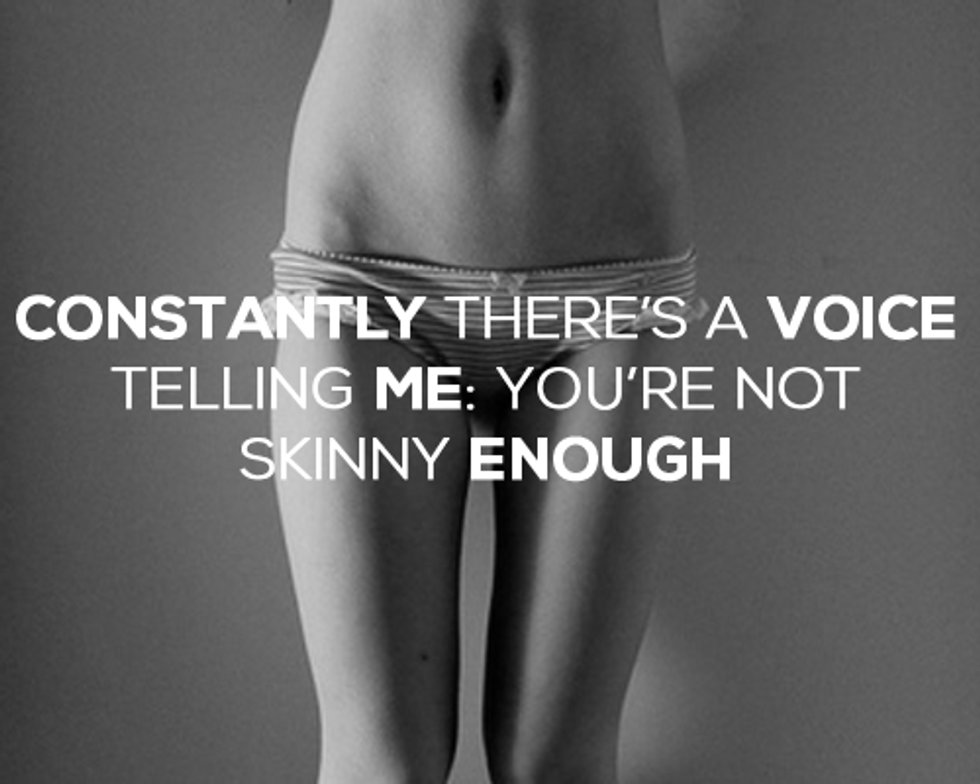
Emaciated
abnormally thin or weak, especially because of illness or lack of food
-Oxford Dictionary of English
With words like abnormally, weak, and illness, it’s hard to argue that emaciated could be considered a positive adjective. However, the dictionary definition of “skinny” is “very lean or thin; emaciated.” Why, then, is skinny considered the baseline standard of beauty in today’s society according to popular culture? Society’s idea that being skinny is the only way to be considered beautiful is setting completely unrealistic standards and teaching women everywhere that who they are just isn't good enough.
Popular media loves the idea that thin is beautiful. Turn your television on and any advertisement you come across will feature sparkling smiles, perfect hair, and a thin body. It is not often that you see a curvy woman, unless the advertisement is for a weight loss program or some other product or service that paints being full-bodied as a negative attribute. The media’s love affair with skinny women is a daily reminder to those who are curvy that they do not meet the “social norm.” The continuous portrayal of skinny women as having the “correct” body type has the ability to lower a woman’s sense of self-worth.
Given enough time, this deteriorating sense of personal importance creates what many consider to be “thin privilege.” Thin privilege may be subtle, but it is evident every time you walk around your local shopping mall. Many popular retailers advertise clothing as “one-size fits all”; an inaccurate and demeaning name considering that the sizes tend to run quite small. This unfair system of sizing can make a woman doubt her own body based purely on her inability to fit into what is advertised as a universal size.
Another example of thin privilege is society’s assumption that because you are thin, you must be healthy. Magazines constantly feature articles promoting the “healthy lifestyle” with a picture-perfect airbrushed model tacked on. Though these articles are well intended, the message is contradictory because healthy does not always come in a size zero. Thin privilege, a creation of the media, implies that being skinny is the only way to be beautiful and as a result lowers a full-bodied woman’s sense of self-worth.
It is no secret that body standards have changed significantly over time. The 1950s promoted big-breasted, voluptuous women such as Marilyn Monroe as the ideal body image. Fast-forward a decade and flat chested, one hundred and twelve pound Twiggy is what women were striving to look like. Society’s take on what is “sexy” is ever changing and is nearly impossible to keep up with. If women were to change their bodies according to what was “popular” during specific decades, the average body size would fluctuate dramatically.
July 2014 marked the introduction of the newest size in jeans—size triple zero. Also known as an extra extra extra small, size triple zero is equivalent to the typical waist size of a six to eight-year-old girl. The introduction of such a small, and frankly unhealthy, size further perpetuates the social dogma that being skinny is the only way to be considered beautiful. Constantly changing body image ideals coupled with impractical sizing options set unrealistic standards for women.
It is important to remember that encouraging a healthy lifestyle isn’t the problem. The problem exists when “healthy” is portrayed as an overly photo shopped size zero. Society needs to break this unattainable standard and starting promoting all shapes and sizes so that women can start to feel comfortable in their own skin and love who they are no matter what they look like. Beautiful truly does come in all shapes and sizes.
"I praise you, for I am fearfully and wonderfully made. Wonderful are your works; my soul knows it very well." - Psalm 139:14