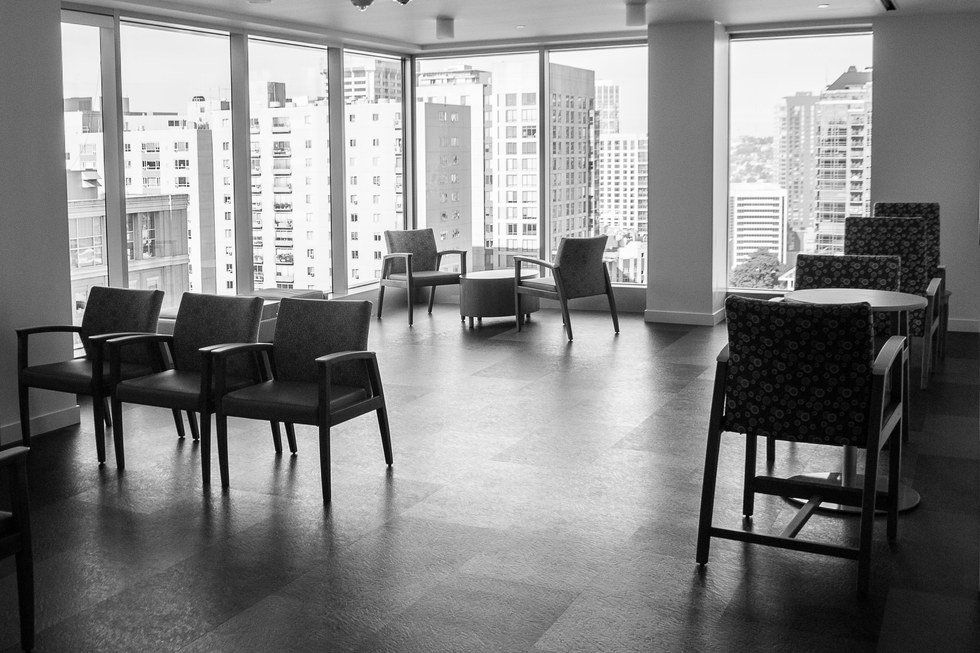
I have a regular couch in a waiting room of what I’m told is one of the world’s best hospitals.
Donna and Edith, the pair of octogenarian sisters from New Jersey, always bring rosaries. I watch their lips move in a rhythmic "Hail Mary” for what seems like the millionth time today. There’s a daughter and father who have just come in; the daughter, wearing a fur vest and Jimmy Choo heels, looks dressed for a stroll down Fifth Avenue rather than sitting in a waiting room.
She pulls out a Torah from a bag that looks like it cost a semester’s worth of tuition and gently rocks back and forth while reading it. To my left, my mother is scrolling through screenshots of du’aas—supplications for prayer—on her iPhone. I have never used a rosary, have never read the Torah and am unsure of the precise Arabic scripture that my mother is reading, but I know what they are all praying for.
She goes in. I take her coat, her iPhone and her hat. For the time that my mother is gone, I try to channel each and every ounce of trust in medical technology that I have. I’m working towards a degree in biology, I think to myself. I am a rational person, chimes another part of my brain. I read a text from my dad: She’ll be fine. I begin to pray, too.
From the corner of my eye, I see that the older Haitian couple has arrived. They’re late. I feel a pang of disappointment and am upset that they have come in after my mother had already gone in—we love them so much. My mom and I have never spoken one word to this couple but have spent more time than is healthy speculating about their lives. They are our definition of relationship goals: they show no public displays of affection and never speak a word to each other. Conversely, they usually spend the entirety of their time waiting doing what Mia Wallace refers to as a "comfortable silence in "Pulp Fiction." That is love to us.
But today I can’t watch the Haitian couple. The inside of my mind becomes a marathon of late night commercials, quickly running through the details of drug side effects. The last real medication I’ve taken myself is a cough drop but I feel dizzy as Google searches run through my mind, popping up like spam in my head: "radiotherapy, immunotherapy, efficacy." I wonder if I am radiating anxiety, but then that brings the thought of radiation back into my head. I become hyperaware of the tiny waves of energy fragmenting the malignant cells in her brain. I realize that I am not very good at praying and think that perhaps I should peruse a magazine and learn how to wear black lipstick this holiday season.
My question is answered and I feel a tap on my shoulder. It’s Linda. Not the Linda from Massapequa with three children and breast cancer, but the Linda from upstate New York with myeloma who’s spent $3,000 on Uber rides this year alone. I know that she knows something is wrong with me today because we don’t chat about knitting or Miley’s Cyrus Paper magazine interview. She rises and winces, undoubtedly in agony, but squeezes my hand anyway. “Can I pray for you?”
Under different circumstances, I might have been uncomfortable. Apart from the few conversations that we’ve had in the waiting room, she is a perfect stranger to me. But somehow, the weight of the room is falling on me and she is an unexpected hand, trying to guide me in whatever way she understands. I hope that I don’t appear ungrateful for her offer with my hesitation when I accept. “I’ll pray for you, too.”
Waiting rooms are not ideal places. Despite efforts in recent years to make them visually appealing, they ultimately serve as spaces where you feel like you are wasting hours of your life—sometimes unsure if the wait is even worth it. But I have learned that even the most dreadful of spaces can be made sacred, too. It has become a place where I have learned stories, where I have developed new notions of love.
It has even become a place where seeds of faith—in technology and in miracles—can grow. I feel a sense of camaraderie with the other caregivers. Yes, I spend a lot of time texting friends, but I spend even more time than I could have ever imagined making new ones. It’s cheesy, but I have begun to understand the meaning behind of the words, “Good comes to those who wait.” It’s okay if I have to wait a little longer.