
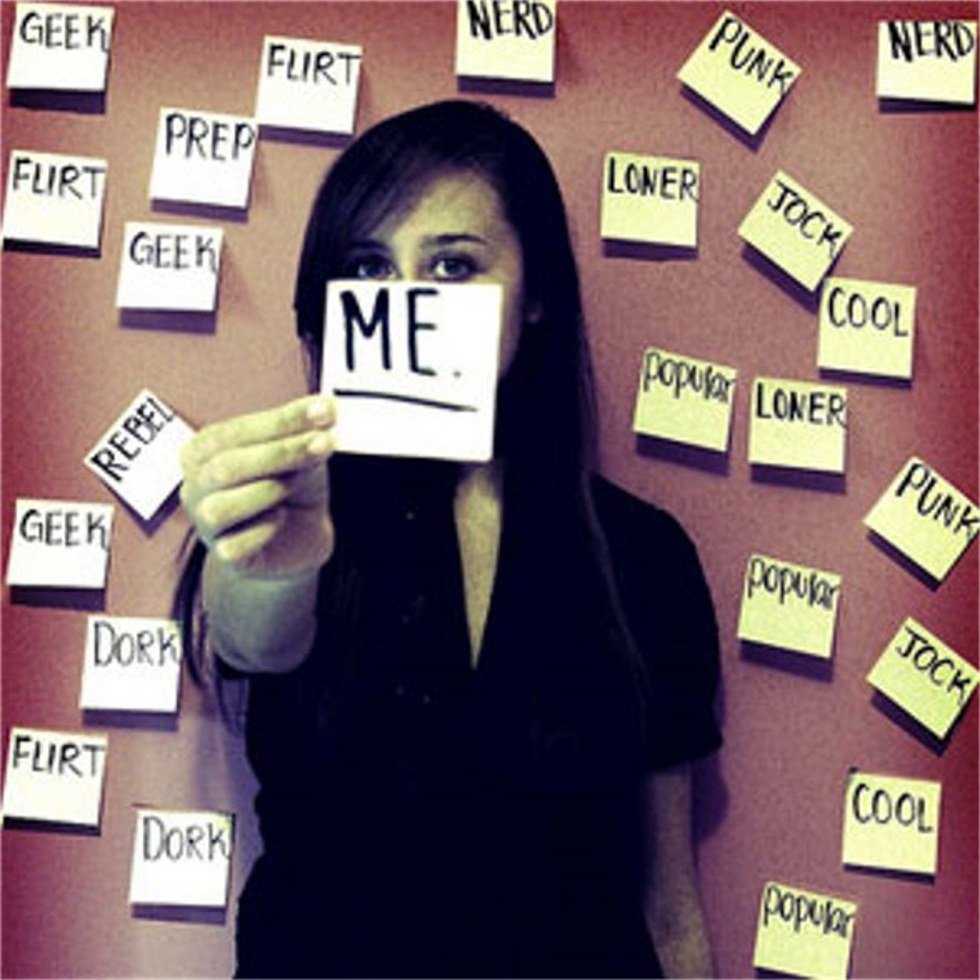
When asked to describe themselves in just a few words, most people offer about three positive adjectives and maybe one negative feature. We realize that we are made up of so many characterizations, too many to list at once. However, if someone else were asked to describe you, he or she would probably just mention the most noticeable aspect, and that description would have to portray everything that makes you unique. In fact, to unknowing company, it would substitute your identity.
It is only natural to want to characterize people by the one element that seems most obvious, but behavior can often become situational. For instance, how you act around your boss is, of course, probably not how you would act around a sibling. Also, categorizing people by just one or two traits always leads to swooping generalizations. The three most common examples are likely “the pretty one,” “the smart one,” “the funny one,” and any other one limited to this basic description.
Even though this is a natural instinct, labeling people can do far more harm than was intended, especially when people begin to think of themselves as only equal to the general ways in which others describe them. No one can truly know your character after just one, ten, or even two hundred conversations. Instead of raising ourselves to another’s expectations or standards, basing our self-identities on skewed perspectives only lowers our own potentials and dims our lights.
1. Labels make us resentful.
This might sound like an extreme response to a seemingly harmless instinct, but being labeled as just one kind of person inevitably leads to the question: what is wrong with the rest of me? Now, we know that someone’s simply addressing one detail in a description does not mean we are lacking in other areas. However, it could make us wonder if our efforts in every other stage of life were not good enough to make an impact.
For example, first consider someone labeled as “the smart one” just because of high grades. In addition to intelligent, maybe “the smart one” views himself or herself as humorous even though he or she might not necessarily be “the funny one.” However, some people believe that because “the smart one” takes school or work seriously, he or she cannot be funny without the additional label of “the class clown.” This kind of response goes beyond generalizations to extremes because it hints that if someone is not one of the most purposefully hysterical people in a group, he or she is not capable of being considered less than stoic. When labels are ridiculously used like this, we might easily feel resentful toward the people who limit us from being more than one kind of person.
2. Labels make us territorial.
This begins once we start accepting others’ perceptions and viewing them as indicators of our overall identities. When we become territorial because of labels, we want everyone else with their own labels to stay in their own categories. For instance, “the pretty one” must always be the most concerned about her appearance, even though everyone considers how he or she looks in the mirror once in a while. If someone tries to slip out of his or her labeled box, the overall system feels threatened.
However, the true trouble begins when we feel that only we have the right to claim our labels. There are probably only a dozen actual labels, if even that, but there are billions of people in this world. We are going to share labels with at least some of them because almost every group can generalize its members. Then we are shocked when we discover someone more studious than “the smart one,” more creative than “the artsy one,” and more symmetrical than “the pretty one.”
Even worse, though, is when people who expertly seem to belong to one category begin to sneak into our own. For instance, when “the pretty one” earns a scholastic award then receives the accompanying praise, “the smart one” might easily feel a little twinge of territoriality. After all, the latter is probably not shopping for the latest cosmetics in hope of surpassing or even meeting the former’s level. After a minute’s consideration, this reaction immediately feels petty because people should encourage and build each other up rather than tear one another down. However, for someone living under a label’s restrictions, he or she might feel threatened because society usually only permits one label per person. When he or she is left without a label, it is only natural to question what is left of one’s identity from society’s viewpoint.
3. Labels make us settle.
Lastly, when we begin to believe in labels, whether they are from first impressions or lifelong friendships, we narrow our interests based on what labels tells us we can and cannot do. Beyond merely limiting us, labels try to restructure our personalities, goals, and dreams to fit one person’s or one community’s perception. Just because someone is categorized as “the pretty one” does not mean he or she must run a salon instead of run for government. Similarly, every “smart one” or “funny one” has an equal chance of winning pageants as people with other labels. Maybe “the quiet one” who volunteers herself to a corner is really just not as loud as “the wild one.” When we grow comfortable under these labels’ restrictions, we settle for a different life than we might have wanted and neglect our futures.
Instead of lowering ourselves to a label’s standards or expectations, we need to appreciate and display every aspect that makes us one-of-a-kind.
As for me, I’m “the one with the pocket thesaurus, fantasy manga, and emergency mascara.”