It seems as if every month, the NFL comes under fire for mistreatment of public issues that appear fixable on the grounds of virtue. But the sad fact of the matter is, they currently have no reason to right these wrongs. They’ve created a product that their consumers love; a product that their consumers feel they need. In doing just that, they’ve constructed the most untouchable organization in America.
As I viewed Greg Hardy’s interview with Adam Schefter a few days ago, I became sick. I became disturbed. I watched a prominent man in the NFL community do either one of two things: get utterly bamboozled by a fantastic liar, or deliberately promote Hardy despite his violent past and defiant demeanor.
I suppose, in hindsight, we should have seen this coming. It’s not unlike the “worldwide leader in sports” to savagely slop recited testaments from perpetrators of both law and morality in order to restore the integrity of their most valuable aspect of coverage: The National Football League.
After the interview, Schefter surfaced his opinions of Hardy on the Dan Patrick show. Among many liberations of Hardy’s past, Schefter stated, “I found him to be a changed kind of guy,” before quickly expressing regret for saying so on Boston’s 93.7 WEEI.
Regardless of Schefter’s fickle conclusions, it’s insulting that Hardy is still making headlines. This interview wasn’t about asking for a second chance. This interview wasn’t about asking for forgiveness. This interview was about Hardy having the opportunity to deny the allegations made towards him as a whole.
In light of a recent exposure to the advantages of winning cases against high profile persons via ESPN’S 30 For 30 documentary about the Duke Lacrosse scandal, I have become wary to put a “guilty until proven innocent” way of thinking into practice. But this is a different story. Hardy was convicted.
As his case proceeded to a higher level, Nicole Holder, the alleged victim, didn’t show up to court. Was she threatened? Paid off? For all intents and purposes, I would like to set these theories aside, in lieu of furthering the accusations against Hardy’s misconduct.
Any conviction at any level of such debauched actions should have warranted a severance of association with the league. Instead, Hardy received a ten game suspension; which was then reduced to four games, because the case was thrown out due to Holder’s absence.
In the grand scheme of things, the NFL’s reluctance to come down on Hardy is a simple matter. They knew it’d probably be easier than the lawsuit he’d hit them with if they kept his suspension at ten games, and they knew that it wouldn’t produce a noticeable negative effect on their viewership or ticket sales. They knew that in Hardy’s week 5 return against the Patriots, fans would still tune in because, well, it’s the Patriots and the Cowboys.
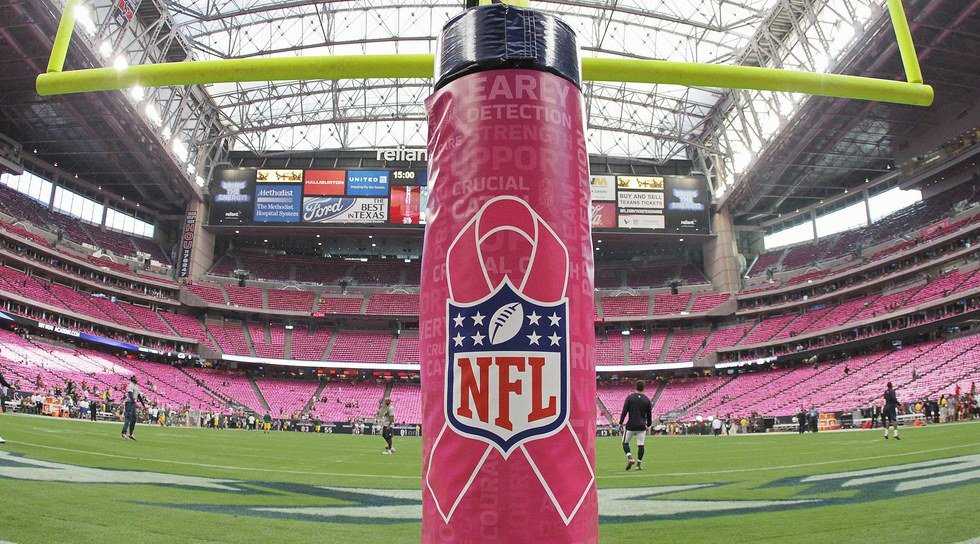
Not only will fans tune in because of their undying passion for the violent sport, but also because the NFL is among the world’s best when it comes to depleting negative attention by parading around their wonderful deeds – like their undying commitment to helping find a cure for cancer every October.
Yes, the NFL’s favorite month; breast cancer awareness month. And why wouldn’t it be? They get to contrast every team’s green field with an eye popping, high volume of pink breast cancer awareness apparel – available in stores and online at nflshop.com. You sir, or ma’am, watching at home, would make an incredible difference for someone in need by purchasing this $85 sweatshirt with pink lettering, and your favorite team’s logo on it. All proceeds, of course, go to the American Cancer Society.
However, as businessinsider.com reports, “all proceeds” is a bit of a stretch. As it turns out, only 90 percent of the proceeds go to the American Cancer Society. That 90 percent still seems like a lot, until you find out where the 90 percent comes from. After Darren Rovell of ESPN reported that the NFL donates 90 percent of half of the retail price, Business Insider broke it down like this, for every $100 of revenue from pink gear:
- $12.50 goes directly to the NFL
- 90 percent ($11.25) of that $12.50 goes to the American Cancer Society
- The NFL keeps the remaining $1.25
- $37.50 goes to the merchandising company
- $50 goes to the company that sells the merchandise (usually the NFL and its teams)
In conclusion, $62.50 goes to the NFL or its teams, while only $11.25 of every $100 goes to the American Cancer Society. As if you expected anything different.
So while attentiveness to unlawful acts by the NFL and its players is compromised by a flashy charity campaign, they’re still managing to do as little as possible to actually make a difference. NFL.com/pink reports that since 2009, the league has donated a whopping $8 million to the American Cancer Society.
Now, one could argue that any contribution is an admirable one. But if you take into consideration that statista.com reports revenue totaled from all 32 teams hovers around $9.17 billion, it’s completely irresponsible to praise an organization for donating just a little over a million dollars a year through a campaign that is advertised as giving so much more.
Misguided assertions and pretenses on the NFL’s behalf strike even harder in the community of the league’s current and retired players. An unwillingness to protect players when their years of stepping on the field are over is the latest allegation the NFL is facing, in the wake of an acknowledgment to the link of CTE and football that was made by the league just last month.
Former Baltimore Raven and Jacksonville Jaguar, Will Rackley, spoke out on the treatment he’s received for the brain trauma he’s received from playing football. “I don’t want to say that they don’t really care, but I haven’t received any help,” he said. “Not that I’m asking for help, but I haven’t received any checkups from the Ravens or anything.
Rackley retired from the game in 2014, and has since been the victim of excruciating pain from brain-related issues – to which the NFL has been of no help. The NFL has denied Rackley of multiple disability claims, leaving him to fend for himself in the terrifying nature of his personal health, all the while taking twelve pills a day to handle symptoms ranging from sensitivity to light, depression, and constant mood swings.
Rackley is one of the many former NFL players victimized by the league’s policy on post-career healthcare. Recent media efforts like the movie Concussion have done their part in raising awareness of the neglect that faces the game’s bravest participants, but they haven’t done much to actually damage the league’s ability to produce revenue.
The only way to break down the NFL’s arrogance and downright immorality is for fans to stop consuming the game altogether. But that’ll never happen. NFL telecasts will still dominate the screens of televisions across the country every Sunday, and PA announcers will still proclaim record breaking attendance numbers to the delight of every fan within the bounds of all thirty-two stadiums.
Football is America's drug, and the NFL has its territory right where they want it.