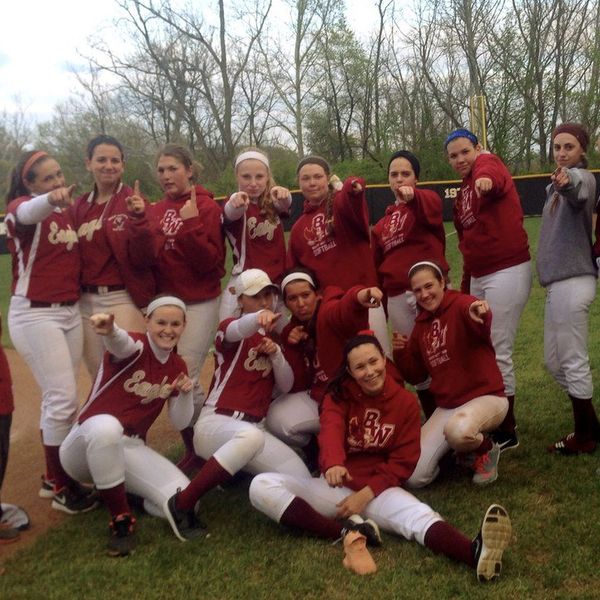


At Boston College, the presence of student-athletes is undeniably massive. Some argue that the individuals who make up the student-athlete body are noticeable to a fault and diagnose a latent division between the regular students and the student-athletes. They exhibit of a variety of unnecessary characteristics, which perpetuate such a separation. And as a Boston College student-athlete I have to agree with the statement. There are a multitude of indications that may ascertain the identity of BC’s 708 student athletes. Some may point out the standard issued white Under Armor backpacks and the perceived “white backpack privilege,” but in my opinion there are countless other, albeit more subtle, clues to just who those student-athletes are.
The girl sprinting from Conte to a class that started five minutes ago; the boy with dark eye circles whose flight from FSU landed at 3 a.m. this morning; the sweaty students in the back scarfing down lunch because they didn’t have time to eat after practice; the stumbling student on crutches walking up the Million Dollar stairs. These are the real signs of student-athletes. The over-committed, over-worked, over-tired students.
The NCAA permits Division I sport teams, such as those at Boston College, to utilize 20 hours a week while in season. Twenty hours each week is the equivalent to taking eight extra classes on top of the average BC course load. Twenty hours each week constitutes a part-time job. Twenty hours on the field is more than time spent in class and for some, even more than time spent sleeping. But these 20 hours mark only the time commitment that our sports teams require. It doesn’t count the additional physical, mental and emotional demands, which reach far beyond the constraints of any athletic field.
There is indisputable honor in being a Division One athlete. You have earned the opportunity to be a member of some of the most selective teams in the nation and represent your school in one of its most competitive forums. Statistically, this honor is even more selective than one may have thought. The chance of an American high school-athlete going on to compete in NCAA Division I sports is less than 2 percent according to scholarshipstats.com. This means that to continue your athletic career, you have to better at your sport than 98 percent of your childhood peers. As a student-athlete, this statistic is equal parts striking and satisfying. It’s concrete validation of years of hard work on and off the field and of physical and social sacrifice. But to be a student-athlete at an ACC school like Boston College demands continued hard work and sacrifice.
As a BC student-athlete, we are pursuing some of the most difficult academic and athletic routes. We are constantly pulled between being successful students and competitive athletes. The demands from each are massive. On the best of days, we manage to stay afloat in the ocean of practices, classes, lifts and homework. On the harder days, these commitments act as torrential waves pushing us to the brink of drowning. And so those moments when we’re running late to class from morning practice, without a shower while shoving food in our mouths are the real times that distinguish us a student-athlete.
People at BC speak of “white backpack privilege” and the perceived special treatment of student-athletes. And this feeling isn’t just exclusive to Boston College, for it is shared among many Division I institutions throughout the nation. Consequently, this detected division is voiced more heavily from the non-student-athletes than their counterparts. Regular students may envy the network that comes with athletics while I may resent their social and scholastic flexibility. Gossip of this “white back privilege” is just that, gossip. The tales of exemption from the housing lottery, of full-coverage meal plans or of eased grading are speculative. I can tell you in my time as a Boston College student-athlete, I have yet to experience any of these or other privileges. But I undoubtedly have encountered the intense stress of balancing school and sport, of scheduling class around practice, of finding time for a modicum of sleep or socializing.
Students at a selective institution such as BC are competitive by nature. This competitive edge manifests itself in stress. Who can take on an additional class? More extracurricular activities? A part time job? There exists a drive to be the individual or group that is the most over-committed, over-worked, and over-tired.
You may ask who in college isn’t some combination of three aforementioned characteristics? And the answer is unequivocally no one. Students today face immense stress from school and society. And this drive to take on crazy amount of stress is futile. It’s poisonous to one’s health and to the condition of our community. Rather than try and construct boundaries between groups with claims of more difficulties or more advantages, we must seek more instances of similarity. If nothing more, we must use our agonizing and exhausting stress to unite as students. No individual is inept to stress, but just experiences variations of the same feeling at different times, to different degrees and for different reasons.
That girl running late to class may be a nursing student who just finished clinical or the boy with dark eye circles may have woken up early for ROTC. And so student-athletes are therefore by no means the only students at BC experiencing pressure. But we represent a group who, for lack of voice or for lack of relatability, often go overlooked. Yet all students, both athlete and not, understand just how difficult it is to be a student at a school like BC. So why would we ever want to prolong the pressure of our peers? It is imperative we act as allies for our fellow students rather than construct a toxic social boundary based solely on perceived differences that aren’t grounded in truths.
So, in conclusion, the intention of this article is not to perpetuate the supposed divide between athlete and non-athlete, but instead is to encourage us to recognize our common feelings and celebrate our different experiences. We must strip away the distinguished social differences to unearth the identity of our student body beyond the superficial. As BC students, we must do what it takes to construct a community that is equally harmonious and heterogenous.