
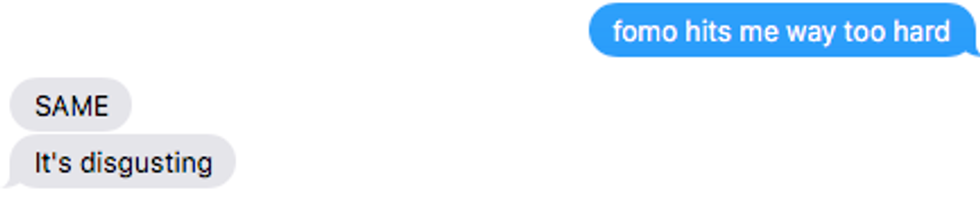
"FOMO," or fear of missing out, is sweeping the nation as one of the most infectious and toxic diseases among college students. FOMO can be defined as a state of mental and emotional stress caused by the fear of missing something great (usually at a party or friend-related excursion).
Side effects of FOMO may include but are not limited to: sleep deprivation, binge eating, binge drinking, lack of focus, anxiety, less participation in academic events, a cluttered schedule, and insomnia.
FOMO has the ability to make students neglect work and other school-related assignments or events. FOMO may affect individuals and lead them to believe that if they do not spend every waking moment surrounded by friends, that they may pass up on something unregrettably awesome. This lack of alone time may unfortunately lead to a lower grade or an "incomplete" on an academic assignment.
FOMO affects all types of people; most people have a chronic fear that someone, somewhere could be having a better time without them.
Social media, namely Snapchat and Instagram, are largely in part for perpetuating this sense of panic. Seeing friends at a daylong while you're inside studying on a Saturday afternoon can set off your FOMO and therefore lead to your lack of focus on academics and an increased obsession with your Snapchat feed.
Self-care is needed to control and reduce the effects of FOMO.
To reduce symptoms, turn your phone off, study hard when you need to, or simply refuse to let your friends to do anything fun without you. When in doubt, list out the pros and cons. Decide if it's really worth it.
In severe cases, deleting social media apps may be required to reduce the inevitable anxiety related to missing out on something fun.