
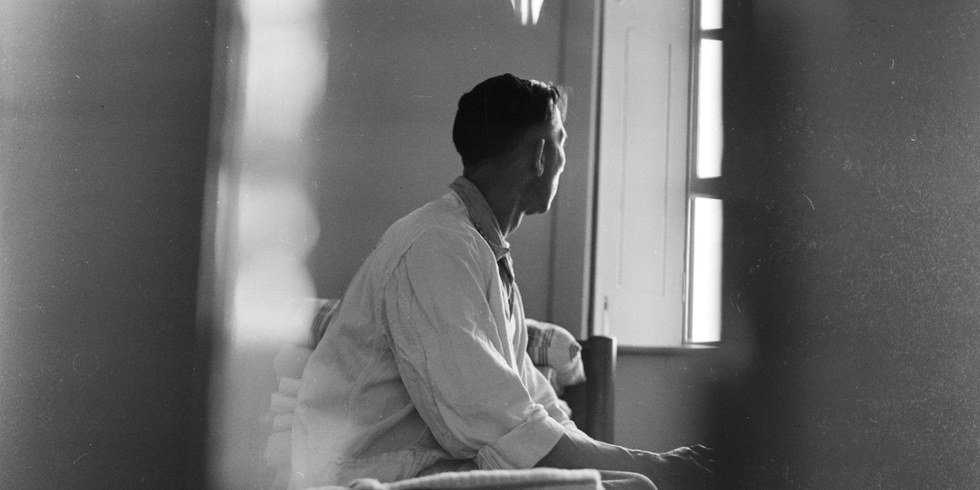
You’re trapped. Everything is cold and covered in concrete. The lights are dim, your eyes still haven’t quite adjusted. Every surface around you is the same color and it’s making you see things that aren’t there. You can’t remember the last time you talked to another human being. You think about your family. Do they remember you? Do they still think about you? What you wouldn’t give to hear your mom’s voice. Does she still love you? Does anyone still love you? Have you been forgotten by the ones you love most? Will anyone come for you? You have never felt so alone. You can hear other inmate's screams travelling throughout the building, reverberating off the walls and nestling inside your ears so you hear it ringing inside you, a constant reminder that you’re suffering alone. You’ve been here for a year at most, but it feels like it’s been six.
This is just the beginning of what inmates go through when they are locked away in solitary confinement.The prison system is not one that is scrutinized by the public very often. For us, it is hard to ignore the glaringly obvious fact that hovers over everyone’s mind when prisons are brought up: the people inside are prisoners, criminals, the ones everyone hates the most. Who cares about them and their comfort?
It is extremely important to remember that criminals are people too. No matter what terrible things they did or how badly they messed up, feelings anyone might have must be pushed aside for a moment to actually see and comprehend what is happening.
We put all of the “bad guys” into a concrete box and leave them there for years, decades even, and we expect them to be perfectly normal people ready to immerse themselves back into society when they come out, even though they have been isolated for a superfluous amount of time. People that are put in there undergo so much psychological trauma due to the inhospitable conditions of the cell, and it gets even worse if they are placed in solitary confinement.
Solitary, or “supermax” cells are supposed to be for the criminals who break the law in jail or are deemed a threat to faculty and staff. But recently, according to a study done by the Guardian, people can be put in solitary confinement for ridiculous reasons, like having an untreated mental illness, not being white, having a religion that isn’t Christian or any reports of misconduct by officers, which means if an inmate looks at an officer the wrong way, they can expect a couple years added to their sentence. Some inmates are in there for committing terrible acts of crime, but others are wrongfully sent to supermax without even another thought.
Solitary isn’t just a corner for time out--it is a six by nine foot cell that inmates stay in for years with hardly any contact with human beings. The walls and the ceilings and the floors are all the same dull gray color. There are no bars on the door, just a bleak steel door with a slot for food. Inside the cell, there is a bed with the thinnest mattress, an awkwardly small table with an uncomfortable cafeteria-style seat, a small metal toilet that the inmates are responsible for cleaning and a water fountain that serves as their only source of water for everything from drinking to bathing. But it’s not the furniture of the cell that is the issue.
The main issue is the idea that leaving people in a box away from society is a good thing for the inmate and that they will be perfectly fine in the end. In a study done on inmates and their psychological health, it was found that the most severely affected inmates suffered from hallucinations, disorientation, as well as paranoia and dissociation. Many individuals during the course of their psychosis experienced memory loss and found themselves unable to recall what went on during their episode. Other very common effects of solitary confinement included cognitive difficulties, obsessional thinking, heart palpitations, nightmares and becoming hypersensitive to external stimuli.
The purpose of solitary confinement has become blurry and unidentifiable in the recent years. The line between punishment and torture has become blurred, which has led to completely unjust treatment of many that do not deserve it. This form of prison has transformed into a power misused to (intentionally or not) “put away” the mentally ill so they’re no longer an issue and make the sane increasingly less sane. But the negative effects can never be erased and trying to change a person through torture, guilty or not, is in my book cruel and unusual punishment.
The prison system should be scrutinized more for the sake of humanity itself. We as humans are not innately violent or inhumane and usually, when something shockingly illegal happens, there is a malfunction in the brain. However, police and authorities simply see that as ‘bad’ or ‘evil’ and locks the person away forever. As a progressive society, we should change this tactic for something more effective with less of a negative after-effect. It’s 2016, we can definitely alter and perfect the system to get what we want out of it without leaving much of a footprint otherwise, we are headed for a dark time.