I walked into the first English class of last semester like some bright-eyed freshman out of a cliché, second-rate movie. But I am not a freshman. And real life is no movie. That first class filled me with so much exuberance—so much anticipation— for what was to come; I think I overshot things a tad. I began my first classwork assignment writing a short narrative from the viewpoint of a boy; a take on a much longer story I had already begun at home. I digress that I write stories for fun, and couldn’t have thought of a better way to begin English class than to submit a small part of none other than one of those aforementioned stories.
This is going to be the most spectacular classwork assignment in the history of classwork assignments, I thought to myself as my fingers worked over the paper with a frenzied, exuberant fervor. My fingers ached. The paper curled. My mind went a million miles a minute.
And then my heart sank to new depths a week later, when I received my classwork, only to realize I hadn’t come anywhere close to getting my point across. As long as my name was slapped on the front of a paper, anything written in first person would assume a female point of view unless otherwise specified. While I held strong to the belief that what’s on the outside isn’t nearly all there is to any individual, somewhere inside me, something shattered. How would I ever be taken seriously? Though realistically, people are assumed to be something or another, just from the way they look, act, speak, or carry themselves on a daily basis.
Let’s jump right into this. I’m talking about gender. Every gender. Along with the specific issues that seem to be blasting the trans* community as of late. It’s difficult to introduce and discuss concerns such as the spread of misinformation or being uninformed without sounding critical or biased, but it’s definitely not impossible.
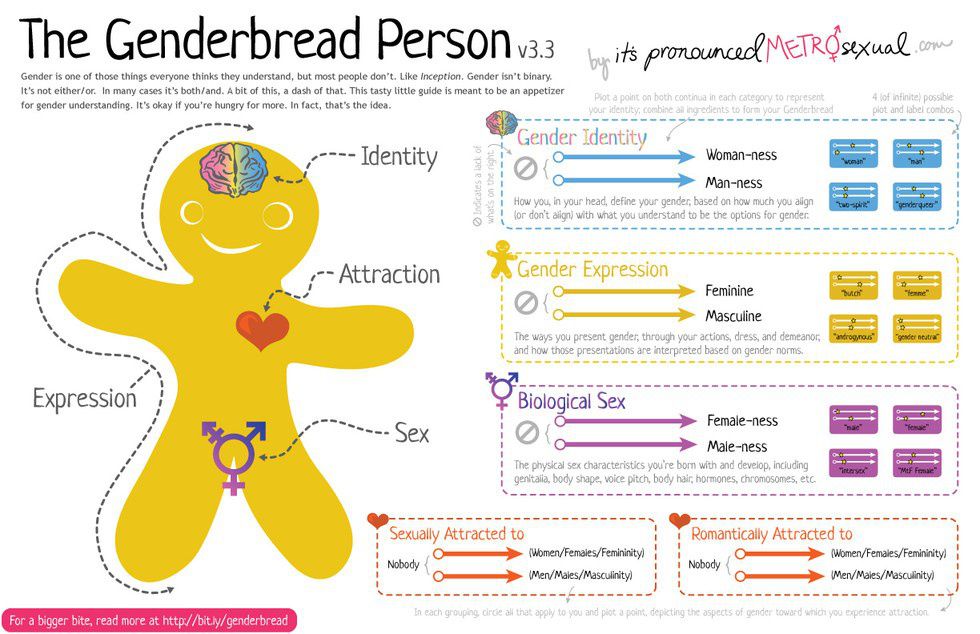
As proof, this little infographic itself can pretty much get you informed in a heartbeat.
Firstly, we’ve all been guilty of mild ignorance or some form of it at some point or another. Aren’t we all uninformed to some extent? There’s always something new to learn or discover; no human being knows everything there is to know in the entire universe. Sure, sometimes, ignorance is harmless; you learn—about five seconds later—that there was more than you expected there to be in a situation. Then, all is well in the world and you proceed with your life.
A lot of the time, being uninformed—or under informed—is involuntary. We are so used to saying and doing certain actions or statements, that we don’t realize when we’re not being as open minded or accepting as we have the potential to be. While not knowing better isn’t a solid excuse, at that stage, we still do have an opportunity to become aware of our behaviors and change for the better.
On another hand, there is clear and obvious hateful behavior that is still prevalent to this day. According to the National Coalition of Anti-Violence Programs, “People were threatened with death… punched in the face, slurred at, [and] socked with rocks” just to name a few types of hate crimes that are eminently common. Now, there are differences between hate, ignorance, tolerance, and acceptance. While these differences are not black and white, it is easy to discern that being hateful gives people reason to be criticized and hated in return; the intent of hate is clearly malicious. Ignorance and tolerance can also tie into hate, due to the fact that neither is the act of acceptance. Though, the intent may be different as ignorance and tolerance don’t necessarily go hand in hand with ill intentions. Acceptance, last but definitely not least, can be seen as the most caring and open-minded perspective, as accepting individuals quite obviously do not unknowingly express animosity towards people they barely know anything about. To muddle the ideas further, those who are ignorant or tolerant stand a chance to improve themselves and make an evident effort to gain knowledge, be informed, and make informed statements and judgments.
Right next to ignorance are all the über-prevalent stereotypes brought on by celebrities and the media. I mean, by now, it’s hard to miss news of some sort about Caitlyn Jenner, for instance. An obvious deduction is that transgender celebrities help the trans community by being widely viewed and positively publicized. But, on the other hand, famous individuals can also be quite detrimental. At the end of the day, celebrities are also human; they obviously don’t say and do what’s expected of them 24/7. People who are constantly in the media’s spotlight are similar to any regular person who may not realize that it wouldn’t hurt to be a little more informed. Furthermore, while the media brings about that air of acceptance towards the transgender community, it also manages to sensationalize trans people while veering away from the more serious aspects of life that trans people are facing today.
One of those issues that is often skirted around is that of mental illness and general mental unrest in the trans community. The prevalence of transphobia and hate easily leads to issues such as depression, suicide, anxiety, and more. An instance that is fairly well known is that of the suicide of Leelah Alcorn, a transgender girl who was forced into conversion therapy by her family. Conversion therapy greatly contributes to the deterioration of individuals’ psyches, as it forces trans people to identify with the gender and sex they were born with. From the story of Leelah Alcorn, it’s quite easy to recognize that conversion therapy can lead to depression and even suicide. Moreover, it’s common knowledge that bullying takes place in schools throughout the world; while children might not realize the full impact of their actions, these behaviors can lead to hate crimes in the future.
An aspect which we may not commonly think of is the economical standing of trans people. Is there even such a trend? you may ask. While there isn't a specific economic niche, some shocking statistics are still fairly prevalent. Firstly, trans and gay youth alone make up 20-40 percent of the homeless population in the U.S.—in other words, 320,000 to 400,000 people—and this isn’t even including adults. As if that weren’t appalling enough, according to the Center for American Progress, “13.5 [is] the average age that transgender youth in New York become homeless.” To add to the fact that homelessness is so extensive among younger trans people and adults alike, there are still businesses that ban both transgender customers and potential employees. There is blatant discrimination, and even mainstream companies, such as Urban Outfitters, that have marketed transphobic products at some point or another. Likewise, studies from the Williams Institute show that gay and transgender individuals earn anywhere from 12 to 32 percent less than their heterosexual counterparts. The wage gap, along with the extreme discrimination is what, in the end, leads to the rates of transgender joblessness, and eventually, homelessness.
As if enough problems haven’t already been presented, there are still more. Healthcare is yet another considerable concern. Firstly, there is the fact that most insurance companies don’t cover surgeries or hormone treatments, and even if they do, there is an almost never-ending list of qualifications one must meet to qualify for either of these procedures—some of which include mandatory appointments to special gender therapists and proof from a psychiatrist. Additionally, according to the Emblem Health website, the individual has to have been living as their true gender (rather than the one they were born with) or a year or more in order to qualify for any type of surgery or hormone replacement therapy. In addition to the few aforementioned requirements, the insurance company has a PDF with approximately two pages of requirements. Why do individuals have to prove something with their outer appearance in order to qualify for treatments that are essentially necessary? The strict yet ridiculously vague rules put people in boxes and could leave them stuck in a state of dysphoria that can’t be eased up or alleviated––something that particularly irks me to no end. It appears that individuals have to prove their gender outwardly, or present as one side or the other of the binary. For instance, a trans man...has to successfully pass as a man...in order to be considered to actually transition? It's quite a conundrum when you think about it; that just doesn’t sit right.
So, how do we get around to solving the mountain of issues? How do we even begin to process what’s going on and what we can do? Personally, I believe that there needs to be some level of normalization towards all parts of the gender spectrum. The fact that the word "normalization" even has to be used makes me so uncomfortable. There shouldn't be any "normal" or "abnormal" genders to begin with. Further, the fact that trans people are still being treated as spectacles and freaks of nature should have been over and done with ages ago. Certainly, society is working towards some form of progression with fixtures such as gender neutral bathrooms, fewer bans, and equal employment laws. Though, with the prevalence of homelessness, hate crimes, inhumane “therapy” sessions, and ceaseless stigmas, all those changes for good seem to be undone. One way to eradicate part of this problem would definitely include educating children about gender identity, expression, and sexuality early on, and continuing to educate people as time passes. I do believe that, if changes continue the way they have been coming, there might be hope for the trans community, and much less strife at some point in the future—maybe not the near future…but eventually.