"Legally Blonde" came out in 2001, but it’s still a breakthrough movie that combated the dumb blonde archetype in the film industry by keeping the stereotypical characteristics of the peppy pink blonde, but removing her from the intellectually deficient context, and instead creating a story of her great success in law school and the courtroom. This acknowledges that a cheerful disposition and femininity do not signify stupidity. The reactions of the other characters towards the intelligent blonde show how society rejects this originality and is more comfortable with an archetype.
Archetypes are defined as anything that has been repeated in storytelling from ancient times to the present. While it’s not accurate to say the dumb blonde archetype goes back to ancient times, it has been around for awhile. From the damsels in distress in "James Bond" to the bully in "Mean Girls", the blonde character has always fallen short in terms of brain cells. "Legally Blonde"s main character, Elle Woods, is introduced as the classic dumb blonde. She’s a sorority girl, specializes in fashion and haircare, wears mostly pink, is quite open with her emotions, and always looks on the bright side of things. The producer of "Legally Blonde" made a wise decision of keeping these pieces of the dumb blonde stereotype because they set up the viewer to expect a lack of intelligence.
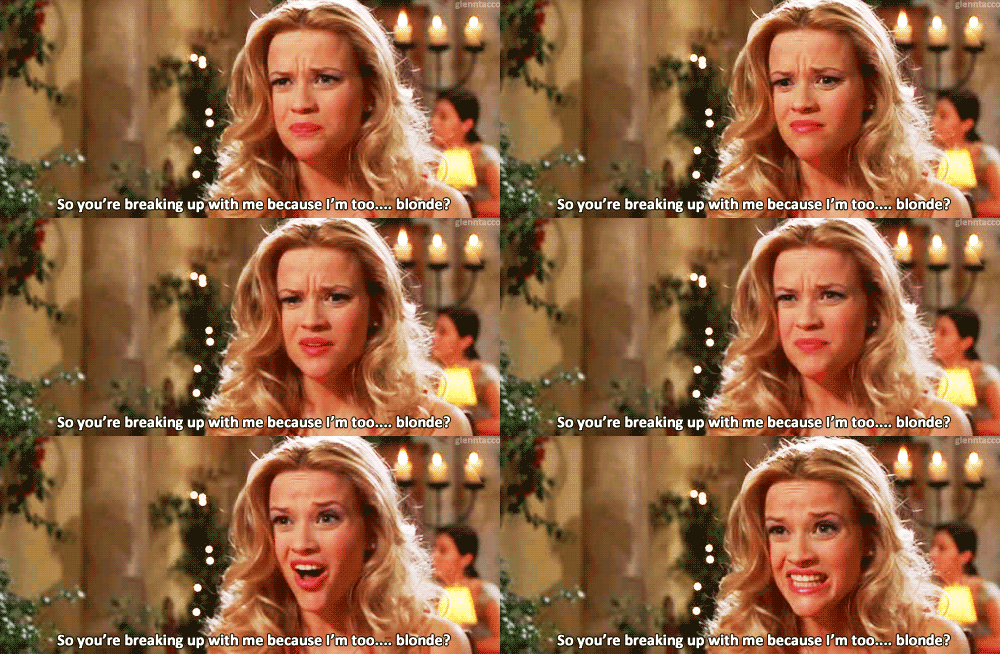
In the beginning of the movie, Elle’s boyfriend Warner leaves her because he is going to Harvard and wants a girlfriend who “looks smart”. There is a shift in the movie when Elle decides to prove herself worthy by earning a law degree at Harvard herself. She excels in her classes and wins the case she argues in court, defending a woman who is accused of murdering her billionaire husband. She never lets the disapproving looks or mockery from others stop her from accomplishing a dream everyone else believed was just a dream. Even on the movie poster, the “average” people in the background dressed in sophisticated suits are looking at her with surprise and disapproval. These people are a reflection of how we unconsciously interpret perkiness and a fashion sense to mean stupidity. Elle is wrongly judged not only on her dress but her voice. A higher-pitched voice is interpreted as childlike and ineffectual, while Elle is anything but.
I find Elle’s role as a woman in the movie industry who triumphs over misogynist views very original. Masculinity and femininity are frequently seen in pop culture as being polar opposites and signifiers of dominance/aggression versus passivity/submission. Elle crosses these boundaries as a dominant and aggressive female lead while expressing liveliness and femininity without restraint. Most people see a cheerful woman as a symbol of innocence, but Elle is constantly proving her intellect and incredible understanding of the law and is not hindered by her positive outlook on life. She also proves that knowledge of fashion is useful when she points out that the billionaire’s daughter couldn’t have been in the shower when he was murdered, because she had gotten a perm that day and the shower would’ve ruined her perm; this leads the daughter to reveal herself as the real killer.
Somehow, Elle never sees herself as dumb and this allows her to become successful. We see this often countered as movies are always telling women that playing dumb is what makes you beautiful. Without this lens of society to corrupt her idea of herself, Elle is free to be confident about her abilities. It is also important to note that Elle does not change who she is to succeed.
Even further, "Legally Blonde" breaks the mold of the overly-competitive, therefore negative, female. When men are portrayed in films as competitive, it is written off as simply the way men are. However, when a female becomes loud and combative, she is viewed as out-of-control and “bitchy”. In court, Elle does not let this silence her; she is self-assured and not afraid of an argument. This is furthered in the relationship between Elle and Warner’s fiancée, Vivian, uncoincidentally a brunette. As soon as the fiancée discovers Elle is Warner’s ex-girlfriend, there is tension between the two. Elle refuses to fight back because she is no longer interested in Warner, rather she has her eyes set on the law degree. Fighting between females in movies is commonly depicted as ceaseless and catty with petty purposes. However, as the end of the movie flashes forward to Elle’s college graduation, she and Vivian are friends, and Warner has been diminished for his sexist behavior.
At the college graduation, Elle gives a speech in which she says, “It is with passion, courage of conviction, and strong sense of self that we take our next steps into the world, remembering that first impressions are not always correct. You must always have faith in people. And most importantly, you must always have faith in yourself.” "Legally Blonde" supports originality, feminism, and a positive outlook while crushing the dumb blonde stereotype under its pink Prada high heel.