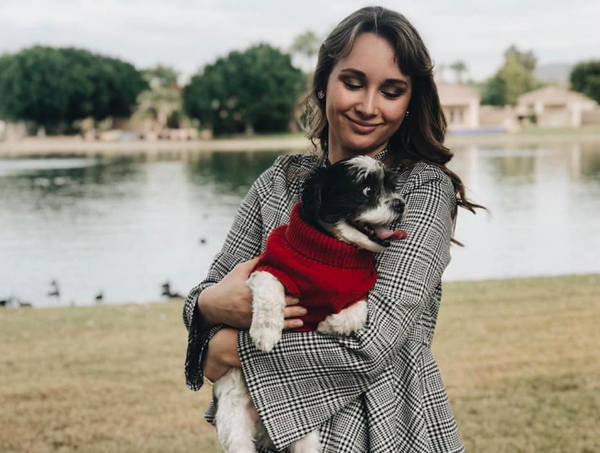


Recently, I've been seeing many service dogs on my school's campus, and the handlers of the service dogs are not blind or appear to be deaf, so I began wondering about service dogs and the different types of service they provide for those without visually or auditory disabilities. To my delight, because I am an extremely large mental health advocate, I came across several resources discussing the use of service dogs for psychiatric disorders-- and I was quite excited! I can't imagine many years ago before mental health started to take a true impact and recognizance in government, educational, and social institutions and policies, that service dogs for psychiatric disorders was even a "thing". A specific article I found fascinating because they offered different circumstances and services the dogs provided for different types of mental health issues:
"A person with severe hypervigilance due to PTSD finds she is unable to enter her own home. Her symptom causes her to believe there is an intruder in her home who will attack her if she enters. Her dog is trained to perform a systematic search of any room or building and bark on finding someone. When her dog finishes the search pattern and returns, she knows it really is safe to enter and that the presumed intruder was just a symptom."
"A person with OCD subconsciously picks at the skin on her arm. She has done this with such persistence that she has scarring. Her dog is trained to recognize picking skin as a cue to bring her a dog brush. Because she is not picking intentionally, the interruption of the dog will stop her from picking. Handing her the brush is a reminder to her that grooming the dog is a non-harmful alternative behavior for her OCD symptom."
"A person overwhelmed with anxiety has taken a strong prescribed tranquilizer. While the tranquilizer reduces his anxiety, allowing him to breathe more efficiently and to think a little more clearly, it has also impaired his ability to walk without assistance. His dog is trained to walk close at his side so he can rest his hand on the dog's harness to help him keep his balance as he moves to a safe place to finish recovering from his attack."
"A person who experiences hallucinations sees a person who should not be in the room with him. Is this a hallucination he can safely ignore, or is it an intruder? His dog is trained to go and greet any person his handler points at, on command. The man points at the intruder and instructs the dog to "go say hi." The dog moves in the direction indicated, but can find no person to greet, so he returns to his handler. The handler now knows the person he sees is a hallucination and calls his doctor for help instead of calling the police for an intruder."
Another benefit of these dogs specifically for people who suffer from depression, is that the dog's dependence on the handler to care for him can facilitate a person to get out of bed, take the dog for a walk and get fresh air, and when they feed the dog it reminds them that they also need to eat whether they do or not. In my own coping with depression and seasonal depressive disorder, the basic routine of daily living is often of the most challenging aspects of my condition-- in turn making this "basic" aspect of human living a nearly impossible, unfathomable task.
In this intimate connection that humans have with dogs for centuries and centuries, due, in part, to many pieces of evidence and data of co-evolution, I think that no matter what pet you have as a person, that they help you in more ways than you consciously realize. And though you may be alone some days in your own thoughts and perception, animals have much to show for us that we are not alone, and they make our lives a little brighter every day. And in learning about this topic, I'm humbled to see dogs now as partners in people's lives, in a matter of life and death with our own inner demons.
“Perhaps one central reason for loving dogs is that they take us away from this obsession with ourselves. When our thoughts start to go in
circles, and we seem unable to break away, wondering what horrible event
the future holds for us, the dog opens a window into the delight of the
moment.”
- Jeffrey Moussaieff Masson, author