
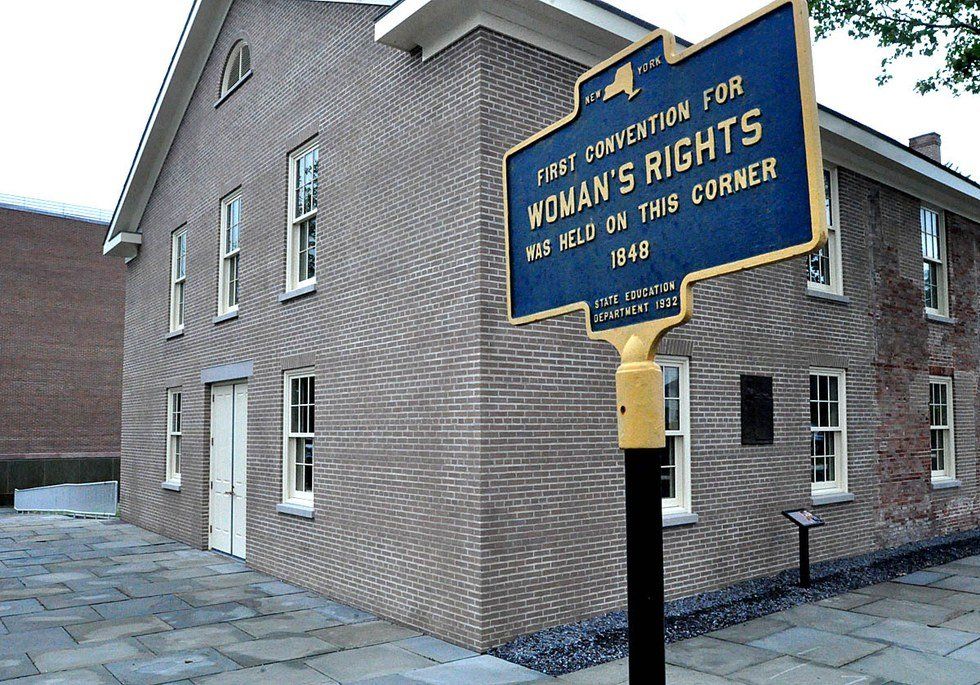
On July 19 and 20, 1848, nearly 200 women and many men met in the Wesleyan Chapel in Seneca Falls, New York to discuss a matter of pressing importance in their lives: "the social, civil, and religious condition and rights of women," or lack thereof. Organized by Lucretia Mott and Elizabeth Cady Stanton, along with Martha Coffin Wright, Mary Ann M'Clintock and Jane Hunt, it was the first women's rights convention to officially occur and was the precursor to a series of National Woman's Rights Conventions, which began in 1850 and ended when the Civil War broke out.
I wish I could say that the women and men who met in that space would have been appalled by the country we live in today; instead, I think they would have found it almost familiar. They lived in a world where lynchings were accepted by society; how many black men have been killed in recent years by police officers without anyone going to jail? They lived in a time before slavery ended; we live in a world where slavery... hasn't really ended for everyone in the United States. They fought for women to be treated equally to men in all ways, and today we're, ah, still working on that.
So this week, on the 168 anniversary of the Seneca Falls Convention, take a moment to remember the beginning of the women's suffrage movement, and how they struggled, and how they triumphed. As Robert Cooney wrote for the University of Maryland:
For women won the vote. They were not given it, granted it, or anything else. They won it as truly as any political campaign is ultimately won or lost. And they won it, repeatedly, by the slimmest of margins, which only underscores the difficulty and magnitude of their victories. In the successful California referendum of 1911, the margin was one vote per precinct! In the House, suffrage passed the first time by exactly the number needed with supporters coming in from the hospital and funeral home to cast their ballots. In the Senate it passed by two votes. The ratification in Tennessee, the last state, passed the legislature in 1920 by a single vote, at the very last minute, during a recount.
It was not easy. It was not fast. Many people were on the "wrong side" of history- the side advocating for staying the same, allowing stagnation and rot to permeate society. Many people, including many women, fought against women's suffrage. It was a long, slow, uphill battle that took over seven decades. And in 2016, we're fighting our own uphill battles, sadly not so different from some of the ones back in 1848. And people are people in every age, meaning many people are on the "wrong side" of history still.
Not that any one group, or movement, is ever perfect. It's important to remember that the women’s suffrage movement learned from, and grew from, the abolition movement. And that when the time came, it threw people of color right under the bus and ignored issues of race and religion, with the familiar white feminism explanation of "we need to focus on this issue, which affects me, first, and then when it's solved we'll get to your issues after." (Or even, in many cases, used race against black men especially, using racism to bolster the white suffragist cause. I'm looking at you, Elizabeth Cady Stanton.)
Despite this-- and, in part, because of it-- it's important we remember the anniversary of the Seneca Falls Convention.
Take the time this week to read the Declaration of Rights and Sentiments. Actually, read the whole document, if you can. Printed in Frederick Douglass' print shop--and yes, that Frederick Douglass, the only black person who attended the Convention-- it summarizes and chronicles the entire two-day event and contains the entire text of the Declaration as well as some resolutions which were approved by the assembly. Think about the issues that these women saw as the primary issues of their day, and how our society has changed, and how it hasn't.
The Convention began the "official" conversation about women's rights in the United States for the first time. It was seminal to the understanding of women's oppression on an institutional level, an understanding that we are still working towards today.
The men and women who gathered in Seneca Falls were ridiculed and harassed, told they were fighting a pointless fight, told their cause was hopeless and that they should just give up. And they heard that for decades. Women-- well, white women--didn't get the vote until over 70 years after the signing of the Declaration. That's 70 years of picketing, petitioning, protesting, demonstrating and being incarcerated. Elizabeth Cady Stanton and Susan B. Anthony both died before they saw real change. But they did it. Change came.
So in a world that continues to tells those of us seeking to reform the broken systems in the United States to be quiet, be civil, be patient, be kind, be good and maybe someday we'll see something happen; remember those who came before us. Those 68 women and 32 men who signed the Declaration could not have known- but may have hoped- that those words would continue to ring through the years:
In entering upon the great work before us, we anticipate no small amount of misconception, misrepresentation, and ridicule; but we shall use every instrumentality within our power to effect our object.
They did it, spearheading "one of the most remarkable and successful nonviolent efforts to change ingrained social attitudes and institutions in the modern era." We will too. Don't give up. And don't forget to vote, because not so long ago, you couldn't. A lot of brave women and men fought to ensure that right was available to you. This week, remember them in all their glory, with all their flaws. They were not perfect. Neither are we. But honor their struggle. And if you haven't, register to vote.
Dedicated to the thousands of women who fought for decades for the right which I, along with millions of others, will exercise this November. Thank you.