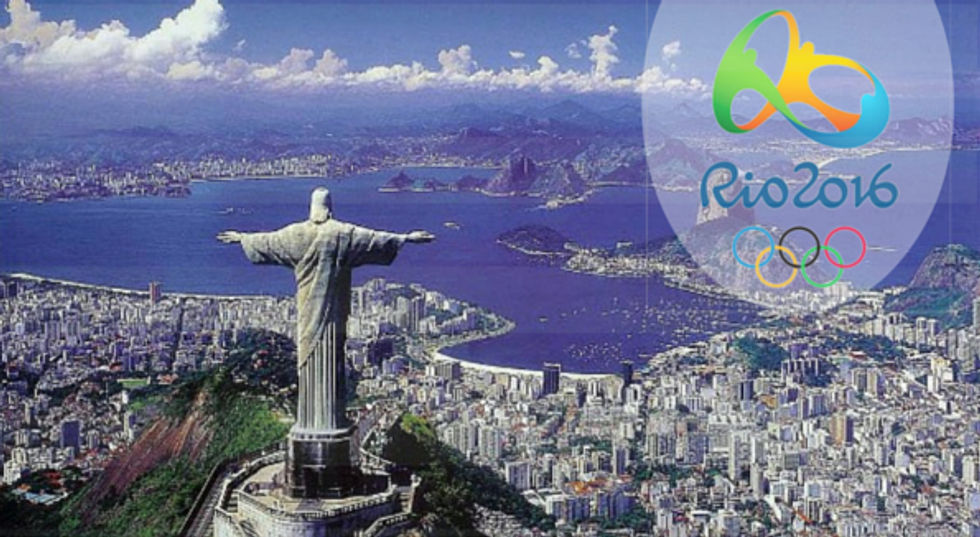
This year, Rio De Janeiro is due to host what is possibly the world's greatest sporting event: the Olympics. This is the competition that athletes train every day for, spectators travel thousands of miles to experience, and people all over the world tune in to. During the Olympics, country pride is at its optimum level, along with world unity. But for many people involved in the Olympics, the glamorous podium pictures are only a fraction of the story. Only a few of the issues associated with the Olympics are mentioned below; the debate of whether the games are worth it, however, could be unending.
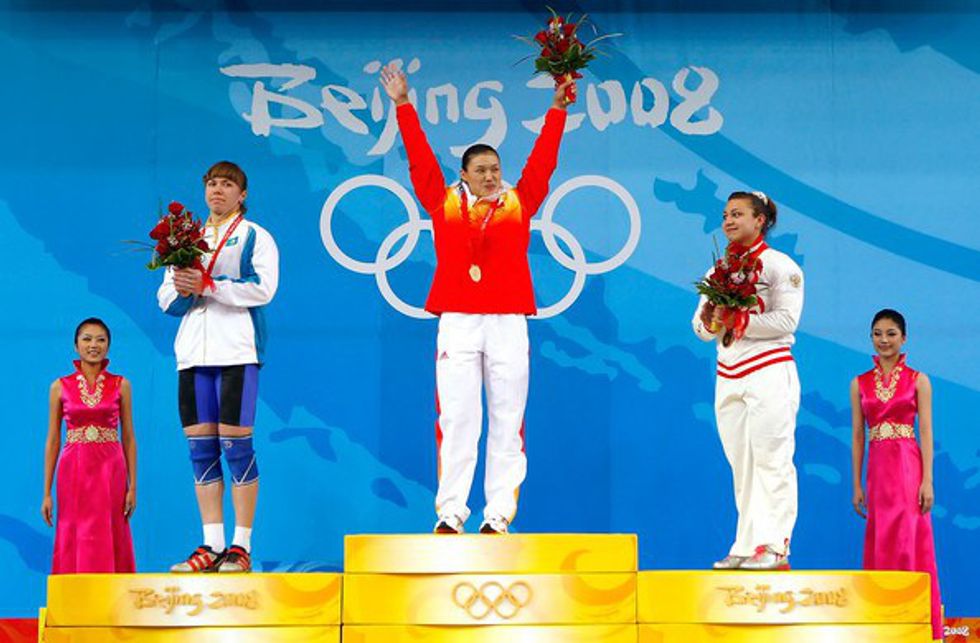
(Photo Credit: Zimbio - Olympics 2008 Weightlifting Day 7)
One major issue that Brazil has already faced is the displacement of people and their homes. In an already built-up area with hubs of crime and unrest, positioning for facilities and capital infrastructure is a challenge and something that will be a major cost to both the government and society. Relocating people from their homes is not likely to create a positive view of the games among those effected. It has been estimated that over 22,000 families have already been moved to outer areas of Rio. As expected, this has had repercussions on these individuals' careers and mental health, only creating more of a downward ripple effect for the people of Rio De Janeiro and the local economy. Many of those relocated from their homes reported feeling unsettled and depressed. On a humanitarian level, this is unsought, but from an economic standpoint, this is particularly undesirable as individuals' efficiency is likely to fall.
Rio is already a social and political area of unrest at this time, with high rates of street crime—robbery in particular—and a worrying statistic of three murders a day. So in the end, the TV will see the glossy new stadiums, but it will not see the humanitarian suffering that has taken place and the social unrest onset by evicting people from their homes. Nor will it see the extra cost that the government has and will continue to inevitably incur by trying to control the violence and anger of locals. Crime rates have not fallen in the city and, with eight months to go, it is not looking likely that they will anytime soon. Instead, more security will be deployed at a massive economic cost. Again, the ripple effect that is likely to arise due to the anger of the people in the favelas is immense—spurring social unrest, rising crime and a continued safety threat to tourists and athletes.
However, there is a highly-debated positive associated with relocating people out of the favelas: now the Olympics can be used as an appropriate excuse. The favelas have long been a hotbed for crime, gangs and drugs. It is not uncommon to see young children armed with guns to protect their communities, which are dictated by drug gangs, from police raids. Many of Brazil’s armed police refuse to enter the most dangerous favelas…located just on the outskirts of Rio de Janeiro. Now that the Olympics are here, Rio may have found the perfect time to force the dispersion of these favelas and thus reduce its crime rate. The Olympics might have been the final push the government needed to reduce the gangsterism that controls the communities and prevents populations from pursuing education and creating opportunities. If the theoretical idea of dispersing the favelas proceeds (however rare its fruition may be), then Rio should see a reduction in crime rate, drug use/abuse, the creation of a more prosperous environment for education, and an overall increase in economic growth in the community, reducing the Brazilian government's long-term costs. The likelihood of this result actually occurring, however, is slim; drugs have an inelastic nature of supply, simply meaning that people will pay a lot of money for them and that when there is money to be made, people will find a way to make it.
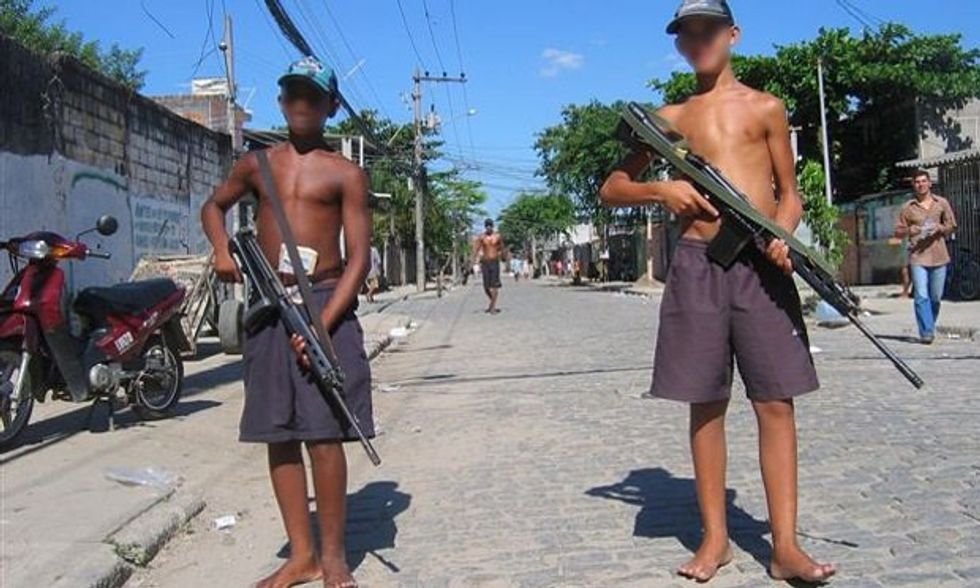
(Photo Credit: The Guardian - Guns, Drugs and Bandidos)
Given the necessity for new infrastructure, it is inevitable that new jobs will be created in order to build the Olympic facilities and run them during the games. There are obvious economic benefits associated with the creation of jobs; however, the jobs being offered tend to be short-term work that ends when the games do, making people question the games' real long-term benefits. This is always the key question asked when a country hosts a global event. Brazil, a BRIC economy that was predicted a high growth rate, will benefit from the improved infrastructure such as railways, roads and other transportation. This is likely to increase the country’s efficiency, thus making it more competitive in the global market as the exportation of key materials overseas becomes easier and Brazil steps closer to modernization in the Western world.
On the other hand, the manner in which the country deals with the issues associated with hosting the Games could be a key indicator in future international competitiveness. If the reputation of Rio de Janeiro and Brazil as a whole is further damaged by crime and a lack of national security during the Olympics, then the likelihood of attracting further trading partners is slim. Private firms are unlikely to want to expand their business if the country cannot prove that it is a safe environment to trade with. This potential lack of trade and demand for exports could be catastrophic for Brazil’s economy in the long run. There is a real pressure on the government to ensure that these Olympic Games go smoothy.
The major short-term benefit for Brazil is the size of the export of the Olympics. The games are likely to bring a record rate of tourists into Brazil, many of whom will be rather wealthy and ready to spend money. From small street vendors to large Brazilian firms, there is thus a temporary increase in market size and, consequentially, a demand for their products. Hotels, restaurants, taxis and others are likely to experience an increase in profits during this time, which could mean the expansion of these firms resulting in more employment, foreign direct investments and an overall increase in economic growth. This assumes all is equal, however as mentioned above, the myriad of external influences in the interdependent global economy means that like is likely not to be the case. Brazil can only attempt to utilize the 2016 Olympic Games as a catalyst for economic growth in the long run.
With these pressing issues of crime, displacement, social unrest, pollution, national safety and many more, it is clear that Brazil still has a plethora of obstacles to overcome before August. The cost of clearing up these problems in monetary terms could be perpetual, but the cost to society may be the true problem. We will have to wait until the Olympics are over to see if the investment created an economic return for the country and whether the reputation of Brazil is in good standing for future investors and global trade.