
I in no way disrespect the beliefs of organized religion. In truth, I envy them. It must be a beautiful thing, to place one’s confidence so fully into the hands of the many. Personally, I have yet to find a religion I entirely agree with, therefore it is impossible to commit myself to a practice based upon spiritual sanctity whole-heartedly.
I am a Christian. Not a Catholic, not a Protestant, not a Methodist or a Baptist: a non-denominational Christian. Twelve years of Catholic school did nothing but push me away from the Church, but it took me to a deeper, personal understanding of my God. It ingrained in me a detachment to the idea of organized religion, of a universal explanation and understanding of the Lord. I have learned to resent the idea of God being manifested in humanity in any way, especially in a church. I have come to comprehend the Catholic religion as a governing body, fixated on the physical and meta-physical advancement and evolution of mankind as one being: “The Church,” as opposed to a perfect temple of The Body. These beliefs led me to a greater understanding of morality vs. reality.
It’s an extremely sensitive topic, abortion is; one that was avoided like the plague in a school where they didn’t preach sex education, but abstinence. I never fully understood the reproductive process until I was maybe fifteen, simply because I was reading a biology book. I was never encouraged to study things outside of the practices of the Church…even when I marched the streets in protest ten years ago with my fellow fifth-graders chanting “Save the Babies,” no one cared to explain what we were protesting, or why. It also stood out to me that…nobody asked. None of my peers seemed to yearn to form their own opinions. To this day, I have friends who believe things simply because it’s what they’ve been taught the majority of their lives. They don’t question what they’ve learned, but rather accept knowledge for what it is, wrapping their identity in the opinions and views of others.
It wasn’t until halfway through high school that I escaped this type of mentality. Eventually, I had a truly unbiased view of societal issues, thanks to a few wise teachers who didn’t even know they were encouraging students to broaden their minds. Very quickly, I came to the personal conclusion that the idea of politics and freedom of religion should be very separate. Never before had I experienced such an epiphany… religion and day-to-day activity didn’t have to be completely intertwined…? That was a genuine shock to my previous mentality.
Somehow, along the way of my religious education path, I never fully understood that the United States was not religiously affiliated. I just naturally connected my religious beliefs to the day-to-day observations I made of the world. I came to the conclusion that no governing practice, nor its leaders, has the right to impose the independent beliefs of said leader on the people they are governing. Of course, organized religion somehow finds its way into politics on a daily basis.
Personally, I believe it is of the utmost importance to separate one’s individual religious views from political ideals. I understand the choice of devout believers who choose to keep their spiritual practices before anything else, and I admire that. But I also believe it is unrealistic to keep exclusively traditional beliefs alive in a world evolving as rapidly as ours. I was once told you “cannot pick and choose what you believe in the Bible,” because God’s word is eternal and shall remain true throughout the generations. This is what most Christians use as a defense against anyone wishing to modernize organized religion as a whole.
As a Christian, I find this defense lacking. In my twelve years at Catholic School, I’ve become very familiar with the Bible. If we, as Christians, truly practiced everything in the Bible as-is, we would pay strict attention to the evil of mixing fabrics or cross-breeding animals: “Thou shalt not wear a garment of divers sorts, as of woolen and linen together,” Deuteronomy 22:11. We would note the multiple wives Lamech, Moses, and Soloman had in the Old Testament… and then, the later rebuttal of polygamy in the New Testament.
The Bible is not perfect, and I don’t believe it entirely represents the word of God. The Bible was written by man, inspired by the Holy Spirit, yes… but still conceived through the mind and hands of men during a time far different than the one in which we live. If we are supposed to adhere to every word, every sentence put forth in the Bible, then we are to stone those who wrong us… yet, murder is forbidden? We live during a time of change, a time different of that in which the Bible was written. Today, the Bible is analyzed and interpreted differently by every denomination. Each group of believers changes it to varying degrees of meaning, so doesn’t that count as “picking and choosing” from the Bible? If each practicing body preaches a different meaning?
I think man has polluted the beauty and purity of belief. I believe there is too much hypocrisy in modern teachings of religion to properly give young people reasonable expectations of the world. Do I believe God is creator? Yes. Do I believe in Jesus Christ? Yes. Do I believe in abstinence and the sanctity of love and the absolute necessity to have prayer in life? Yes.
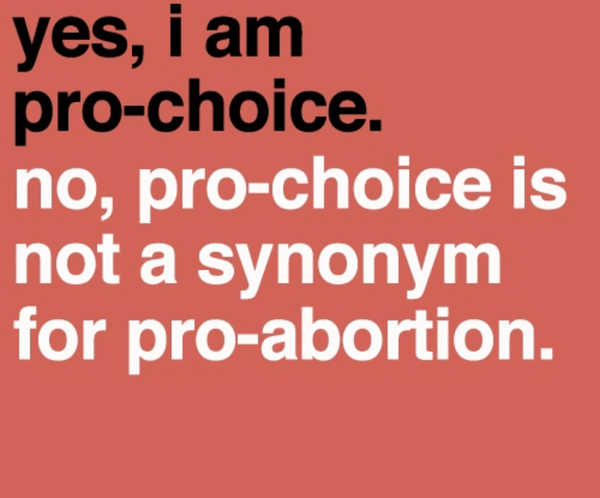
Do I believe people should have more choices in this world? Yes. I am a Christian, and a Republican, and I support choice in the matter of abortion.
I don’t believe the government should have any connection to religious beliefs at all. If I did, I would consider myself pro-life. The very concept of abortion saddens me, as a Christian and a woman. I disagree with the practice of such an act, as it conflicts with my moral and ethical interests. But why do my “moral and ethical interests” matter in the debate of pro-life vs. pro-choice? They don’t. My religious and personal beliefs should have no effect on another woman’s ability to make a different decision. Abortions have been occurring since ancient times! The fact is, procedures exist. Whether or not government officials agree with it, they happen. Whether or not you, or I, or anyone else agrees with it… it exists. It is accessible to women; therefore, they should have a choice.
Too much emphasis is put on the beliefs of politicians. There are a plethora of things wrong with that sentence, but it’s true. No, nobody in America wants a corrupt, moral-lacking politician leading the country. We want a leader who is true, honest, and disciplined. Who has opinions he/she firmly believes.
Beliefs are good. Opinions are good. But, in a matter such as this, where the driving force behind a conflict is morality and religious beliefs, I simply think it is wrong to put one’s personal beliefs over those of others. My opinion on this matter is a choice. Your opinion is a choice. Now, what about those who believe differently? Shouldn’t we all have the opportunity to put our beliefs to practice if one so chooses?
I think God wants His people to have choices… they shape character, help build personalities and heart. I truly don’t think government officials should have the right to tell people how to choose or what to believe. Because really, how can you learn anything at all if you don’t think for yourself?