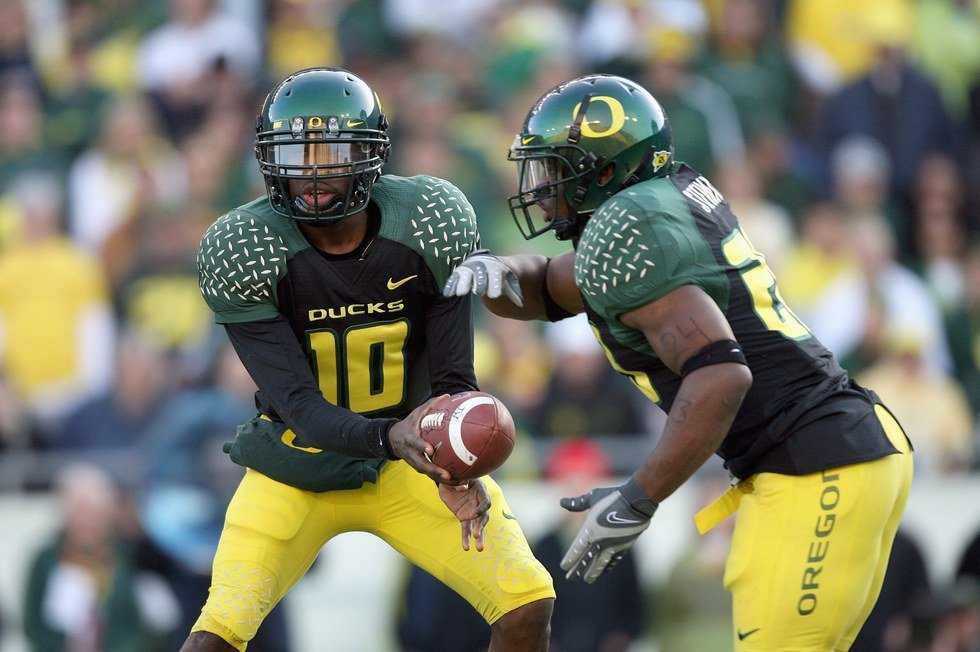
When you watch football, do you like watching teams put up a bunch of points? It would be silly to say otherwise; that’s part of what makes the game fun to watch. The new trend that is becoming a part of almost every NCAA offense is the read-option offense with the quarterback and the running back. They leave a defensive lineman unblocked (the offensive lineman goes downfield to block) and make the defender pick which player he wants to tackle. Once he chooses, the quarterback either hands the ball off or decides to keep it and run. Most teams now have an athletic quarterback that can run the option and also throw the ball downfield. It sounds like a great recipe for success, right? Maybe in college, but the evidence is there to support the claim that quarterbacks in this type of offense doesn’t translate to success at the next level, which is the NFL.
Before Tim Tebow became the starting quarterback for the Denver Broncos in 2011, teams rarely used read-option plays. The trend before that was the wildcat formation (similar to the read-option, but without the quarterback), but at the time the wildcat was beginning to lose its popularity. Even before Tebow, players like Dennis Dixon, Vince Young, and Joe Webb were extremely successful running the read-option in college and experienced little success in the NFL. Now so many quarterbacks enter the NFL using this in college, but the majority still haven’t lived up to their expectations. Players should be used in a way that best utilizes their abilities, but there comes a point in time when they need to elevate their game in order to continue to experience success.
Athleticism from the quarterback position is highly sought after nowadays, so why does this lack of success keep happening? Part of it is the mechanics of running a pro-style offense. This was made famous by legendary coach, Bill Walsh, in the late ‘70s and then in the ‘80s with the San Francisco 49ers. His west-coast offense relied on timing with receivers, footwork (dropbacks, not out of shotgun), and play-action. The pro-style offense is also more complex than the read-option. The read-option relies mainly on athleticism from skill-position players and not as much with actual passing mechanics or intellect required to be successful at the NFL level. Recent examples of read-option quarterbacks in the NFL include RGIII, Marcus Mariota, Colin Kaepernick, and Tyrod Taylor. While all of these players are at least somewhat-skilled passers, they just cannot seem to maintain consistency. The big difference between these players and guys like Russell Wilson and Cam Newton is that consistency factor. While, yes, they can run the read-option effectively at times, their offenses don’t just rely on that factor. Wilson and Newton can play from under center, make all the throws, and run more traditional plays at a high level.
What’s one thing that almost all the read-option players listed above have in common? They are all injured frequently. If a team is running this type of offense, especially at the NFL level, they are more susceptible to getting hurt as opposed to traditional passers in more traditional offenses. Why are they more prone to injury? When NFL quarterbacks run with the ball, they are considered running backs and aren’t protected by rules as they are in the pocket – which means they can be hit and tackled like anyone else. It’s difficult to win without a good quarterback, and if the starting quarterback keeps getting hurt, teams have to rely on their backups to come in and try to win games without as many practice reps – and usually not a lot of skill.
Defenses at the NFL level are also so much faster, stronger, and smarter than college defenders, so they can defend the option with much more consistency. Defenders like Luke Kuechly, Anthony Barr, Kam Chancellor, J.J. Watt, and Von Miller have the smarts and athleticism to move from their current place on the field and make a play on the ball-carrier. Even when teams were having initial success with the read-option, defenses caught on and forced offenses to find a different way to beat them. Tom Brady, Peyton Manning, and Aaron Rodgers are the best quarterbacks the NFL has seen in the past five years, and they don’t have the type of mobility that some of the others have. Brady, Manning, and Rodgers have been elite for years due to their ability to read defenses and make all the throws.
Tebow might have brought his type of offense to the pros, but like most of the other passers that are read-option scramblers, his inconsistencies throwing the football and running conventional offenses that almost always win championships led to his inability to live up to expectations (and I even enjoyed watching him play). It bothers me when these types of college quarterbacks are said to be the next big star, when in actuality they are rarely ready for success (Mitch Leidner, anyone?). Anyone can make the case that maybe it is just quarterbacks that run the spread offense in college that have trouble making the adjustment into the NFL, but at least they have to be skilled passers in order for their teams to score points to win games. Any quarterback can achieve some form of success in the pros, but if quarterbacks want long-term success they need to learn the mechanics of consistently throwing the football and running more complex offenses.