

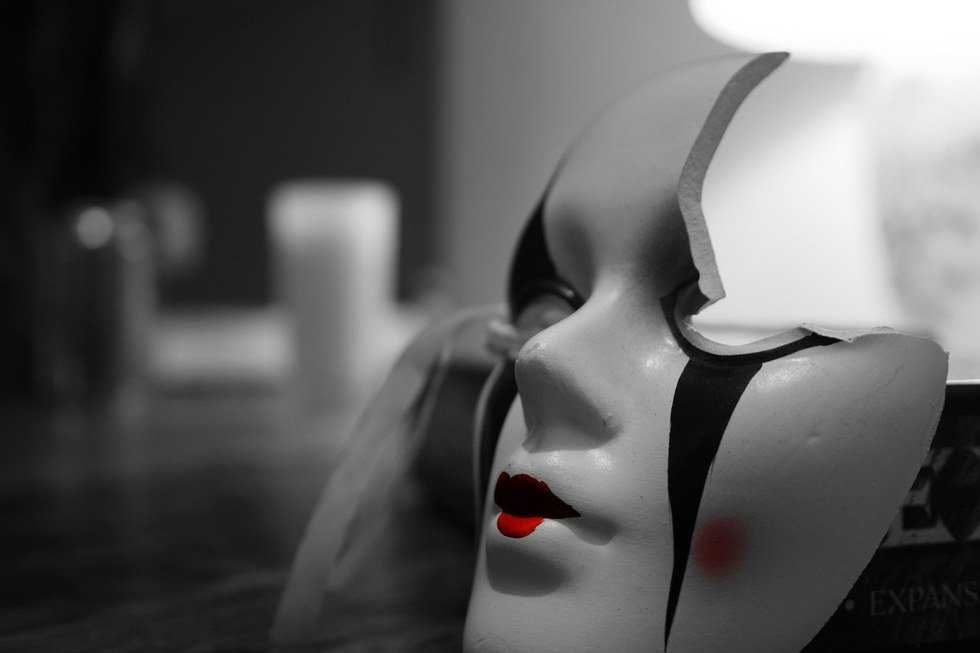
What would happen if we simply put down our masks? If we let ourselves be seen. Bruises, scars, everything. What would happen if we broke the silence with the secrets that were messy and uncomfortable to face? Not just white lies or stress, but things like pornography or same-sex attraction.
Too often, we feel as if the church expects us to be put together, that once we accept Jesus, we’re forgiven, which many equate with being “put together.” But what would happen if we let these secrets and struggles be released? If those who suffered knew they weren't alone?
Not hiding. Not covering up.
We talk about grace and God’s forgiveness. But that seems so foreign, and our sins seem too big to be covered, our problems too messy. Shame tells us to try to hide them from the world and from God and to be "put together" and “good” all of the time.
What would happen if we broke the cycle of shame that sin keeps us shacked in? What would it look like if we broke the stigma of mental illness and dared to speak about it? What would people do if we openly and freely confessed the things on our minds and our hearts and our screens? What would happen if we admitted that we were not okay? What would it look like if we dared to walk together as a community, daily helping each other carry our brokenness and lay it at the feet of our Savior?
A community that, together, is authentically broken in the process of being redeemed and covered by grace. I ask these questions, but I won’t pretend to have all the answers. Because we are afraid.
We are afraid of being seen as broken and "messed up." We’re afraid that, if we let ourselves be truly seen as the person behind the mask, no one could possibly love us, the sinful beings we are. Afraid of being rejected and looked at in disgust. Afraid we would be deemed failures with no hope of recovery.
But God says: "Broken and sinful, yes, that's what you are, but a failure? Never."
In Hebrews 11, we see the Hall of Faith chapter. We see Rahab, the prostitute; David, the murderer and adulterer; Moses, a murderer, etc. But it goes on to say that,
"They desired a better country, that is, a heavenly one and that God is not ashamed to be called their God."
Do you hear that? Dear friends, do you hear that? Do I hear that?
Do you hear that, beloved daughter covering up the cuts on your wrist and putting a smile on your face just to get through the day?
Do you hear that, beloved son, fighting daily to keep the darkness in your mind at bay, fighting to make it another day or another hour?
Do you hear that, beloved children, who pick fights with your food and your body day in and day out, hoping that if you look the part, you'll be enough?
Do you hear that, beloved son, who works and works and works to impress his friends just to make sure they don't abandon him?
Do you hear that, beloved daughter, who fights against the temptation to keep the computer closed, the images off her screen, fighting against the temptation to give in for just one more look?
Do you hear that, new creation in Christ, overwhelmed with anxious thoughts in the midst of this crazy life?
He is not ashamed to be called the God of tax collectors, the God of lepers, the God of prostitutes or the God of broken and sinful people.We hear that. We know that. We hear that over and over in scripture, and if you grew up in a Christian home like me, we hear it a lot.
But then comes shame, one of mankind’s first reactions to sin. It’s an instinct and something that Satan is very good at throwing at us.
Shame is a lie.
Satan uses this lie to eat away at our minds and our hearts until we're at some of the darkest parts of our lives, where we think the only way is to hide it from everyone. Or if by putting it in the open, we are opening ourselves up for judgment, and everyone will look at it as a failure. By putting it out in the open, we are admitting we are sinful like everyone else. But we are also showing Christ's power simply in the public declaration of it.
That can come in many forms; telling one, five, or ten people; or simply answering the question of “How are you?” with “I’m struggling.”
Instead of listening to the shame and keeping it hidden, we are overcome by a power from the One who redeems, and being real, admitting that "Hey, I’m a sinner, maybe not in the same way, but just like you." Here, you are being venerable and real and authentic.
In these struggles, in these open moments, we allow God to come in. And there, there is freedom.
He, our Heavenly Father, calls us His children. We are free. And we are heirs, not to shame and condemnation, but to His glorious, lavish, compassionate inheritance.
"Because you are his sons, God sent the Spirit of his Son into our hearts, the Spirit who calls out, “Abba Father.” So you are no longer a slave, but God’s child; and since you are his child, God has made you also an heir." ~Galatians 4:6-7
I pray that we would be a people who do not give into the lies, but instead, throw off our shame. As a community, may we walk together, support each other in our brokenness, realize we're all screwed up and messed up in some way, help each other continue on walking (or crawling), help carry one another's chains and point each other back, again and again, towards Christ's love, His redemption, His grace and His mercy.
I pray that, as a church, we would be the body of Christ. Broken, but found collectively whole in His love.
Friends, we need to be honest, real and authentic about the sin in our lives. Satan wants us to hide it, but God can take these broken pieces and these scars and use them for His glory.
I write this message for you. For me. For us.
And all glory to Him who sets us free.