
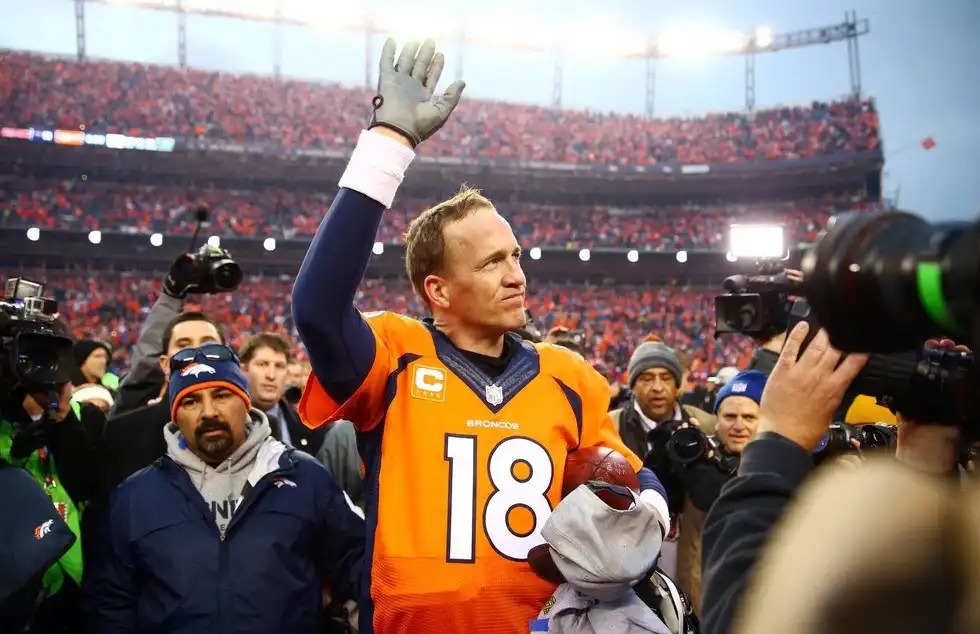
After 18 seasons, five MVP Awards and two Super Bowl victories, Peyton Manning has decided to retire. This news shouldn’t come as a shock to anyone. Football fans, even non-football fans, knew this season might be Manning’s last. Sports shows will use the next few days to celebrate Manning’s illustrious career, and rightfully so. But today is a sad day for the NFL, as a “quarterback-starved” league has lost one of its greats.
Peyton grew up learning football from his father, former NFL quarterback Archie Manning and he grew up playing the game with his younger brother Eli. In high school, Peyton quarterbacked his team to a 34-5 record over three seasons as a starter. He was named the Gatorade National Player of the year in 1993.
At the University of Tennessee, Manning set school records for most passing yards in a career (11,201 yards) and most touchdown passes in a career (89), among many others.
Manning was selected by the Indianapolis Colts with the first overall pick of the 1998 NFL Draft. He spent 14 seasons in a Colts uniform. His years in Indianapolis included four MVP winning seasons (2003, 2004, 2008 and 2009) and a Super Bowl victory over the Chicago Bears in 2006. He set many Colts records. After the then-35 year old Manning missed all of the 2011 season due to a spinal fusion surgery, many fans thought he would retire, having played his whole career in a Colts uniform. Despite a significantly weaker right arm, he wanted to keep playing. The Colts released Manning after selecting Andrew Luck with the first overall pick in the 2012 NFL Draft.

In March 2012, Manning signed a five-year contract with the Denver Broncos. That season, he finished second in MVP voting and named the NFL Comeback Player of the Year. Manning won his fifth MVP Award in 2013 and led his Broncos to the Super Bowl, but they were defeated by the Seattle Seahawks. During the 2014 season, Manning joined Brett Favre as the only quarterbacks to beat all 32 NFL teams, and he broke Favre's career passing touchdowns record when he threw his 509th career touchdown pass to Demaryius Thomas.
Manning’s final season was his most interesting and perhaps his worst season of his career. He missed seven starts with a plantar fascia tear near his left heel. In November, Manning had a cast on his left foot. In December, he was running the Broncos scout team, and by January, he was back in the lineup for another playoff run. And in February, he was hoisting the Lombardi Trophy. His 2015 season was marred by allegations of human growth hormone use, and shortly after his Super Bowl win, he was cited a lawsuit filed by a group of women alleging that the University of Tennessee violated Title IX regulations and created a hostile sexual environment. Manning’s reputation was able to weather that public relations storm and his legacy is still one of the greatest in the history of football.

Throughout the last season, many of Manning’s current and former teammates and coaches have spoken about his career and what made him so great.
“It was a blessing to coach Peyton Manning. Nobody worked harder at the game and nobody prepared harder than Peyton," Broncos head coach Gary Kubiak said.
"Peyton Manning is the kind of player, the rare kind of player, where no matter how long you played with him, whether it was a month, a year, 10 years, a week, you're always going to say, 'I played with Peyton Manning,’” Broncos tackle Ryan Harris has said.
"Peyton, he made me better. He made a lot of guys better," former Broncos and Colts wide receiver Brandon Stokley stated.
Peyton Manning set many records during his career. His 2013 season is one of the greatest seasons by a quarterback in NFL history. That year, he set single-season records for passing touchdowns in a game (7), passing touchdowns in a season (55) and passing yards in a season (5,477). Some of Manning’s most notable NFL career records include most passing yards (71,940), most passing touchdowns (539) and wins as a quarterback (200, this includes postseason wins).
Manning’s legacy goes beyond the numbers. Lucas Oil Stadium, where the Colts play, is often called “The House That Manning Built” because of the success he brought the Colts’ franchise. He changed the way the quarterback position was played.
Before Manning was in the NFL, after each play most offenses would huddle up to get the next play. Manning arrived in the NFL and started utilizing a no-huddle offense and calling audibles while at the line of scrimmage. Manning didn’t invent the no-huddle offense, but his success with it brought it back into the spotlight. The NFL is a copycat league, and the use of the no-huddle offense has rapidly grown since Manning’s early success using it with the Colts.
Ask people what they think of when they hear the word “Omaha”. Some people might think of the largest city in Nebraska. Football fans might be more likely to hear Manning shouting “Omaha” at the line of scrimmage while calling an audible.
Manning has become the envy of every athlete looking to make it big through their endorsement deals. Manning has appeared in commercials for Papa John’s Pizza, Nationwide Insurance, DirecTV and many other companies. His Nationwide commercial jingles have made their way into everyday use. Manning will have no problem finding work now that his days on the football field are over.

Today, the NFL didn’t just lose a Hall of Fame quarterback, it lost its most marketable brand. Peyton Manning talks slowly, with a thick Southern drawl. You won’t catch him out partying with celebrities or getting in trouble with the law. He was, perhaps, the most relatable player in the NFL- just a guy from New Orleans that knew how to play the game well, he was a student of the game and he understood what it means to be a professional.
It's great to see Manning go out on his own terms. After the five-year wait period is
over, he'll have a bust forever enshrined in the Pro Football Hall of
Fame in Canton, Ohio.