

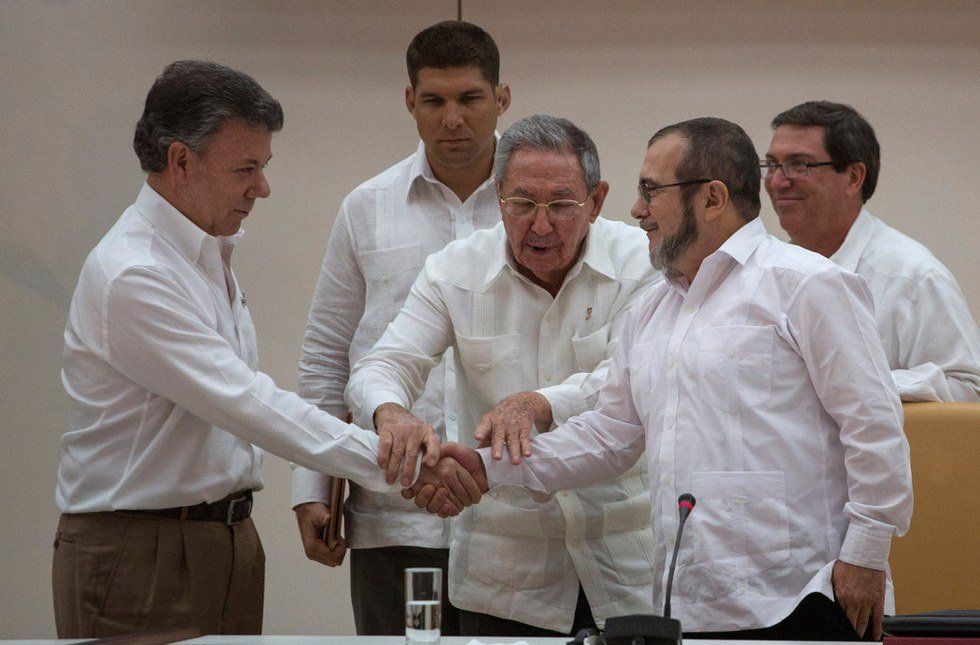
This last Wednesday in Havana, the final peace accord between the FARC (Revolutionary Armed Forces of Colombia) and the Colombian government was signed. President Juan Manuel Santos went on Colombian television to announce the agreement, “Today begins the end of the suffering, the pain, and the tragedy of war. Let’s open the door together to a new stage in our history.”
The conflict between the FARC and the Colombian government was the last major remnant of Stalinist guerrilla uprisings in South America that were widespread throughout the 1960’s. Over the course of the 52 years of conflict, approximately 250,000 Colombians were killed and a further 6 million displaced from their homes. In more recent times, the FARC devolved from communist guerrillas to major contributors to the cocaine trade; crimes attributable to the group include pressing children into military service, executing civilians, extortion and bribery, and kidnapping.
Under this peace agreement, FARC fighters will surrender their weaponry to Colombian forces in 23 “normalization zones” supervised by the UN, and aid in disabling landmines. Leaders of the group will be tried for various war crimes, such as those listed earlier, and will have punishment restricted to 8 years of community service. A special tribunal will be selected by Pope Francis and UN Secretary-General Ban Ki-moon for these trials.
But what does this mean for the rest of us? What does the end of a 50 year long civil war mean to a college student writing an article or to someone reading that article on the toilet?
Put yourself in the place of a Colombian negotiator. Since you were a kid, you’ve heard story after story about guerrilla raids killing thousands of people, drugs being shipped out of the country by the ton, and children being forced to fight for FARC. Up until about ten years ago, there was the very real threat of car bombs rocking your city. And now, after all of that, you’re given the chance to negotiate with the same people who committed all of these acts of violence, for the sake of peace in your country. Admittedly, quite a few people would take that chance, but what does it subjectively show the people who’ve lost family and friends to FARC? That instead of looking for “justice”, you’re looking to let them off easy?
Here’s the thing about negotiating with your enemy, you won’t find a solution that involves a win-win scenario. You have to be able to compromise and listen to the people you’re negotiating with. To many of us here in the US, compromise has been somewhat of a dirty word. It’s a rare thing to see Democrats and Republicans reach across the aisle, or employers cooperate with employees during a dispute. It appears as though we’ve put too high a value on voicing your position and too little value on compromising.
If we want to change this, we must change our attitudes. The next time you get into an argument with your boss, try and find some common ground and find a solution to the problem. In case you argue with your spouse or significant other, remind yourself of what you have together, and work out your problem instead of fighting. Instead of getting angry, shouting your feelings and getting into somebody’s face, take a moment to remember that the only way past any issue is by working together, not against each other.