
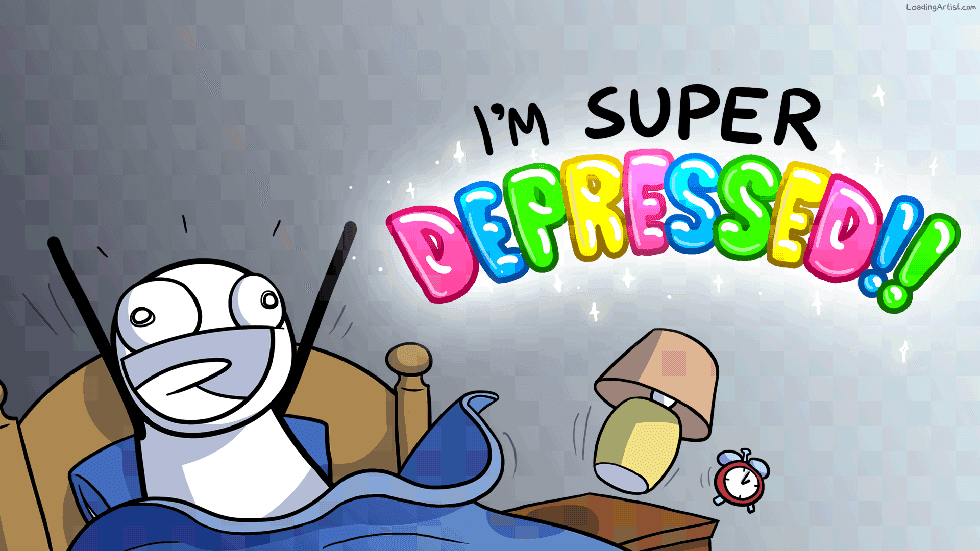
I recently read an article meant to be an inspirational, self-help guide for “overcoming” depression. The title reads that, “Yes, you CAN overcome depression!” in wonderfully colorful writing with rainbows interspersed around the text in what I can only assume is to promote feelings of “happiness.” This article goes on to suggest that depression is all in our heads, and stems from often unconscious beliefs that one is “separate,” “unimportant,” “unlovable,” “worthless,” “powerless” or a “victim.” I personally am no stranger to such statements like: “just wake up and CHOOSE to be happy!” or “why don’t you just stop thinking like that?” to which I often shake my head and proceed to remove myself from the situation before strangling myself, or quite possibly those around me. I do not fault people for their ignorance, but I do find many faults in the ways in which depression and other mental illnesses are handled by society.
First off, depression is not a choice. Let me repeat that for clarification: Depression. Is. Not. A. Choice. If I could just “wake up and choose to be happy,” believe me, I would. If I could get up and go through my day without being pinned under my sheets, contemplating the point of my existence and suffocating under the weight of a world that seems it wasn’t meant for me, I would. I would never choose to force smiles and laughter instead of actually experiencing genuine pleasure; nor would I choose to watch those around me hopelessly flounder for answers and treatments and “cures” for something I have struggled with since I was old enough to think for myself. Mental illnesses are not a choice, no more than any physical ailment is a choice.
One of the aspects of this article that I found most disturbing was the emphasis on this “choice,” in the sense that “nothing comes to us or seems to happen to us without our choosing it.” Not only is this blatantly incorrect in a general sense (see the definition of rape, etc.), it is entirely incorrect when it comes to mental illness. Yes, depression is a disease that plagues the mind, and in this sense we may become victims of our own minds. However, this statement serves to lessen the severity of mental illnesses, as no one would ever brush off a person suffering from heart disease and justify this with the idea that he is simply a victim of his own body. Just as there are some aspects of the mind that we can control, there are also aspects of the body that we can control. Regardless, neither of these realities establishes that our mental or physical struggles are a product of our own choice.
Depression is a serious illness, not a sign of weakness or a flaw in character. It is not a rainy day where you look out the window and feel a little sad or your reaction to your boyfriend breaking up with you. Depression is being on the other side of a glass wall, where you are forced to look at everyone around you enjoying themselves, yet you can’t figure out how to get to the other side of this prison. Depression is thinking about swallowing those pills on your desk once every few minutes, coupled with the fear that one day you will look down at an empty bottle in your hands and you won’t even remember how you got there. Depression is not a bout of sadness that comes and goes whenever life gets a little too hard. It is the agonizing war between what is more terrifying: the thought of death or the thought of waking up, the thought that it could all be over or the thought that this is only just the beginning.
Please do not tell me that depression is only my mind tricking me; do not tell me that I can overcome depression if I make the choice to do so. Do not tell me that “it gets better,” or that last year you were depressed because your aunt died but now you are completely fine and I will be too. Depression is not “cured” by trying harder or choosing to rid yourself of a psychological disease. Depression is a lifelong struggle, it is dealt with and fought against and there may be good days and there may be bad days. There is no magic pill or miraculous recovery; there is no way to make it go away forever. There are only small steps upward, and sometimes, you will be pushed back. There is a reason the anti-depressant commercials do not show the dark cloud disappearing with a dose of Cymbalta; depression becomes more manageable if you are able to learn how to cope with it, not by choice, no matter how hard rainbow-filled articles will try to have you believe.