Advertisements surround us every day. They are used to market items, ideas and people. They tell us who we are, and who we should be. They are how we circulate information so that we can keep up, and be "in the know" about the best of the best. We don't want to fall behind the latest trends, so we feel a certain pressure to be informed. However, because we are so used to seeing ads, we do not realize the deep effect that they have on us. Ads can be harmful not only to our society but to our health and wellbeing as individuals.
It’s not at all abnormal for us to see a sexualized image of a woman in order to sell shampoo or even a burger. Because, in fact, what is being marketed is the woman's sexuality, not the product. Now, more than ever, there is less emphasis placed on the quality of the product and more placed on how to sell the product. And in many cases, we sell things by sexualizing them.
This brings about another crucial point: those presented in ads create extremely unrealistic standards of beauty. From the time children first pick up a magazine, they see images that they subconsciously attempt to replicate over time in order to achieve that level of perfection. This is impossible, as the images are so heavily manipulated, and sets individuals up for low self-esteem from the start.
We feel like we just aren't good enough.
Females are most affected by our society’s standards of beauty. Many models in advertisements you see are stick-thin with a large bust and flawless features. First of all, it is extremely rare for thin women to have this particular composition. Those that do have most likely had surgery or have been subjected to photo editing. Seeing this trait constantly in the media sets women up for failure. They literally cannot achieve the standard of “perfection” that they see, therefore they fail. They feel like they do not measure up and that they never can. This dramatically lessens self-esteem and increases feelings of hopelessness, anxiety and depression. Eating disorders have become a more rampant problem than ever. A confidence crisis has been created.
Advertisements and magazines cause us to compare ourselves to others. We bear the pressure to be perfect in almost every way. We want to look like the models, even though the models don’t even look like the models. So please, hear me out --All body types are beautiful. What you see in ads are standards of perfection that are realistically unattainable.
Supermodel Cindy Crawford said it best. "Even I don't wake up looking like Cindy Crawford."
While this issue harms women the most, it surely affects men as well. They are told from a young age that to be desirable and masculine, they must have huge muscles and a toned physique. The truth is, men are often airbrushed or made to look more muscular in ads. Men, while less likely to express their emotions or thoughts about themselves, do experience decreasing confidence caused by the media's male ideals of perfection.
Many celebrities are starting to stand up to this outrageousness. Recently, Kate Winslet officially told L'Oreal that they no longer had permission to airbrush or retouch photos of her. She realizes the damage that is caused by companies presenting flawless images of women that are not even real. She told E! News, “I do think we have a responsibility to the younger generation of women. I would always want to be telling the truth about who I am to that generation because they’ve got to have strong leaders.”
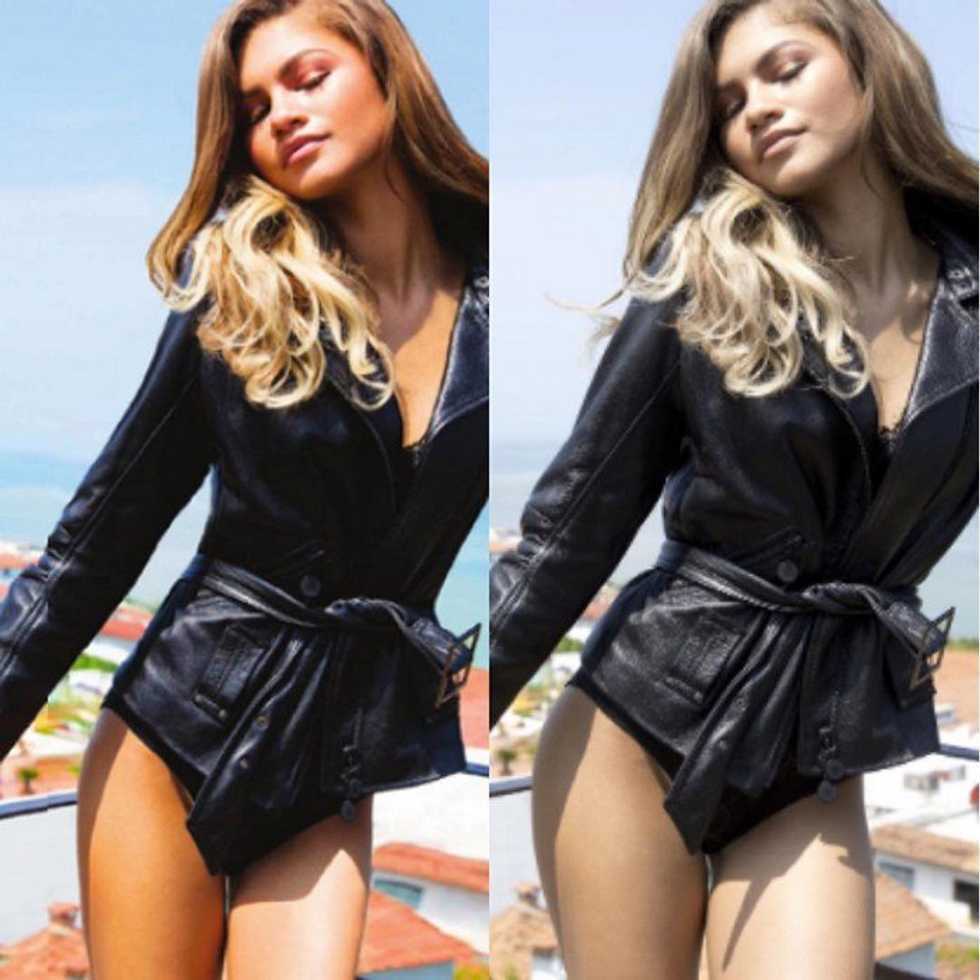
Zendaya, 19-year-old actress, also had something to say about this. When she discovered that Modeliste magazine had reduced the size of her torso and legs in a photo shoot, she took it upon herself to release the real, unedited image of herself on her Instagram (Photo shown above).
"These are the things that make women self conscious, that create the unrealistic ideals of beauty that we have," Zendaya said.
Thank god for people like Kate Winslet and Zendaya, the ones who have the power from within to spread the message to women: We don’t even look like the people they make you think we look like.
So, here’s the thing. It’s almost impossible not to compare yourself to others. It’s human nature. But please, the next time you glance at an ad or a magazine cover, know that it isn’t real. Know that the person in that photo has flaws that have been airbrushed over, thighs that have been slimmed down and skin that has been edited to give off a heavenly glow.
We may not be able to change the industry. It’s been this way for decades, and frankly, only grows worse over time. However, what we CAN do is constantly remind ourselves that our ideals of beauty should come from within, and should not be based off what we see in others, on billboards or on TV. Strive to become your personal best. Exude confidence. Know that you are beautiful just as you are, flaws and all. Those are what make you unique, and inherently human.