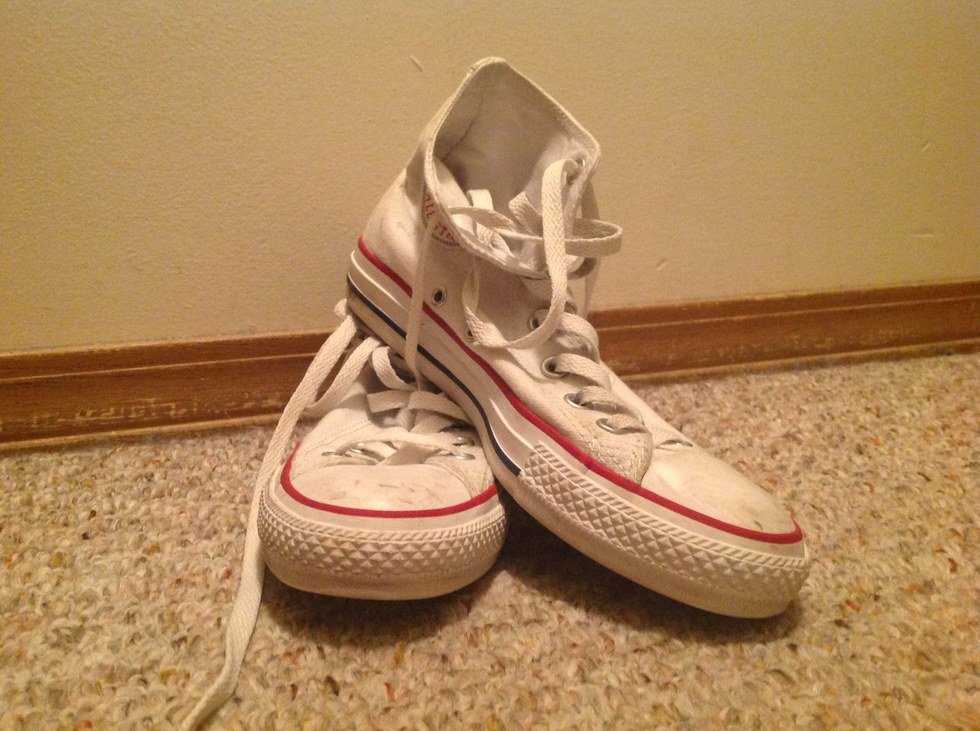
I was in elementary school the first time I remember being encouraged to imagine how it is to walk in another person’s shoes. The sentiment was nice: By understanding what other people might think, see and feel, a person can better understand their perspective of the world. The phrase was somewhat lost on me when I wondered how my larger-than-average feet would fit into some of my classmates’ shoes, but I eventually grasped the concept.
A lesson I once thought would be reserved to my childhood found its way into my adulthood too. The current charged political climate with the rise of Trumpism has brought to light the consequences of a monocular worldview. After being taught the lesson several times, I learned perspective-taking surely must be important. But what if the concept itself is wrong? Moreso, what if it’s impossible?
United States Supreme Court Justice Sonia Sotomayor, in her recent autobiography “My Beloved World,” writes that one of her greatest life lessons was learning that the world begins to break down when we fail to see the it from one another’s perspective. I’m loath to disagree, but I do. The world doesn’t break down when we fail to see the world from others’ perspectives, it breaks down when we fail or refuse to recognize that there are other perspectives to be had in the first place.
A lack of perspective-taking is a ritual of the closed-minded, but the act of perspective-taking is a sign of perceived cultural superiority. When a person says there are groups from which we need to learn to “walk in their shoes,” a line is being drawn — a line of otherness. If perspective-taking is meant to nullify otherness, it has given it the exact opposite: validation.
Perspective-taking focuses on those things which make us different rather than what makes us similar. These differences aren’t meant to be ignored, but they aren’t meant to be used divisively either. Differences, not similarities, create otherness and focusing on these differences only perpetuates this otherness.
On a physiological level, viewing the world from another’s eyes is impossible. It is impossible from a more abstract level too. Perspective-taking is premised on the idea that it is possible to come to a true understanding of another person’s lived experience. This simply can't be true.
I have six sisters. Growing up, I sat first row to view the experiences of burgeoning womanhood and the sexism our culture burdens women with — I should know women. But no matter how hard I try I'll only have a perspective of women, not a woman's perspective.
When I take account of all I am as an individual and then attempt to take the perspective of another person, I will fail. I cannot disregard all I am to fully recognize all she is. And to do so would trivialize her lived experience. Who am I to measure the weight of the burdens she carries? It is a disservice to both myself and her to romanticize the suffering she endures and the sweetness she enjoys in an effort to affirm myself in believing that my worldview is informed from an experiential understanding of the variety of human lives.
Perspective-taking is nice in thought, but flawed in practice. Perspective-taking only gives us a perspective of a perspective. I'm never walking in your shoes, I'm walking in shoes I assume to be like yours.
The world isn't breaking down because we’ve failed to see it from one another's perspective. We’ve failed to allow variation of perspective in our society. Variance is necessary to recognize the best in all of us and to weed out the worst. But variance alone will not do it.
Currently, we deem those who call for an open-minded society of perspective-takers as politically correct as if for some reason it is ridiculous to push for a more understanding culture. At the same time, those who struggle to perspective-take are quickly labeled bigots and cast out from main-stream society. Every coin has two sides and both sides of this coin are wrong. Ironic enough, perspective-taking has led to these further divisions in an effort to end divisions.
What our culture needs is empathy. Empathy offers compassion in understanding others and dedication to self-growth. Empathy builds bridges between two seemingly different individuals. Empathy in our own perspectives negates any need to take another’s. Ultimately you and I have one life to live — each completely different and unique — but radically different people thrive when they choose to live life openly together.