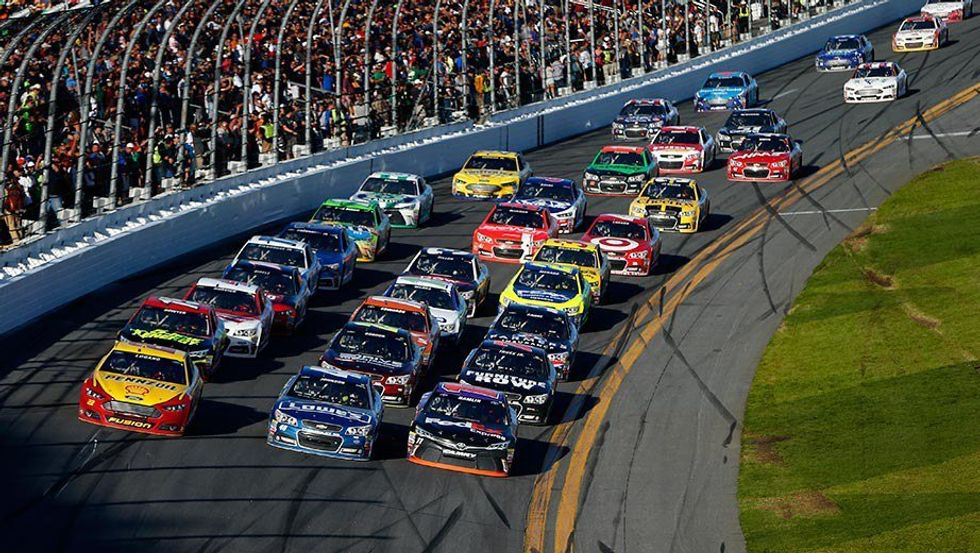
NASCAR is one of those things that are unquestionably American, like deep-frying, foreign intervention and institutional racism. What’s not to love about thundering engines, spectacular crashes and a ridiculous amount of commercials?
Of course, if you asked the average person what they think of NASCAR, they’d probably say it’s just a bunch of hillbillies watching guys in fast cars go around and around in circles. While this hypothetical average person wouldn’t entirely incorrect, there’s much more to this modern, redneck version of chariot racing than meets the eye.
First off, NASCAR isn’t just how southerners say “nice car,” but an abbreviation for the National Association for Stock Car Racing. Stock cars are heavily modified versions of cars sold to the public, or at least they used to be.
While stock car racing takes place in countries across the globe, NASCAR has separated itself from the pack with its preference for racing on oval tracks (where drivers go around and around for hundreds of laps) over road courses (tracks that aren’t just left turns). Additionally, NASCAR drivers no longer race modified versions of cars sold to the public, but custom-made vehicles that just happen to share the same logo and engine as some production models. It wasn’t always this way, however. In fact, NASCAR’s origins are actually pretty fascinating, unlike today’s races.
NASCAR owes its existence to another one of America’s previously beloved pastimes: bootlegging. For those unfamiliar, on January 16, 1919, Congress ratified the 18th Amendment, which made the selling, transport, and even the making of alcohol illegal. Being the boozehounds that we are, this obviously didn’t sit well with most Americans. So instead of wallowing in sober despair, many Americans started making and selling their own alcohol. And who transported the now-illegal substance? Why bootleggers of course.
Over 10 years later, after the government finally realized how badly the 18th amendment had backfired, the 21st Amendment was ratified. This Amendment repealed the 18th, once again making alcohol legal and ending the Prohibition Era.
Even though NASCAR wasn’t officially founded until fifteen years after the end of Prohibition, it couldn’t escape its bootlegging roots. Junior Johnson, one of NASCAR’s first and most famous drivers, credited his success to bootlegging, claiming “It gave me so much of an advantage over other people that had to train and learn how to drive.”
So how could something with such a kickass origin become so boring? I keep asking myself the same thing since I absolutely adored NASCAR when I was a kid. One of my most prized possession back then was a VHS tape (remember those?) of the 1998 NASCAR Winston Cup season.
Every weekend, the drivers would travel to a different track and race. Depending on where they finished at the end of race, they would gain points and at the end of the season, the driver with the most points won the Championship. There were intense rivalries, nail-biting finishes and vibrant personalities that all made the racing all the more interesting.
When we had to dress up and pretend to be our favorite athlete or celebrity for a school presentation, I chose Jeff Gordon, my favorite NASCAR driver. Maybe I was just easily entertained back then and that’s why I enjoyed watching NASCAR so much. But now when I attempt to watch it, all I see are guys in fast cars going around and around in circles. I’m still into racing and motorsport, don’t get me wrong, but NASCAR doesn’t feel like either of those things anymore.