


You know that meme that goes around Facebook and Twitter every few months about how college is like riding a bike, except the bike is on fire, and you're on fire, and everything's on fire? It's pretty accurate. Transitioning to college is a massive undertaking that tests everyone's mental and emotional limits on a weekly, if not daily, basis. Jokes like these make light of the tough parts of college. But the uncomfortable experiences of homesickness, anxiety or emotional breakdowns aren't all that funny to go through. They can be gut-wrenching and awful because they force you to grow. While I was dealing with these feelings throughout the last year, I sought out every healthy resource possible to ease this painful growth. Take all of this guide to heart or just parts of it, but know that everything on here helped me at one low point or another.
1. Counseling
Most colleges have some form of student health services. These services typically include basic medical care as well as counseling services that range from personal appointments with therapists to group therapy. In my experience, these services are typically free. Therefore, there's no reason not to reach out and ask for help when you need it. It might be scary to admit that you want to see a therapist or talk to others who feel the same way that you do, but it's really not rare or strange. You also might think that whatever you're dealing with is trivial or not something important enough to bring to other people's attention. This isn't true either; if you're feeling at all overwhelmed or helpless about something, anything, going to professional help is the best thing to do. There's only so much you can do for yourself sometimes, and only so much you can ask of the people in your life to help with. Some things are beyond you and the advice of your loved ones. Sometimes, you need an outsider's perspective to validate and normalize your experiences. The simple act of talking and having someone really listen without looking at you with concern or judgement is so relieving.
2. Essential oils

Essential oils are natural oils taken from an organic source, like a plant, which are then distilled. They keep their fragrance and are believed to have healing or wellness properties, especially when certain oils are mixed for the purpose of things like bringing joy or calm. I'm lucky to have a mother who is an expert on all things natural health related, and it was no problem for her to create small rollers of essential oils for application on my feet before I put my socks on in the morning. I have mixes called joy, harmony, and valor. They have helped in all the ways that their names imply.
3. Exploring

Hands down, the easiest way to deal with being in an environment that is uncomfortable because it is unknown is to explore. Figure it out by physically walking around and seeing things for yourself. Going to college involves campuses and cities that are foreign to you at first, until you walk around and get a sense of place, a sense of direction. Grab a friend and find popular places on campus. Head off campus and learn how the city's bus or train system works. It's only through doing these things that you'll become confident in your ability not to get lost. It will eventually help build up your confidence until you feel you belong there, which can be everything in a time of such chaotic and abrupt change.
4. Facetime or Skype
Technology is wonderful because it helps us to feel connected to our loved ones hundreds of miles away. There will be moments when you just want to see your mom or dad, your brother or sister or your boyfriend or girlfriend. Take some times to see their face, even if it is through your phone. It's the only way to feel like you're with them when you're not, and sometimes, that's all you need when you're upset.
5. "Good things"
The best way to gain mental control over a bad situation is to have a positive attitude. This is easier said than done, and to change your own attitude, you may need help. This is where practices like keeping a list, journal, or even a box of "good things" can help tremendously. Once you start recording everything good that happens in a day or a week, you start looking for more good things to add to your list. This creates a sort of addiction to finding positivity, which then changes your whole outlook. There may be times when you forget to record your good things and stop seeing as many in your daily life, but this is an easy practice to jump right back into. All you have to do is open a note on your phone or find an empty notebook.
6. Health food
 This is probably the hardest way for college students to think about coping with the stress of their lives, however, it's more than worth it to eat a few salads a week and keep fruits like apples and bananas on hand. Too many carbs and sugars will not help stabilize your emotions, nor will they make you feel good physically. If anything, they'll make you sluggish, tired, and more irritable or easily upset.
7. Homeopathy

This is a method of natural medication not known by everyone. Again, due to my mom's background in natural health, I have my own box of homeopathic remedies. The box consists of smaller bottles with small, circular sugar pills. The idea of homeopathy is that the pills have the energy of their source which can be used to help heal minor to major illnesses or injuries, as well as anxiety or over-emotion. They can be dissolved under the tongue or dissolved in water if you need more than one type of remedy at a time. I simply put a mixture to help with anxiety in my water bottle every morning for class. That way, any time throughout the day that I start to feel overwhelmed, all I have to do is drink my water. Fun fact about homeopathy: if it's dissolved in water, the potency gets stronger if you add more water - so you just have to add more water before you run out entirely to still get the effects of the remedies, even stronger than before.
8. Journaling
As a writer, I've always turned to putting my thoughts onto paper to sort through emotions and experiences, but a journal is something I'd recommend to anyone. It doesn't have to be formal, you don't have to write every day, and heck, it could even be done in the notes on your phone, just like the good things. The point is, writing down your feelings is a great way to part with them. You get them out of your head, and then you get to move on from them. You also get to better understand them through choosing the right words for them, which can also help you to move on.
9. Phone calls

Just like Facetiming or Skyping, calling your family or significant other can help in moments of exasperation. The people who know you best often know how to calm you down in moments where you can't calm yourself down.
10. Reminders
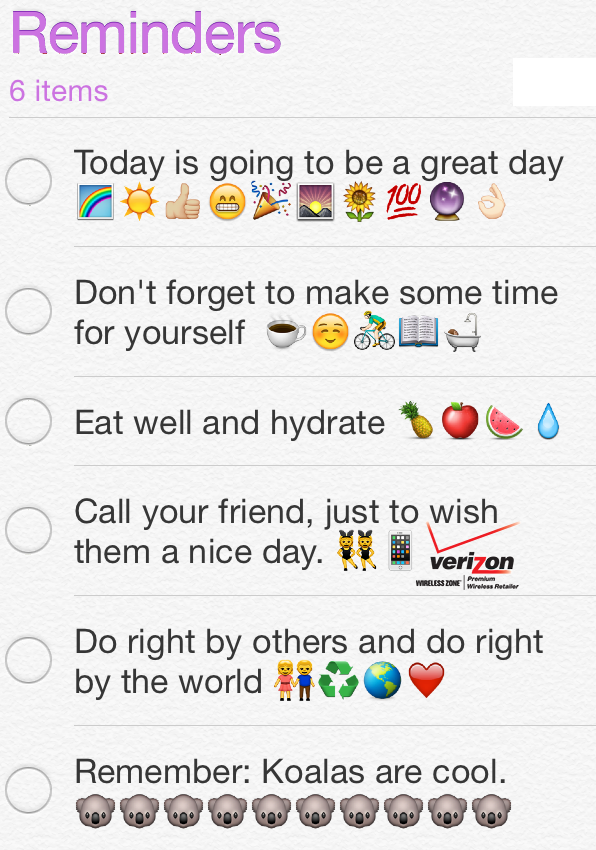 There are two things I use the reminders on my phone for: positivity and organization. I have one alarm every day that goes off, reminding me how lucky I am to be at the college of my dreams and still have such a loving home a state away. I originally set this reminder because it was a positive feeling that I wanted to have, not because I already felt that way. In having that reminder go off at noon every day, and reading my positive phrase over and over again, I now can say I do actually feel that way. Of course, the reminder didn't change all of my emotions, but it helped to change my mindset. I would recommend picking the most positive outlook you want to have toward your life for your own alarm.
The organizational part of the reminders is simple; remind yourself when you need to do something. Once you get past things like anxiety or displacement, it's easy to be overwhelmed by the fact that being an adult requires never-ending to-do lists. Reminding yourself to do things like call so-and-so or turn in assignment five is half the battle, and doing them right in that moment will give you one less thing to worry about.
11. Sleep
I may have to take back what I said about eating healthy; getting a solid amount of sleep is pretty difficult too. Between homework and hanging out with friends, sleep takes a backseat on your list of priorities. However, if you're already emotionally or mentally drained, sleep is something you truly need. I have had to start making decisions not to hang out with friends on nights when I have class early in the morning because I need to put myself first. Sleep gives you your energy for the next day, and in college, you desperately need the energy to sit through lectures, workshops, and group discussions before coming home and then doing a few hour's worth of homework.
12. Staying put
This was the part about adjusting to college that I took the longest to accept, mostly because I didn't want to. Like I've already said, it can be so intimidating to be in a place where you don't know anyone and you aren't familiar with anything. It is very, very tempting to go home every chance that you get, or to even quit and go home for good. But the only way to really transition is to go through the uncomfortable part of being somewhere you don't really want to be. It very well may help you experience less homesickness or displacement down the road.
13. Supplements

We're getting into natural health just one more time. Supplements are what I look to when I feel I need more medical help than homeopathy. However, they aren't technically medication; they're pills formed from natural substances that don't need to be prescribed. I would highly recommend that you do research and or consult a natural healthcare expert or physician before you start taking things at random. There are a wide variety of supplements, and I personally take two for anxiety, each once a day. The great thing about supplements is again that they aren't prescription medication and therefore aren't a chemical concoction. Like homeopathy and essential oils, they come from natural, generally plant, sources that don't have nasty or unexpected side effects.
14. Trips home
The idea of going home may seem to conflict with staying put, but the thing is, both actions have their own benefits. Staying put helps you later to be more comfortable and stress less over your physical location. But taking trips home is necessary to give yourself a mini vacation when you need it. Just like the mental health days you would occasionally take in high school, sometimes you need mental health weekends at home away from some of the academic and social chaos of college.
15. Yoga

Yoga is another positive practice that you don't need experience or talent for. I had never done yoga before I started attending free weekly yoga classes on campus. If your school offers the same thing, take advantage of it! I get to practice this strengthening and calming form of exercise from a certified instructor for free, every single week (though I may not attend every week). Yoga really does allow you to relax and build strength and balance in muscles you had no idea about beforehand.
16. Walks
Sometimes the best way to combat moments where you feel too stuck inside your head is to go outside. Grab some friends or your roommates and take a stroll through the park or to your favorite place to eat or grab coffee. Be safe if it's later at night, but go to the place where you feel most calm and centered. This simple act will make you feel better.
17. Workout routine

Establishing a workout routine has had a huge positive impact on my life. Most people think of working out to get in better physical shape, but it really does help your mental state too. The endorphins released will make you feel happier, and get your day off to a good start if you establish your routine in the morning. Another benefit is that while your body is busy being active, so is your mind. Like yoga, you have no extra time to obsess or over-analyze. It's like getting a break from yourself that also helps you feel more confident about your physical appearance. Working out doesn't have to be difficult either; you can designate just 20 to 30 minutes right when you wake up or right before you go to sleep to some simple cardio. Buy a workout DVD or head down to your building's or your campus' gym. Once you start, it'll feel natural to continue because you'll feel noticeably worse on days you don't.
The key to a lot of these positive activities helping your mental state is finding balance. Going home can be good, but so can staying where you when you don't want to. Eating healthy is great, but sometimes chocolate will make you feel better. Some of these physical practices like yoga and working out are great to implement in your everyday routines, but you'll want to take a break at least a day or two a week. For a lot of these other activities, the act of balance comes from determining how much you can work through your problems yourself, and how much you need the help of others. Then, there's the balance between looking to your family and friends and looking to a professional. Finding balance in any of these cases is hard, and it's something that only you can do yourself. The important thing to remember is that there are always ways to get yourself through the hardest moments. Those moments in college may be 10 times worse than they were in high school, but the success that comes from getting through them is 10 times better too.