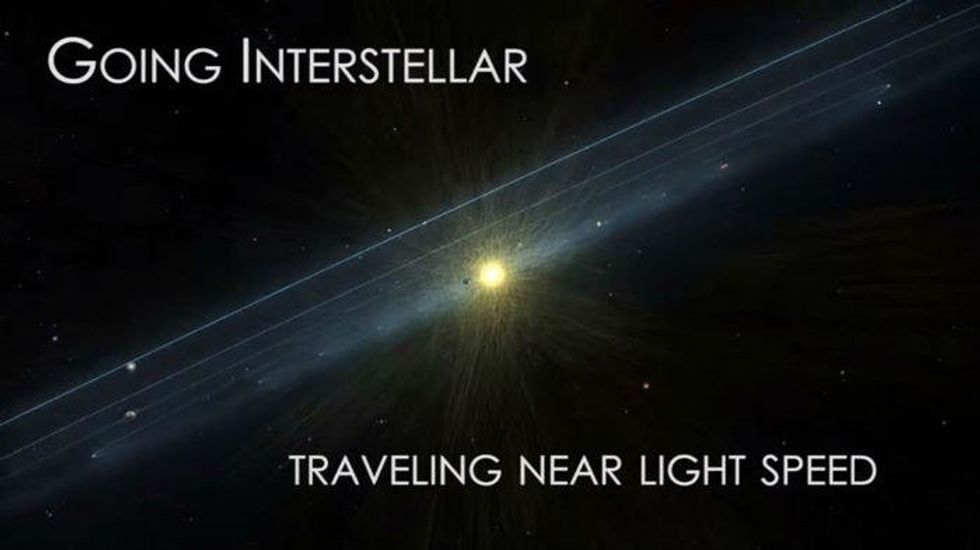
From the time humanity first stepped on the moon, to the time humanity first exited the solar system with Voyager 1 we have been producing great accomplishments. At the rate we are going, we will never reach interstellar travel. However, Philip Lubin, a member of the physics department at the University of Santa Barbara, thinks he has found a solution. He has proposed in his paper, "A Roadmap to Interstellar Travel," a way in which we can achieve these seemingly impossible feats. The Voyager 1 was traveling pretty fast by the time it left our solar system; in fact it was traveling 17 kilometers per second. Seems fast, right? Well, as fast as that sounds, it still took 37 years for Voyager 1 to leave. If we want to conquer interstellar travel, we must travel at relativistic speeds. This means that we must travel at speeds significantly close to the speed of light. To put in some perspective, Voyager 1 was traveling at 0.006 percent the speed of light.
What if we could reach 30 percent the speed of light? Well, we already can; it only takes about 10 minutes. We reach these speeds with photons in laboratories and the energy required is not as significant as it sounds. Photons are basically light particles. They are the fastest things in the known universe because light travels the fastest. So traveling 30 percent the speed of light would be significant. You can read the full PDF of Lubin's paper here (http://bit.ly/1L7QXYl).
NASA 360 has shared these findings with a small video generalizing the idea of Photonic Propulsion. The idea would be to have a giant laser in space to push a spacecraft through space. This can work because one would take the direct sunlight and transform this energy into a highly concentrated laser which would be aimed precisely at a ship (large or small). This laser would then focus its beam on the ship and continuously push it through space using the kinetic energy of the photons within the concentrated laser beam. The effect of a continuous blast from this laser would propel the object at tremendous speeds.
The most incredible part is that we have this technology, now. It would take many years to produce but the idea is plausible. With this kind of technology we can send a 100 kg satellite to Mars within three days and a manned spacecraft to Mars in 30 days (https://www.nasa.gov/multimedia/podcasting/nasa360...). As for interstellar travel, we would be able to reach Alpha Centauri, the closest star system with which may have a hospitable planet, within 15 years. Alpha Centauri is a little over four light years away.
There are, obviously, a few problems with this photonic laser idea, one being there is no way to stop yet. This would certainly be a problem that cannot be overlooked. However, where there is a will (and hundreds of millions of dollars) there is a way. In our lifetime we may very well be able to take a vacation to Mars. Wouldn't that be something?