
Dorothea Dix, an exalted prison reformer back in the nineteenth century, once said “While we diminish the stimulant of fear, we must increase to prisoners the incitement of hope. Failing to give prisoners hope is a problem that has bothered the American judicial system for a very long time, and continues to bother it today. When Hillary Clinton made a statement in 1996 that young black gang members are “super predators: no conscience, no empathy,” and that “...we have to bring them to heel,” she brought national attention to society’s practice of animalizing of prisoners in order to justify their abuse. The general population of America has always dubbed those that are incarcerated as the “undesirables," and as a result, prison authorities get away with shockingly cruel treatment of inmates. Once such treatment is solitary confinement (SC). Solitary confinement is defined by the American Friends Service Committee as the act of locking a prisoner in an area by themselves for full days at a time in order to punish them with a lack of human contact. The specific climates of SC can vary across different prison systems (room temperature, room contents, allowed visits, etc.), but one theme remains the same: solitarily-confined inmates are deprived from human contact for grueling periods of time, often times for the wrong reasons. The American federal prison system should collectively question whether or not SC is a humane practice, and that question has a very clear answer: no.
What does the word "humane" really entail?
All words have varying levels of subjectivity, and "humanity" is no exception. Some people would consider spanking a child to be utterly inhumane, while others consider spanking a child to be an act of mercy. In order to address SC's lack of humanity, it is reasonable to consult pop-culture's go-to word definer to see the gist of humanity's widely-accepted parameters. Google defines the word “humane” as “having or showing compassion or benevolence…[and] intended to have a civilizing or refining effect on people." SC breaches this definition by decimating any of its inmates’ mental and physical health, harshly punishing inmates for crimes that do not fit the punishment, and qualifying as a form of torture; all of which violating the very core ideals of benevolence and compassion.
But does SC really have any detrimental effects in practice?
Jennifer Metcalfe, an executive with the West Coast Prison Justice Society, states in the Canadian Medical Association Journal that one “notices notice a deterioration of the mental health…in [solitarily-confined individuals]." The effects of isolation upon the human brain are devastating, even to those that do not directly experience them. A New Jersey prison officer stated in the Journal of Public Health “When I see a human being who is reduced to throwing feces and urine, it wears me down…I don't believe this is good for officers or good for the prisoners." It is very obvious that those that subjected to time in SC are mentally depleted, and these effects have physical manifestations as well. The American Journal of Public Health revealed some shocking information by conducting a study with 244,699 participating incarceration cases in New York City. Of those cases, 1,303 studied inmates committed 2,182 “acts of self-harm;" seven of those 2,812 were fatal. The journal concluded that “53.3% of [the observed] acts of self-harm and 45.0% of acts of potentially fatal self-harm occurred within this group [of cases that were solitarily-confined]." This study shows that the types of thoughts that inmates experience during their time in SC makes them a danger to themselves, which certainly does not refine or civilize prisoners.
Isn't SC useful as a practice of protection or punishment?
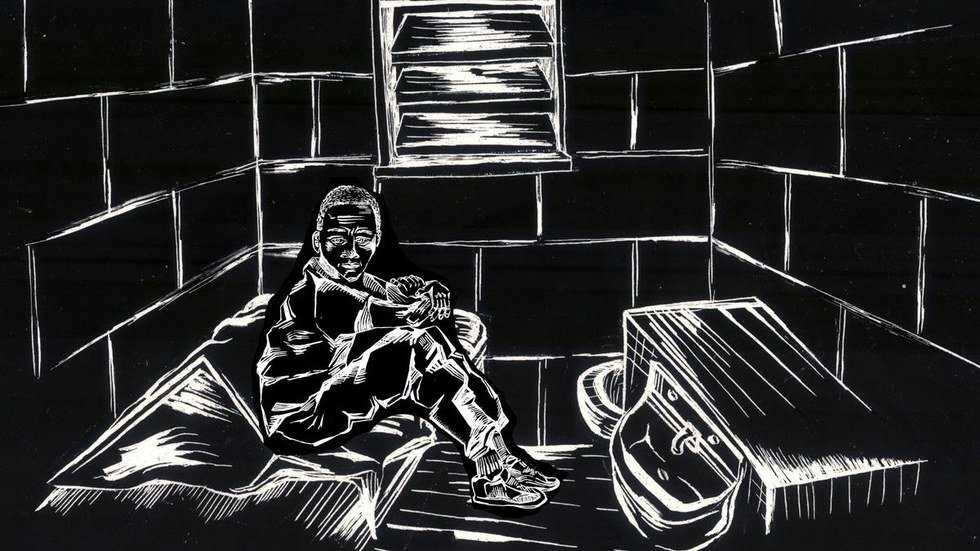
SC is implemented on prisoners for many reasons. In some cases, it prevents an inmate from hurting others or being hurt by others. However, SC is so easily misused, and some are put away for petty deeds such as stealing unimportant items, or quelling activism or protests. Besides, if prison administrations were really dedicated to protecting an inmate, they could find a way to do so without locking them away by themselves in a dark cell about the size of a parking spot. At its core, SC is a tool of isolation that is too dangerous to the human psyche to be used freely as a form of punishment or protection.
Okay, so maybe SC is "inhumane", but how does it qualify as an act of torture?
During a documented general assembly, the United Nations (UN) upholds its definition of torture in Article 1 as “...which severe pain or suffering, whether physical or mental, is intentionally inflicted on a person” with intentions such as forcing a suspect to comply or confess, punishing one for a crime, or general fear-mongering. The UN also makes the following statement in Article 11:
Each State Party shall keep under systematic review interrogation rules, instructions, methods and practices as well as arrangements for the custody and treatment of persons subjected to any form of arrest, detention or imprisonment in any territory under its jurisdiction, with a view to preventing any cases of torture.
Both Article 1 and Article 11 of the UN’s general assembly outline that torture is the unnecessary infliction of pain upon an individual for the listed purposes, and that the government should always work to ensure that torture has no place within the federal imprisonment system. It has already been established that SC severely inflicts both mental and physical pain, so it is clear that the government should seek to abolish all implementation of SC.
But don't these unspeakably violent criminals deserve it?
One opinion held on the matter seems to speak to a sense of revenge upon those that commit undesirable acts. In relations to the case of a convicted triple-murderer that spent twenty-five years in SC, Supreme Court Justice Clarence Thomas insinuated that since the murderer had committed terrible crimes, then a terrible amount of time in SC was fair retribution. This notion is incorrect. If someone commits a heinous crime, the prison sentence decided for him or her by his or her judge is the proper punishment, as defined by the court of law. If an inmate is punished more brutally than another inmate with SC due to their reputation as a murderer or rapist, then the punishers are violating the Double Jeopardy Clause of the Fifth Amendment to the United States Constitution. Double jeopardy prevents one from being prosecuted for an offense more than once if they have already been convicted for it, or if they have been cleared for it. As an exception, it should be stated here that one could be re-prosecuted for an offense if new evidence arises after the trial. To summarize: a bad person cannot be given SC as revenge for a bad crime they did, because the bad person has already been sentenced for that offense. Thomas’ reasoning is wrong because according to the Constitution that his position in the Supreme Court should uphold, one cannot just layer punishment on top of punishment in prison for an offense that has already been settled in court. To be clear, no one here is saying that violent criminals are excused and should be treated to 5-star meals and forgiven by all. I'm only fighting to say that the consideration of the validity of SC should stay within the timeframe of the inmate’s prison sentence behavior, and not his or her actions beyond it.
So no, no one deserves to be locked up alone. If prisoners need to be separated or punished for bad behavior, prison authorities can do so without depriving the inmate of all human contact altogether. SC is a damaging, inhumane practice that makes those that implement it look sadistic and predatory. If America wants to embrace the core values of compassion and benevolence, it can no longer allow its prisoners to live as forsaken prey.