There are 28 sports in this year’s Olympics and one of them is shooting. Shooting, for men, was a part of the first modern Olympic Games (Athens 1896) and there were only five shooting events at that time. In the 1984 Olympics (Los Angeles) women’s shooting events were added and today there are 15 total shooting events that are divided into three different groups: rifle, pistol, and shotgun. Each has its own set of difficulties and the rules for each vary according to the distance between the firing line and the target, the type of target, the shooting position, number of shots, and the time allotted to shoot.
I know this seems overwhelming, so I’m going to focus on just one of the fifteen events: 10 meter Men’s Air Rifle. It would take multiple articles to cover all of them and this is the event that I know best, as my boyfriend is one of the two competing in it: Lucas Kozeniesky, USA.
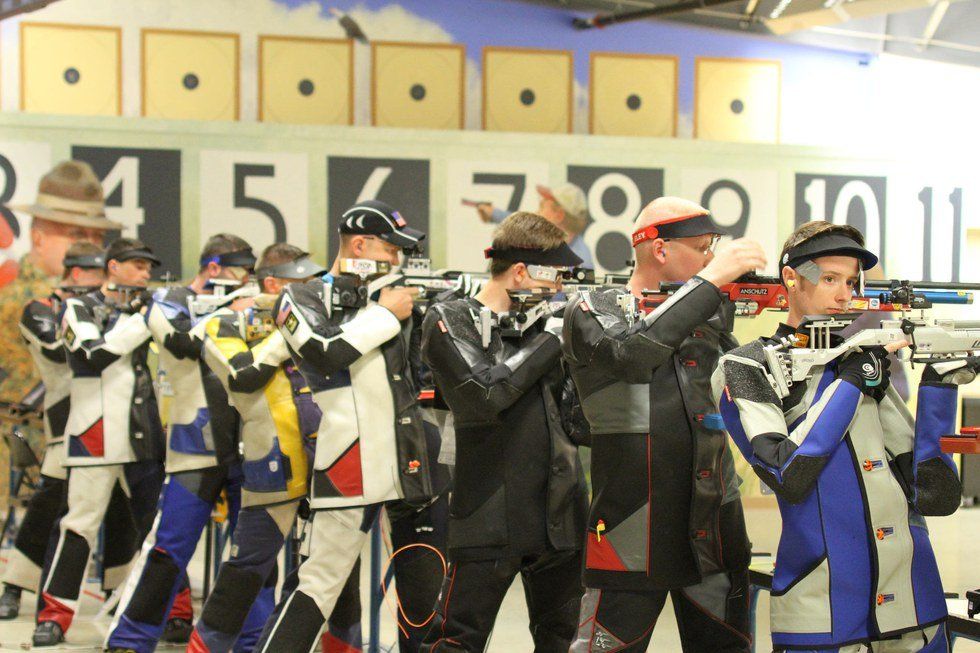
Shooting, a demanding test accuracy. It requires intellectual and psychological skills as well as balance, both mental and physical and an understanding of the technical aspects. Marksmen need to be as steady as possible to be accurate. In order to achieve this, they use relaxation techniques to drop their heartbeat, fire between heartbeats, and wear custom suits designed specifically for the sport. The suits help with the balance and the sweaters underneath help muffle their heartbeat. Their guns are designed to get the tightest grouping possible.
Ten rings make up the target with the center being worth the most points (10), and the other rings decreasing in value the further they are from the center. Each ring is divided into ten zones ranging from 1.0 to 10.9 (a perfect shot). The marksmen shoot strings of ten shots and a good string totals 105.0. All of the targets are set to the same height meaning that the marksmen have to adjust their stance to hit it. Each target is set to the same height meaning that the marksmen must adjust their stance to hit it. When looking at the target the red dot is the most current shot while all of the green dots are the previous shots.
In the Olympic match, you really don’t know who will medal because success is measured by a millimeter. One millimeter can be the difference between whether or not a marksman goes to finals. During the match, marksmen have 75 minutes to fire 60 competition shots. After the match, the top eight compete in finals where their scores are reduced to zero, allowing each marksmen an equal opportunity to medal.
They have eight minutes to sight in (shots that are sighters are indicated by the yellow upper right corner) and prep. Introductions then take place and following the range officer’s command, load, wait, start, and the final begins. They fire three shots within 150 seconds (record shots) after which they ceasefire and repeat once more upon instruction. Up next are the elimination shots where upon instruction and within 50 seconds each marksman takes a shot, waits for instruction and repeats. After every two shots, the marksman with the lowest score is eliminated. This process continues until there are two left and the highest score wins the event.
Selections for this year’s U.S. Olympic team took into account match and finals performance. There were three parts to selecting the team: Winter Airgun (WAG), having a minimum qualifying score (MQS) from a World Cup in the last four years, and a qualifying match in Camp Perry, Ohio.
Part 1 was the Winter Airgun, which takes place at the Olympic Training Center in Colorado Springs. In May, there was a redemption match for those that had an MQS but didn’t perform well or participate in WAG. From WAG, those who were in the top ten for men and top ten for women without an MQS were sent to compete in the last opportunity for Americans to gain one, a World Cup in Bangkok.
Part 2 was the qualifying match in Camp Perry, Ohio. The participants were the top ten from WAG along with anyone who shot above the tenth place WAG score at the May redemption match. There were three days of competition, at the end of which the top two men had punched their tickets to Rio.
The best part about this sport, in my opinion, is that everyone can do it.Everyone can practice and compete regardless of age, gender, physical ability (there are Paralympic teams), or any other defining factor. You’re not restricted by range time either because as long as you have 10 meters and technology, such as a SCATT, you can practice anywhere. To watch Men’s 10m air rifle on August 8, or any of the other Olympic shooting competitions, tune here for the live stream!