When I was 11 years old and in fifth grade (in 2006), I begged my father to buy me a Playstation 2 after hearing all about its greatness from the cool kids in my class. He eventually gave me one as a gift and I quickly found my niche among farming simulators and role playing games.
My First Video Game
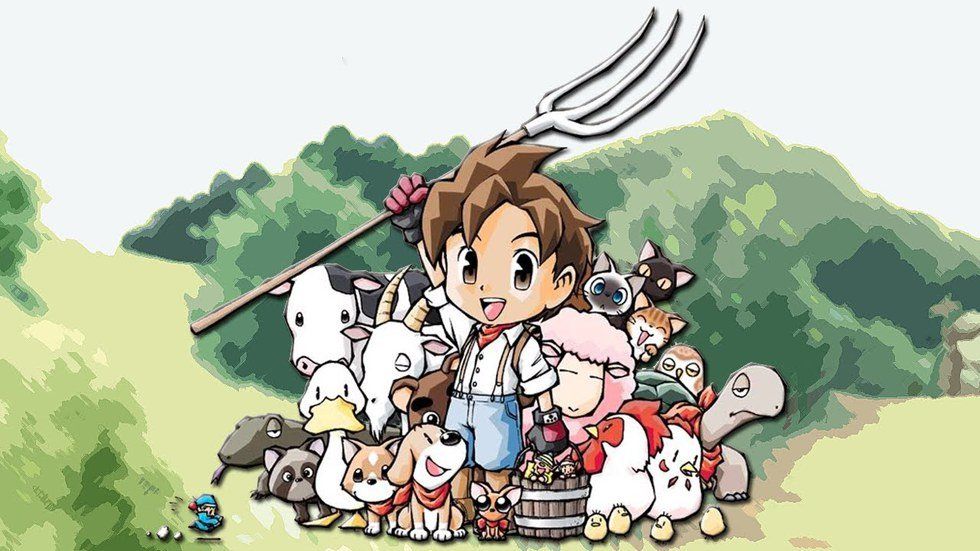
The first game I ever played was called Harvest Moon: A Wonderful Life (titled Bokujo Monogatari: Wandafuru Raifu in Japan), created by Victor Interactive Software and published by Natsume. I remember playing as a bachelor (who I named Takiza) who had inherited a farm from his late father and was mentored by an old man named Takakura. As the story progressed, Takiza had to take care of various crops which grow in different seasons (this includes fruit-bearing trees) and breed animals (including some ducks, a horse, and several sheep). What I loved best, however, is that Takiza could get married. I toyed around with four eligible bachelorettes: Muffy the flower-adoring barmaid lady, Celia the greenhouse worker with overprotective siblings, Nami the witty red-haired nomad living in a cheap motel or Lumina the pianist who comes from a noble family.
Through this game, I learned the importance of community and maintaining a close-knit society where everyone looks out for one another and helps each other out. I also gained a sense of pride and confidence as I made my own choices and decisions about whom to marry or what career should I encourage my daughter or son to pursue. Above all else, I really like the focus on money and resources management: I needed to understand how to spend my income on wise investments, such as buying livestock or selling adult poultries and storing seeds. Every day was an economic analysis on whether to purchase fertilizers or to order an upgraded watering can. For a kid, this game is an intensive but fun. Like a business course wrapped in layers of trials and errors.
The Importance Of Community Involvement And Cooperation
Several years later, I “graduated” into another installment of the game series: Harvest Moon 3: Save The Homeland. When it was released, I promptly asked my parents for some pocket allowance to go get the disk and updated memory cards. This time, the goal of the game was to prevent a whole village from being turned into an amusement park. To do so, the player had to build healthy relationships with the other villagers as each one had aid to give and a potential solution to offer. To date, I have discovered five options on how to approach the problem:
1. I can befriend a doctor who was also a musician and ask him to play his flute to attract a rare blue bird to a nearby beach, resulting in the village being declared a conservation area.
2. Similarly, I can befriend a carpenter girl who will find an endangered weasel.
3. Alternatively, I can befriend a baker who will give me the recipe for a delicious golden milk cake (and thus making the village famous for winning a baking contest in the city and prompting the town mayor to persuade the developer into giving up the gentrification plan).
4. I can befriend a servant whose mistress will give me a silky robe to make an expensive dress from (and hence making the village famous and convince the developer to think that the village should be preserved for its cultural heritage).
5. My favorite ending scene, however, was the one in which my friendship with a florist turned into a hunt for a supposedly-extinct azure butterfly (which led to a photo contest that turned the village into a wildlife sanctuary).
Though many of these solutions are obviously quite convenient and fantastical, the help of the other villagers is required all along the way and the game taught me the importance of recognizing the unique perspectives, ideas and contributions of all members of a community when it comes to solving our collective issues together.
Being Financially Responsible And Independent
Recently, I tried a Thailand game called Country Life. The graphics and the story are much simpler, but it is a free iPhone app and easily available to anyone through Facebook as well. In this game, I played as a man named Derek, whose girlfriend Tida leaves for a university in Bangkok, leading to a long distance relationship. During the four years apart, Derek has to repay his debt to a tax collector who happened to be a big factory and co-operative owner. There are daily, even monthly and annual, targets of how much dairy to produce to raise Derek’s fame. If Derek fails to achieve or surpass his goals, he could lose his property. The game introduced the concept of direct loan from a bank (but no tax amnesty, alas!). This is how I learned about interests and the importance of paying what I borrow punctually. The longer I wait to complete a transaction and return the money borrowed means the more extra coins I am charged later. To avoid being late or having heavy financial burdens, Derek can take on side jobs at night when the farm can be left alone. I would have him go to the river to catch premium fish, pick mushrooms and shoots and sell limestones to the warehouse. This game functions as a lesson on financial responsibility: if I want to be successful, I have to think hard about what I spend my money on and always plan ahead.
Always Allow Yourself To Grow
Some might say video games are a waste of time with no value or wisdom to impart—I disagree. I feel that playing games such as these in my childhood has helped me to better understand mature financial and community considerations and could even influence me towards becoming the owner and manager of my own business or a self-employed individual. I have become a more financially savvy individual as a result of experiencing the challenges and tribulations of expanding my own capital in the virtual world, while also learning the importance of community interaction and solidarity.
I’ve heard that Harvest Moon is going to release a new game on Nintendo 3DS and Wii, featuring a trio of teenagers, in the summer of 2017. Once I get my hands on it, you can bet that I will soon be exploring new aspects of how to conduct a firm and how to be an independent, yet humble and community-focused, happy human.