


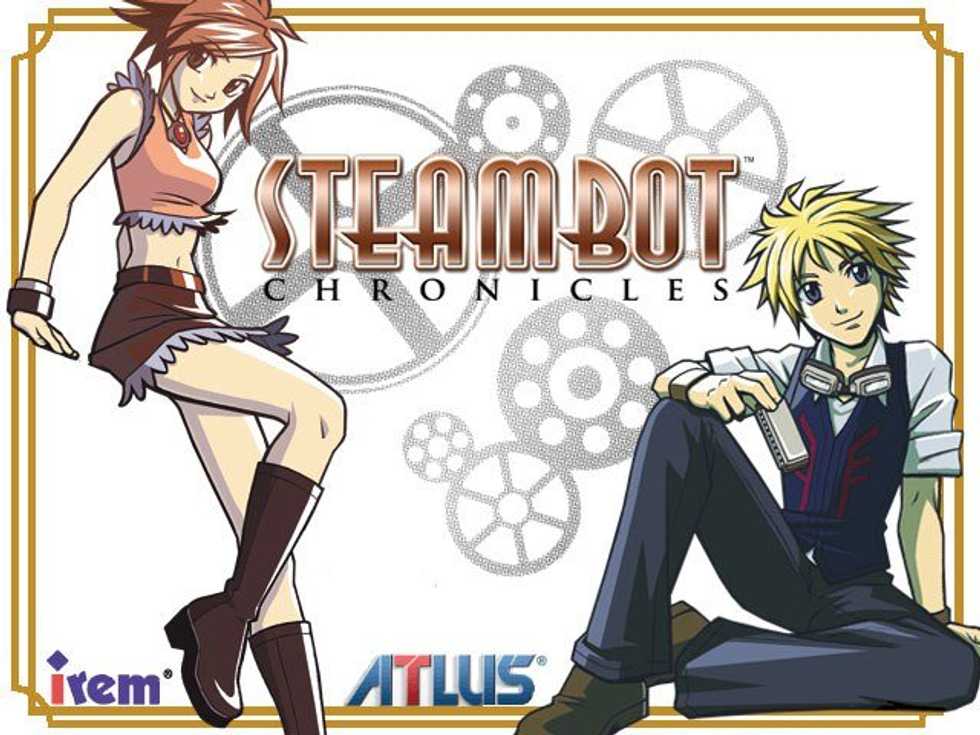
In my first article I said video games rarely have a big impact on our lives. Not only was I wrong in some cases, but I am a living contradiction to that statement. Today we are going to just talk about a little known game called Steambot Chronicles, or Trotbot, everywhere else in the world. I was a 9th grader, I think, when I first found this masterpiece. I had long hair and no clue what I wanted to do with my life, besides play this new game I just picked up for $5. Little did I know it would have a larger impact on my life than most people I have met. This game was the reason I originally applied as an engineering student. It was also part of the reason I switched to economics. You must be wondering what is so amazing about this little game, and I am about to explain.
To begin, the story-line is about a musician who gets involved with some plot to attack the capital. And if you only pay attention to the story-line you miss out on everything. Also there are robots you can control. The robot mechanic is nice; they aren’t super fast, there is a good degree of customization, and you have to worry about fuel. What really shines, however, are the back attachments, because these really take the robots from a fighting machine and turn them into something entirely different. Beyond that, it is not the story-line but the systems within the game that make it shine. You have to eat in the game. You don’t die if you fail to eat, but you are hungry and grumpy and walk around limping. So eat. You can rent an apartment, get a haircut, go on a date, and buy new clothes. You can fight in tournaments and ride trains. All of this costs money. How do you get money? This is where the game turns into something extraordinary, and at no point was what I am about to describe advertised. I saw a game about robots and some girl who can sing and play the guitar at the same time. I was not told it would be an amazing economic model.
In Steambot Chronicles, I have lived in a pent house in the capital. I have lived in a shack meant for resting sailors in-between trips. I have lived across the street from my girlfriend’s mother. I have been evicted. I have played concerts for crowds of people, I have played my harmonica on the street corner to make ends meet. I have played the organ at a church for donations, which I then took to gamble on a game of pool (turns out I’m not a hustler because I lost all the money). I have collected movie reels and sold them to a local movie theater. I helped expand the railroad and, along with it, new settlements. I have sold farm-fresh milk in the city. I have traded wood with carpenters and honey with bakers. I was a double sword wielding robot who fought off bandits as I taxied people from town to town. I even equipped my Steambot with waterproof parts and a harpoon to kill sharks and sell them to the same high end restaurant I used to sell wine to. Once I helped a man in his acquisition of the two largest hotels in the capital.
That was a lot to take in, so let’s see what it all means. First off, I mentioned the back attachments; those are the casks that allow you to carry wine or milk, or the flat beds that allow you to transport bulk wood or dead sharks. It’s a nice way to make money. Now as for the monetary aspect, I talked about being poor and there was something I observed in the game that mirrored what we hear in the real world about the state of our economy as it relates to available nourishment. I hit my poorest point when I spent all my money on entry fees to fight in the arena. They were costly and if I was fighting all day I never had any time to make money. Hustling at pool was just too risky and playing music on the street corner didn’t really bring in enough revenue. Because of this I began to sell my belongings. However I still had to eat, and this is where I began to draw comparison between our world and the world of Steambot Chronicles. Whether or not what you consumed was healthy was never taken into question. However, you still have many choices. As for what you eat, that is an issue of utility, the topic of my last post. For me I would like to imagine my in-game character enjoyed fresh sandwiches or imported fruit. But the cost of some cheese was 10 times that of one doughnut. So I began to eat only cheap food that was, as we know from our own world, unhealthy; doughnuts and sweets as opposed to protein and greens. This was the first glimpse I had at how thoughtfully the game was designed. I was being faced with the same choices that many Americans face on a daily basis.
You may have noticed some of the ways I mentioned for making money. Helping with an acquisition, building a train station to extend the railroad, selling bulk milk, and even selling film reels. All of those transactions had one common theme; I owned stocks in the companies involved. It’s okay if you just spit coffee all over your screen out of shock, unless you broke your device. In that case it is not okay. Yes, I said stocks. In the metropolitan capital of this game world there is a stock exchange, and stocks are traded every day, and they change value based on the performance of the company. I bought cheap stocks in the farm, then when I started exporting their milk, the value went up. The movie theater didn’t have any films to show before I came along, so stocks were dirt cheap. In addition to buying and selling stocks, the game works on a daily cycle so each day you are charged rent and you are issued dividends. I know in real life these things don’t work the same, but given the fact that the game can be beaten in 15 cycles of day and night it is acceptable. The point however, is that this game boasts a robust economic system where your decisions have actual measurable impacts on the economy.
I have one last story to show the true genius of this system. I mentioned an acquisition of two companies. I failed to mention that it was delayed 17 days by me. You see, the owners of each hotel give you the entirety of their stock in each of their companies. You are then supposed to deliver that stock to one man who would assume control of both hotels. Knowing there was some good money in these stocks I slept straight through 17 days and collected the roughly 500 UR (in game currency) of revenue every day. There was a lot I could have done with this; re-purchased all of my jewelry and clothes I had to sell, not eat doughnuts for every meal, buy my girlfriend a new dress or lipstick. But I had a much better plan. On my way to finally deliver the stocks I happened to stop by the exchange. There, I cashed in everything. I had to purchase as many of the publicly traded stocks as I possibly could; this way once the hotels were under new ownership and therefore management, I would be able to prosper from their increased prosperity. Then I delivered the stocks, and as expected, the hotels began to perform better than before and so did their stock.
Steambot Chronicles is a magnificent game and one that will stay with me for the rest of my life. The real beauty of it is how it can mirror our own world. I was faced with real struggles and I became attached to my character because of it. Combine that with an economic system where your actions have actual measurable effects, and the result is one of the best life simulators I have ever played, and one that gives players the opportunity to experiment with a responsive economy. Too bad we don’t have Steambots in real life.

















