There isn’t a Grey’s Anatomy episode about it. There’s isn’t an ER episode either. In fact, the only ‘medical’ TV show to cover any form of Histiocytosis would be House.
And I know what you’re thinking: Histio-what?
September is Histiocytosis Awareness month. And chances are you have no idea what I'm yammering about. Histiocytosis is a collection of disorders where one’s body contains a significant increase in immune cells called ‘histiocytes’. The cells attack the body instead of helping it to fight off disease and infection, causing more harm than good. There are three groups of histiocytic disorders based off of the cells involved. According to hisito.org, “The first group is called a dendritic cell disorder, and the most common disease in this group is Langerhans cell histiocytosis (LCH). Also included in this group are more rare diseases, juvenile xanthogranuloma (JXG) and Erdheim-Chester Disease (ECD). The second group is called a macrophage cell disorder, and includes primarily hemophagocytic lymphohistiocytosis (HLH) and Rosai-Dorfman Disease (RD). The third group is called malignant histiocytosis and includes certain kinds of leukemia and malignant tumors.”
This disease is classified as ‘rare’, meaning 1 in 200,000 people have it. With the statistics seeming to be out of the ballpark, the 1 in 200,000 somehow made its way to my brother.
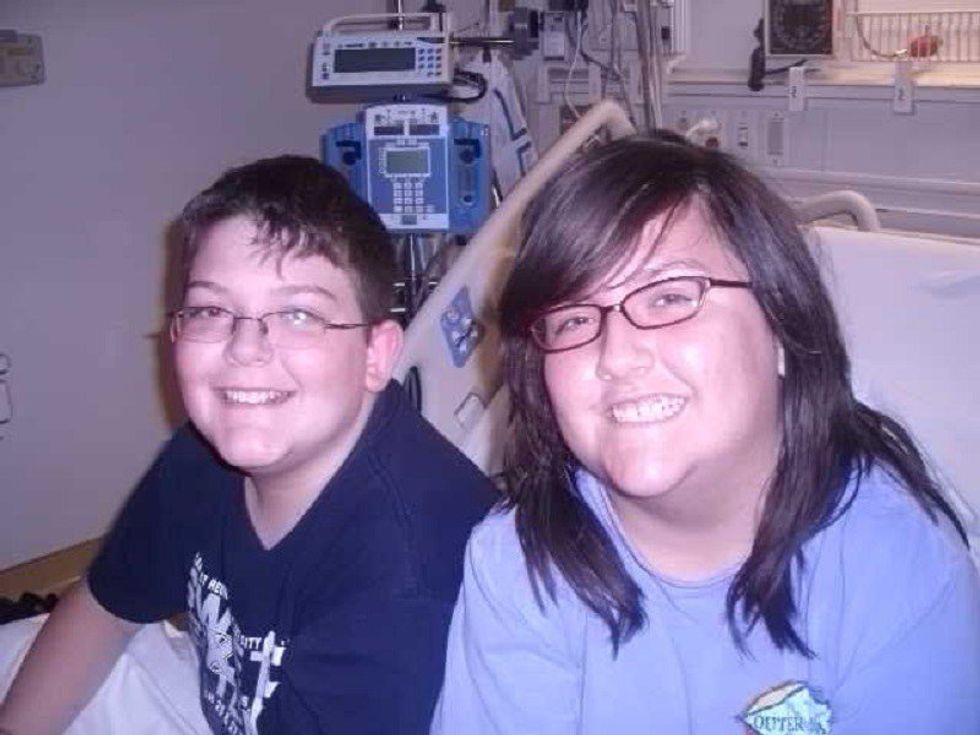
My brother and I are close and as much as I hate to say it, I think this disease made us closer. There’s no doubt in my mind that if he didn’t have this, we’d still be as close as we are today. I don’t remember the day in full detail, in fact that course of events seems like one huge blur. What I do remember is my brother being a typical 9 year old boy. I remember him playing outside and enjoying baseball, basketball and football. I remember him having the really strange skill in memorizing ESPN statistics and players, which he still does today. Almost like he studied these things avidly and would be quizzed the next day on what he knew. Then I remember my mom making doctors’ appointments for him after he complained of having pain that both of my parents assumed were ‘growing pains’ at first. But it made sense. At the age of 9, the kid loved to eat and was always active. He was getting growth spurt after growth spurt so it was the only logical reason.
Suddenly, these doctor appointments turned into tests and moved from a doctor’s office to the local children’s hospital. All I remember was this being a bad sign. That once the appointments reached small buildings, small numbers of people, small and standard procedures to a giant building on what’s known as “Pill Hill”, specialist after specialist, and scan after scan, things were bad. So at the age of 9, my brother’s routine into the rite of passage known as “boyhood” came to a screeching halt. I remember my mom waiting for phone calls about test results and “the next step” and having consultations at the hospital. There was such an urgency and a rush that seemed to drag on at the time but now just falls under the blur. Everything seemed to take a 180 whether my brother liked it or not. His course of treatments included surgeries, scans, chemotherapies, steroids, biopsies, you name it. His pain was being treated with a course of action that only seemed worse, at least in my eyes, than the disease itself. There was talk of losing hair, nausea, PICC lines, home health nurses, mediports, hospital stays, short term and long term effects, lab work, PET scans, CAT scans, MRIs, lesions and so much more. One small doctor’s appointment turned into what seemed like thousands later. It opened up a can of more hospital stays than one human being could want. It gave my brother scars and pain, late night visits to the emergency room, 70+ absences in one school year, a round face and extra weight that he hated, an ILP plan for school, truancy notices, additional medical conditions tacked onto histiocytosis and more. Watching what my brother went through made me proud to be his sister and I admired him so much more as I sat on what felt like the outside window looking in, heartbroken that there wasn’t one thing I could do to help. I couldn’t take any pain from him, I couldn’t give blood for labs for him, I couldn’t go under anesthesia and take the scars for him, I couldn’t sit and take a round of chemotherapy for him when he was tired. All I could do was sit back and watch. Listen to what the doctors say, taking in information. Try not to get in the way if I could. The disease became a world of its own almost – one that my brother wanted nothing to do with and one I only wanted to be a part of so that I could help. It became a world for my family and it affected my mom and brother directly and me indirectly. While my experience was a mere thunderstorm, my brother’s was a marathon of natural disasters over the years. LCH became bigger than any school bully and any bad grade for me. I learned how to watch after my brother in certain circumstances like being in the rain with a PICC line or getting him off the bus and to a school nurse when his port flipped. I learned how to find sleep in hospital chairs at 3:15 in the morning. I learned the names of his doctors and specialists. I learned about mediports, PICC lines and central lines and the prohibited activities behind each one. I learned about my brother’s chemotherapies. I set out to take college chemistry classes head on in hopes to set out for a cure, even when I failed. It taught me how to love hospital food and hospital gift shops. Most of all, it taught me how to love my brother more. While I couldn’t take any of the pain or sickness away, as much as I really wish to this day that I could have, it made me set aside any bickering and “sibling rivalries” that I could. That’s not to say we never fought. We’ve argued and bickered with each other but it taught me things like playing Madden NFL in his hospital room even when I didn't care for the game or football. It taught me to let him watch the news when I found it depressing because that was his connection to the outside world. I would buy him gift after gift from the mall or the gift shop and make him things and wait for his arrival back home.
The point is: I could write a book on histiocytosis and the effects it has had on my brother. I could tell you about how my brother’s case went to Baylor University or how my brother met Michael Jordan and I saw it with my own two eyes. I could write about the ups and downs and how there are more downs than anything or every lesson the disease has taught me. My hope is that anyone reading this article sets out to get a better understanding of the disease. Nobody says you have to go and find the cure and change your career path. But being the rare condition that it is, families that are affected by it need as much awareness as they can get in order to even start thinking about a cure. The road to a cure is paved with research and it can’t happen without the first step which is awareness.
For more information on histiocytic disorders, please visit www.histio.org. Thank you.