
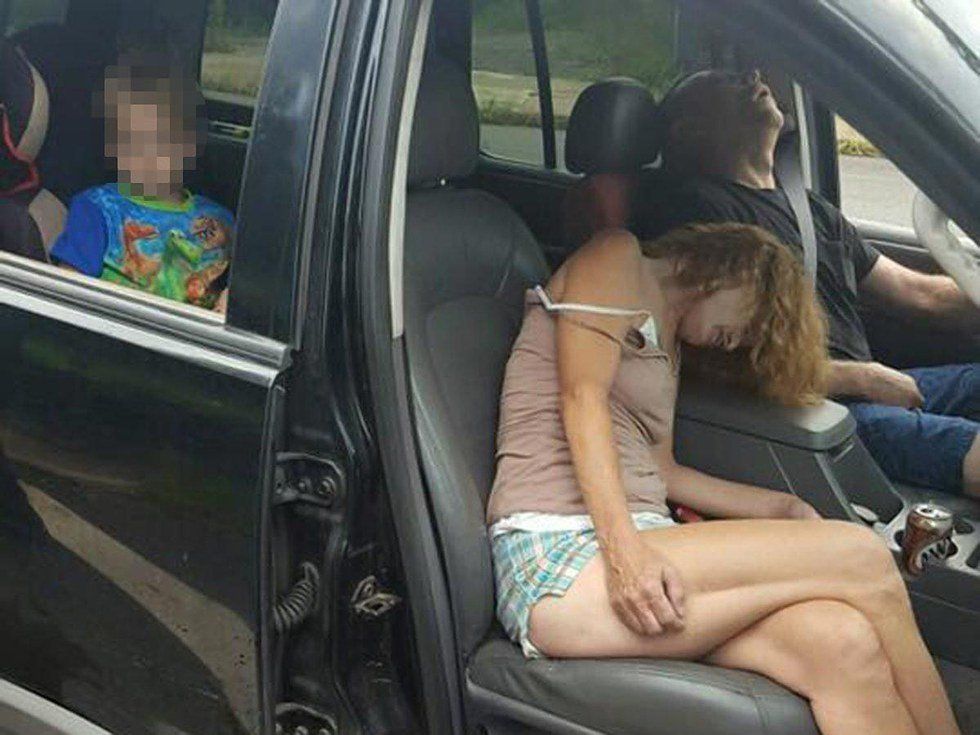
Early Friday morning, East Liverpool Police Department in Ohio released photos showing Rhonda Pasek, 50, and James Acord, 47, unconscious during a traffic stop. The couple was unconscious due to a heroin overdose. In the photos, Pasek's 4 year-old son can be seen in the back seat of the vehicle. Officer Kevin Thompson, who was the officer on duty who had found the individuals, called an ambulance. He noted in his report that the EMS team had "administered several rounds of a drug known as Narcan which is commonly used to reverse an opiate overdose". Pasek and Acord were charged with a number of offenses, including child endangerment and public intoxication.
This isn't exactly a new development. Incidents like this have been happening in the United States for quite some time- in fact, heroin was first synthesized in 1874 for medicinal purposes, and was outlawed in 1914. However, in 2013, the US started to see a demographic shift and increase in overdose rates. It's become a serious problem that affects everyone in one way or another. In the past decade, opioid painkillers have been over-prescribed, and can act as a gateway to its much more addictive, and much deadlier big brother, heroin. If someone gets hooked on painkillers, but doesn't have the money to buy more, heroin is a cheaper alternative because they are both opioids.
The most important lesson this news teaches us, is that the heroin epidemic is real. And it not only affects the addict- it affects the family. We can see this quite explicitly in these photos. Unfortunately, it's news like this that really motivates a movement for change.
There has been a lot of progress: awareness and information, hotlines and help centers, different types and styles of recovery, and Narcan classes have been making their way around the country. The most important tool we can use as a society to combat this epidemic is to avoid stigma.
It can be very easy to judge and chastise an addict, because our culture and society condemns that kind of behavior. In reality, we have to understand, that these drugs chemically rewire the brain into wanting and needing more. Psychologically, getting past and addiction requires a lot of social support, as opposed to an addict trying quit using heroin by themselves. In turn, this requires us as a society to be more empathetic and jump on board with the awareness.
If you or anyone you know is struggling with drug abuse and need help, please contact the SAMHSA helpline:
800-662-4357