
“What’s a referendum?!” asked Chair of the Board of Trustees William Helman IV ‘80 of six Dartmouth undergraduate students. Besides this seemingly naive question, it was clear that this meeting was going absolutely nowhere.
On September 15th, 2016 several members of the Divest Dartmouth campaign held an on-the-record, historic meeting with three members of the Dartmouth College Board of Trustees: Chair, William Helman IV ‘80, Chair of the Investment Committee, Richard Kimball ‘78, and President Phil Hanlon ’77.
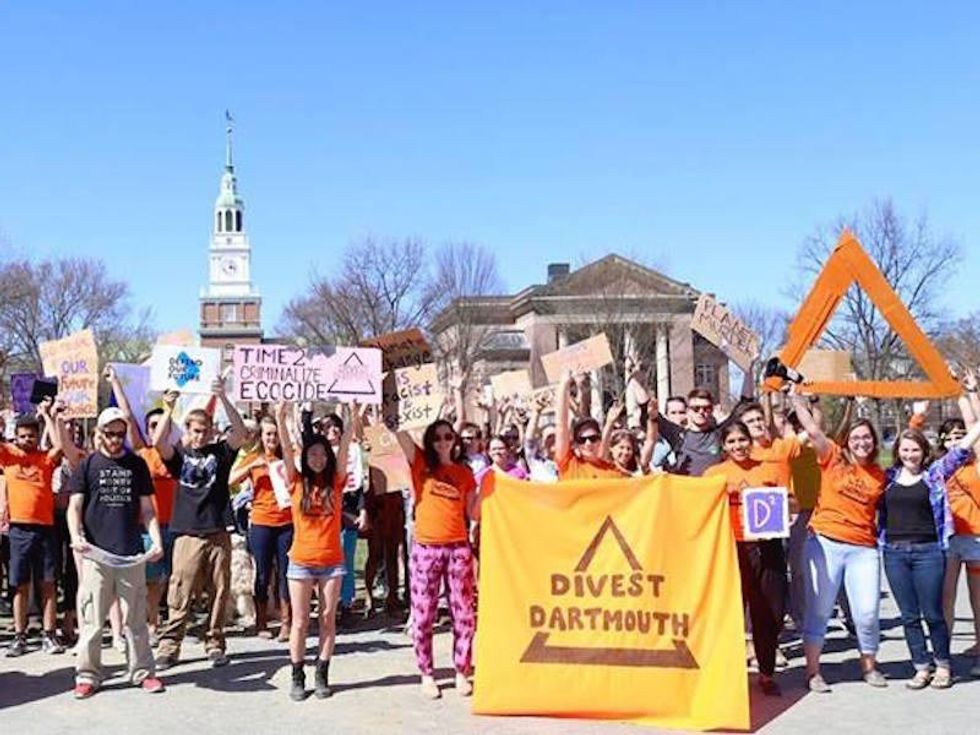
After years of campus organizing and movement building, the Divest Dartmouth campaign has gained statewide and national attention as one of the leading student environmental groups in the Ivy League and throughout New Hampshire. Our campaign is calling upon Dartmouth College to divest its direct holdings from the top 200 companies with the largest fossil fuel reserves. Nearly five years ago, a handful of Dartmouth students started the campaign with the hopes of the college recognizing both the importance and necessity of such an action and for nearly five years, Dartmouth has done everything in its power to stall any sort of movement towards divesting from these corrupt and idle industries.
Here is what we have accomplished: Over 2,500 individuals have signed our campaign’s petition calling upon Dartmouth to divest. The Dartmouth Alumni for Climate Action (DACA) presented a similar petition to the college this month; the petition spans 57 class years and has over 500 signatures. This past spring, Divest Dartmouth organized The Big Green Rally: Climate’s Changing, Dartmouth’s Not. This event was the largest climate rally in the history of the State of New Hampshire in addition to the most co-sponsored event in the history of the college. Nearly 500 students, faculty, staff, community members, politicians, environmentalists, authors, etc. stood in solidarity with Divest Dartmouth. In a July survey conducted by the college’s newspaper, The Dartmouth, Divest Dartmouth was one of only two campus issues that was viewed favorably by students. A few months earlier, in April, former professor at Dartmouth’s Thayer School of Engineering Mark Borsuk developed an unbiased, scientific report utilizing a decision analytic approach that considers the four main objectives (ethical responsibility, financial impacts, academic opportunities, and symbolic importance) of fossil fuel divestment at Dartmouth: it became overwhelmingly clear that no matter how one weighs the importance of one objective over another, complete divestment is the most advantageous option every single time.
It is clear that our campaign has established itself as one that will not fade after graduations or lose strength because of universities’ stereotypical lack of institutional memory.
On September 15th, we were prepared, thorough, thoughtful, and engaging. We clearly articulated the strength of our campaign and why we think divestment is no longer out of the question.
“We have had many off-the-record interactions with President Hanlon over the past four years in which we have reached to no decision or statement regarding divestment”, said Catherine Rocchi ’19, a representative of Divest Dartmouth at the meeting. “We asked to have this meeting so that we can hold the administration accountable to the imperative of climate change action”.
The trustees began the meeting by reading an official statement which declared that Dartmouth’s primary approach to climate change is through “scholarship and teaching”, and that the endowment is not a tool for “progressing social and political goals; no matter how worthy.” They brought up several additional reservations they had against divestment during the course of the meeting, the most important being that divestment may not have an impact at all on climate change.
To which I followed with: “We know that Exxon isn’t going to go bankrupt if we divest tomorrow. That’s not our goal. Our goal is to make a statement. Because investing is voting with the dollar... Investment is a statement about the future.” Additionally, Anisha Ariff ‘19 quoted a statement from Board several decades prior to now declaring the divestment from South African apartheid: “investment policies should reflect the broad societal goals that the institution stands for [and not just primary investment goals]”. At this point, we could see no logical reason for why these three were so adamant about not committing to divesting from the top 200 dirtiest fossil fuel companies and formally declaring that we will never seek nor accept investments of the like in the future.
In light of our successes and having given everything to the board that they have asked of us over the last half of a decade, we asked Trustee Helman, Trustee Kimball, and President Hanlon to commit to making a decision on fossil fuel divestment by March of 2017—i.e. we asked them to hold a referendum in March of 2017 and then later explained what a referendum was to said Trustees.
As we figured, the trustees did not commit to a formal timeline regarding a decision on divestment even after members of Divest Dartmouth repeatedly explained the urgency of our ask.
Here is where things get interesting: 24 hours after our meeting, Dartmouth announced the creation of a new institute, the Arthur L. Irving Institute for Energy and Society, mainly funded by a substantial donation made by the Irving family—the second largest single donation in the history of the college.
Leaving that sterile room in the Hanover Inn that September morning, I could not help but feel like we were missing something. We spent 45 minutes circling clear arguments and answering self-explanatory questions. I never thought that we were going to leave the meeting with a formal decision, but it was unimaginable to me that we would leave with nothing: no next meeting, no timeline, and seemingly nowhere to go.
When I heard about the Irving Institute that next morning my heart sank. Conflicted, confused, angry and upset, I knew that divesting—making a bold anti-fossil fuel statement—would likely threaten the validity of the future Irving Institute.
Dartmouth alumna, United Nations Framework Convention on Climate Change’s COP 22 Delegation Leader at SustainUS, and climate movement champion, Morgan Curtis ’14, sheds some light on the announcement:
“We are talking about one of Canada’s wealthiest men, who presides over a refinery that produces the highest cancer rates in the country, is pushing through the Energy East mega tar-sands pipeline, has never commissioned a community health study, fires workers (1 in 10 New Brunswickers) who are related to or connected with activists, and owns every newspaper in the province to ensure media stays favorable. Their forestry products corporation owns most of the land in the state, mass-sprays glyphosate over remote communities and clearcuts with abandon. New Brunswick is a difficult place to live with the Irving family at the helm--failing school systems, 56% functional illiteracy, no freedom of press or speech.
No matter the supposed independence of the scholarship that will happen at this institute, the idea that Dartmouth will lend its social license through partnership with this corporation is, for me, utterly unacceptable.”
Divest Dartmouth is stronger than ever. We will not rest until our school realigns itself with its values. While I cannot say that Dartmouth refuses to divest because of its alums that can put a whole lot of zeroes on a whole lots of checks, I can say that it certainly feels that way to me.