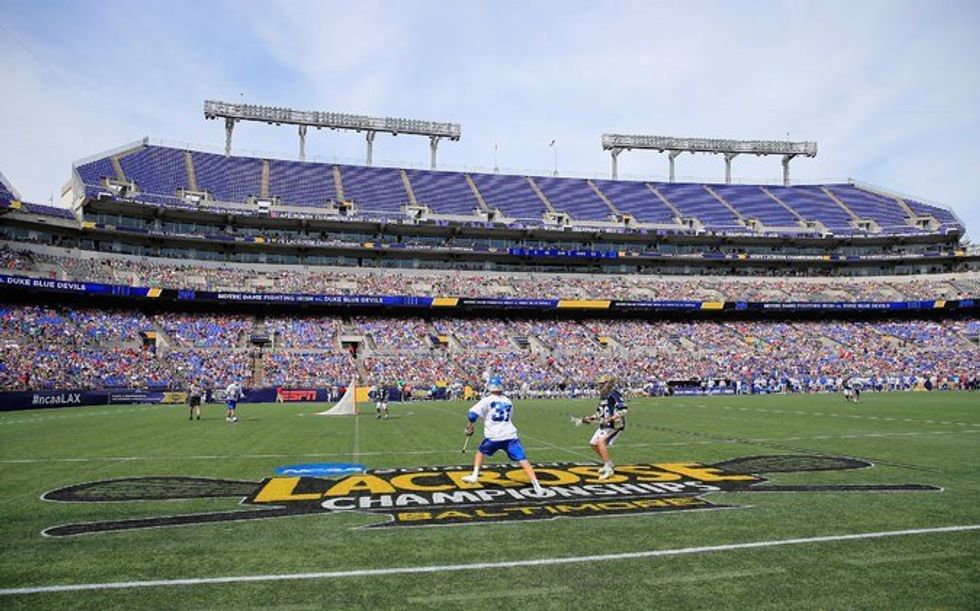
Lacrosse is arguably the fastest game on two feet, but there is no debate that it is the fastest growing sport in the country. According to the NCAA, growth in men’s and women’s lacrosse across all NCAA divisions surpassed all other sports by large margins. Between 2000 and 2014, men’s college participation in the sport rose 95 percent, and women’s 109 percent, garnering 392 new collegiate teams. Looking at all the new programs, it’s easy to see that lacrosse is the fastest growing sport in America. However, the NCAA Final Four attendance paints a different picture.
The 2007 NCAA Final Four in lacrosse hotbed, Baltimore, brought in a record of 100,447 spectators, the first time the semi-final showcase rose above the 100,000 mark. So far, the 2007 showcase of Paul Rabil and the Blue Jays, has been the peak of Final Four attendance. Since, the NCAA Final Four has seen a steady decline to a mere 53,338 attendees in the 2015 Final Four in Philadelphia. In an interview with The New York Times, Terence Fory, Editor-in-Chief of Inside Lacrosse said, “The trend is disappointing - Because, for so long, attendance at the Final Four was seen as such a symbol of growth and progress, as well as validation.”
Although the trend is disappointing, it won’t be long lasting. So far, a total of 57 teams have announced new men’s and women’s lacrosse programs that are slated to hit the circuit either this season or the following two. These new programs are coming from a more diverse set of colleges too. This season, Hampton will become the first HBCU to sponsor men’s lacrosse since 1981. This is great for the game of lacrosse as it adds more diversity to a sport that is overwhelmingly white.
Even with the birth of new programs, it’s still hard to grasp the dramatic decline in attendance to the Final Four. There are several reasons to explain and combat the decline. Changing the long-held tradition of holding the tournament on Memorial Day Weekend might be something to consider. Before, this weekend made sense as the long weekend allowed fans to travel and watch the games. Now, lacrosse is televised more and more. In addition to covering the complete 2016 Tournament, ESPN will broadcast about 100 D1 men’s and women’s games. Television viewership has remained considerably stable through the years which is a good indicator that people are still interested and engaged with the sport. It’s significant to note while the attendance started to drop, prices were on the rise. There is also a correlation to the economic crisis that occurred around the same time attendance slipped. The Duke scandal in 2006 and the death of Yeardley Love in 2010 both put lacrosse in the limelight for all the wrong reasons. The absence of a shot clock in past years could be to blame as well. The list goes on.
However, lacrosse is a sport comfortable with change. It’s an evolving sport ready to bounce back from the downward attendance trend. It’s still on the rise and is poised to be one of America’s (and the world’s) next greatest sports.