

Growing up, I never really believed in God, or a higher power. I was aware of the notion of God, but I didn't necessarily "have faith."
When I was in the later years of elementary school, I started going to Hebrew school. My family isn't really religious, but back then, when all four of my grandparents were alive, it was important to them that my brother and I learn about Judaism, and celebrate all of the holidays, and eventually go through the right of passage of being declared a man or woman by Jewish law by having a Bar/Bat Mitzvah.
I was never keen on the idea of going to Hebrew school—mainly because I didn't want to go to regular school, and then have to go to another type of school just a few hours later. I tried every trick in the book to get out of going—faking sick, refusing to move, telling my parents "if [they] truly loved me, [they] wouldn't be sending me into yet another educational hell-hole" (yeah, I was a pretty twisted kid).
Eventually, I learned that there were different degrees of faith and belief when one of my family friends decided she wasn't going to have a Bat Mitzvah, because she didn't believe in God or religion. As soon as I learned about this, I was completely on board as yet another tactic to get out of going to Hebrew school. I would yell and complain that I shouldn't have to go because I don't believe in God and I don't want to be religious. Unfortunately, my parents said until I had valid reasons and supporting evidence towards my claims, I would have to continue going to Hebrew school.
Even though my claims started out as a tactic to get out of attending Hebrew school, I soon decided that I truly didn't believe in God—and I made that decision when my life took a huge turn at only 9 years old.
When I was nine, my life was taken away from me, and from then on I had to take on a new life—a life full of pain, stress, and uncertainty. At 9 years old, I couldn't comprehend why God would give me a rare and unknown medical condition that completely turned my world upside down. As far as I was concerned, I had learned that God only did "bad" things to people who deserved them, and I couldn't really pinpoint all of the horrible things I had done in my 9 years of life that made me deserving of a progressive life-threatening medical condition.
As my condition progressed, so did my "faith" in science, and my disbelief in God. I had completely denounced God (not that I had formally accepted God at any point), and decided that God isn't real, but science is, and it is science that is going to give me answers, and give me a potential treatment or cure at some point.
While I was going through everything, people of faith would tell me that "God has a plan for you," "God did this for a reason," and "you see this as a bad thing, but maybe your condition is actually a gift from God." Well, not to sound bratty or materialistic, but usually when I receive a gift, I have the option of returning it.
When the time came for me to be Bat Mitzvahed, I wasn't, because I was too sick and didn't have the time or energy to go to Hebrew school. Even though I wasn't going to be Bat Mitzvahed because of my medical condition, I was actually really happy because it meant I wouldn't have to do something that had no meaning to my life, and would completely go against my beliefs at that point. Over the years, I've learned a lot more about religion and science, and it's only caused me to further question all that I have learned about God.
Not only did I question why, if there's a God, they would give me a life-threatening medical condition, but also why there are so many injustices in the world. People who are devoutly religious pray to God to get them through and out of a bad time, and yet I can't help but question if they love God so much, and believe that God loves them so much, then why did God do something so horrible to them, and why will praying to God take away what has been done to them "for a reason?" I know many people would argue that God did it to teach them a lesson, or to spread some kind of message—but if that's the case, then it did the complete opposite for me, because it forced me to not believe in God. As happy and content as I am with my life, the honest truth is I've lost more than I've gained since I began having health problems—and while people view me as an "inspiration" (which I resent because I'm not doing anything inspiring with my life, I'm just living it), and view me as proof that anything is possible, I can't help but feel that I'd rather not be viewed as those things, and just be an average person, because it would mean that I wouldn't have had my childhood taken away from me, and I wouldn't be facing so much uncertainty in my day-to-day life.
My personal situation isn't exclusive in my reasons for not believing in God. The fact that there is so much poverty and war in many parts of the world serves as proof to me that there isn't a God (cliché, I know). What did children in a third world country do to deserve starvation and terrible living conditions? I can see how people would reason that God would punish adults, because everyone has committed some type of sin at some point in their life, no matter how religious or faithful they are (if you really analyzed and dissected the Bible, you'd see that there are so many restrictions that you basically can't do anything except sit in one place and hold your breath if you don't want to commit a sin), but what have children, arguably the purest source of innocence (besides animals), done to deserve horrible lives? I understand that it's called faith because you're maintaining hope and positivity in an unknown source without any concrete proof. But personally, saying "God does everything for a reason," isn't good enough for me. I need facts, I need evidence and supporting information, I need visible proof—and so far only science has been able to deliver that to me.
Another thing that has caused me to not believe in God is the Westboro Baptist Church's visit to my town when I was in middle school. Seeing those people protest different communities, populations, and lifestyles was extremely disturbing—and they were doing it all in the name of God. Being present for something like that, I feel, would make anyone question how God could possibly be real, and how someone could believe in something that creates so much hate and discrimination. Having those people use God as a scare tactic, and as justification for hate and discrimination only fueled my disbelief even more. I can't believe in something that gives people the power to say it's wrong to be a certain way because God says so—when really, it is people pushing their own personal agenda, and labeling it as God's, which somehow makes what they do and say OK in some people's eyes.
Besides all of the injustices in the world, there are multiple biblical stories that really make me question how there could possibly be a God. For example, doesn't it seem just a little f*cked up that God would ask someone who loves them to further prove their love and devotion for them by killing someone?
A lot of people view Beyoncé as a God. However, if you met Beyoncé, and she said to you that she understands how much you love her and are devoted to her, but if you really want to prove your love and devotion to her, you have to kill someone as proof—would you do it? No! Of course not! Because someone asking you to indirectly murder someone for them is not OK. Also, say you did go through with killing someone to prove to Beyoncé just how much you are devoted to her. If you got caught, and you were facing life in prison, and you plead not guilty because Beyoncé told you to kill someone and it's really her fault, then Beyoncé could easily say she has no idea what you're talking about.
You shouldn't have to prove your love for someone by going to drastic measures (murder)—your word and trust, and in the case of God, faith, should be proof enough of your devotion! If you were in a relationship with someone that put stipulations on the trust and love between the two of you, you'd most likely exit that relationship, because it isn't healthy.
Finally, there's the Devil. The way the Devil came to be, and biblical stories involving the Devil serve as proof, to me, that the thought of God just doesn't seem logical. For those of you who don't know, God created the devil. So this holy being who is only seen as a source of good, is actually guilty for creating evil (i.e. -- Donald Trump). If you were to analyze God and Satan side by side, then Satan can logically be viewed as less evil than God (call me a Satanist if you want, I'm cool with that).
Satan, also known as Lucifer, is a fallen angel, cast out of heaven. God is constantly asking to be loved and needs proof of your love, and Lucifer happened to be God's number one fan and loved God more than anyone or anything in the world. However, Lucifer loved God too much, which forced God to say "woah, woah, woah, dude—you're too intense, I gotta send you to this sh*tty place where you'll have to torture bad souls." So let me get this straight: God wants love, but if you love God too much, then you'll be sent to Hell? Seems a little whiny and dramatic to me, but OK, let's act like that's completely normal and logical.
To further demonstrate that Lucifer may in fact be the "nicer" guy between him and God, here's a little (paraphrased and summarized) story: Lucifer makes a bet with God that he can get some random dude to lose faith in God by taking all of his "blessings." God laughs at Lucifer and says "OK, go for it." Lucifer proceeds to tell God all of the horrible things he's going to do to this man in order to get him to lose faith, and God is just like "lol, k." Lucifer does a bunch of horrible things to this man, the final thing being the death of his entire family. The man never loses faith in God because "God did all of those things for a reason," and Lucifer loses the bet. Doesn't it say somewhere that God loves all his children? If this is the case, then why did God let Lucifer massively f*ck up someone's life beyond belief, just to prove how loving and faithful his "children" are? Why couldn't God have just as much faith in his/her/its "children," as his/her/its "children" do in him/her/it, instead of making a bet on someone's life? In that story, Lucifer actually looks like the better guy, because he only did horrible things to the man because God told him to. Pretty crazy to think about, right?
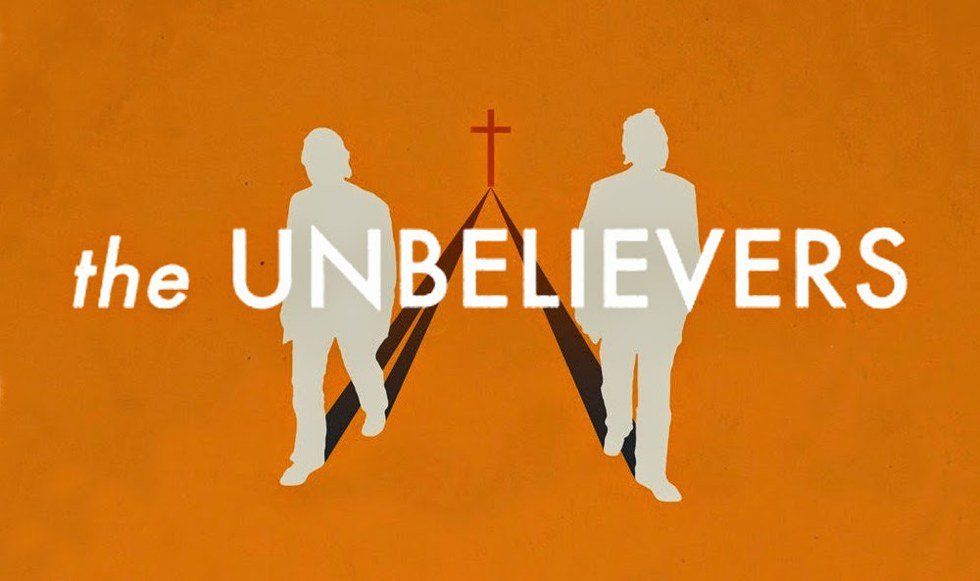
No matter how you identify, I highly recommend watching the documentary, "The Unbelievers," in which scientists Richard Dawkins and Lawrence Krauss travel the world and use scientific logic and reasoning to argue against the existence of God, and show why atheists are atheists. Dawkins has many great pieces of work that are very educational and informational, and I think it's something everyone should watch to get both sides of the story.
Here's one of the great points Dawkins has raised: when we are told that people are hearing voices, and voices are telling them to do things, we immediately think they are crazy. But when someone claims that God is speaking to them, and God is telling them to do things, we view them as religious and faithful—and Dawkins raises the point, amongst many other great points, that the only difference is we've been taught that it's acceptable to "hear voices" as long as you label them as "God." How many times can God be used as a scapegoat to justify irrational actions before it actually causes detrimental harm in some way, shape, or form? There are numerous cases in which it already has.
There are endless reasons as to why I'm an atheist, and even if the existence of God was proven, my views wouldn't change (which technically makes me an apatheist). Even so, I still respect all faiths, religion, and beliefs, as I hope my personal beliefs would also be respected. I'm not telling people to stop having faith or to stop believing in God, but stating why I personally can't live my life that way, and giving reasons as to why religion and faith personally don't make sense to me when it comes to how I live my life, and why I will always choose science over faith and religion.
Nonetheless, I do firmly believe everyone's beliefs should be respected, and that's the most important thing of all in the grand-scheme of faith and beliefs. No one religion is better than another, no one God is better than another, and no one belief system is better than another. Believe in whatever you want, and have faith in whatever you want—as long as you're happy and not harming anyone along the way, then that's all that matters.