


When "Neighbors" came out with their sequel, I was not surprised it was sorority-based. As it started, I genuinely laughed. I enjoy a good parody and "Neighbors" was spot-on in their opening: the entire recruitment video featuring flower crowns and blowing glitter, the overarching Alpha Phi reference, and the tongue-in-cheek way the president and recruitment Chair commented that sororities weren’t allowed to throw parties in their houses, only fraternities could do that -- it all seemed to be building to a smart commentary on the college and Greek system.
It went downhill from there.
Chloë Grace Moretz is playing a woman who decides the typical Panhellenic rules aren’t for her, so she’s going to create a sorority that doesn’t have to follow them -- basically meaning they can party in their own house.
The trailer is two minutes and 32 seconds. Sorority women appear in one minute and 31 seconds of it; OK, that’s a bit over half the trailer. That ratio makes sense, as the movie is half about the sorority and half about Seth Rogan and Rose Bryne's characters living next door.
The scenes of the sorority women in which they are not heavily drinking, doing drugs, or in sexually explicit outfits is 20 seconds. 15 of those seconds are the introduction scene, where it’s the other sorority -- Phi Lambda -- on Bid Day.
Look, I know this is just the trailer, and I know it’s a fictional movie. But for a parody to work there has to be an actual representation somewhere in the culture. Where is that? Sororities get "House Bunny," "Scream Queens," a lot of B-horror movies, and now this. Our best representation is "Legally Blonde: The Musical," which definitely had satirical moments and was hilarious while still not trashing sororities. The small references on other television shows aren’t much better; Rachel from "Friends" was a Kappa Kappa Delta and really only mentions that they “really are bitches” and that once she got drunk at a luau party and made out with one of her sorority sisters.
I’m not asking for a show where sorority women only excel academically and lead completely healthy and balanced lives, but I’m asking for something better than this.
Culture affects us. You tend to become what you see day in and day out. In the original "Neighbors," the sorority women were typically just sexual background characters, and even the lead sorority woman, Brooke, is quickly convinced to cheat on her boyfriend and have sex with one of his fraternity brothers. There was not much depth beyond the sorority women being hot party animals.
Yes, in the original the fraternity men were also wild. There are also sharp topical moments in "Neighbors." But the punchline at the end of the story is that really only Zac Efron’s character, the fraternity president, has any negative consequences; and it’s that he works as a shirtless greeter at Abercrombie and is attending night class to finish his college degree. His friend and co-president lands a great job at an architecture firm and despite all the nonsense that takes place in the movie (they burn down their first house, hit an elderly man with a barbecue, and haze pledges ruthlessly) the fraternity just buys a new house and moves on. This is typically the punchline when it comes to fraternities in pop culture.
This isn’t a call to have fraternities depicted worse, but the comparison is necessary. What the heck is going on? Can sorority women not be depicted without featuring them in bikinis and having them sprayed with a hose? It can’t just be because of the five writers who created this screenplay about sorority women, not a single one was a woman.
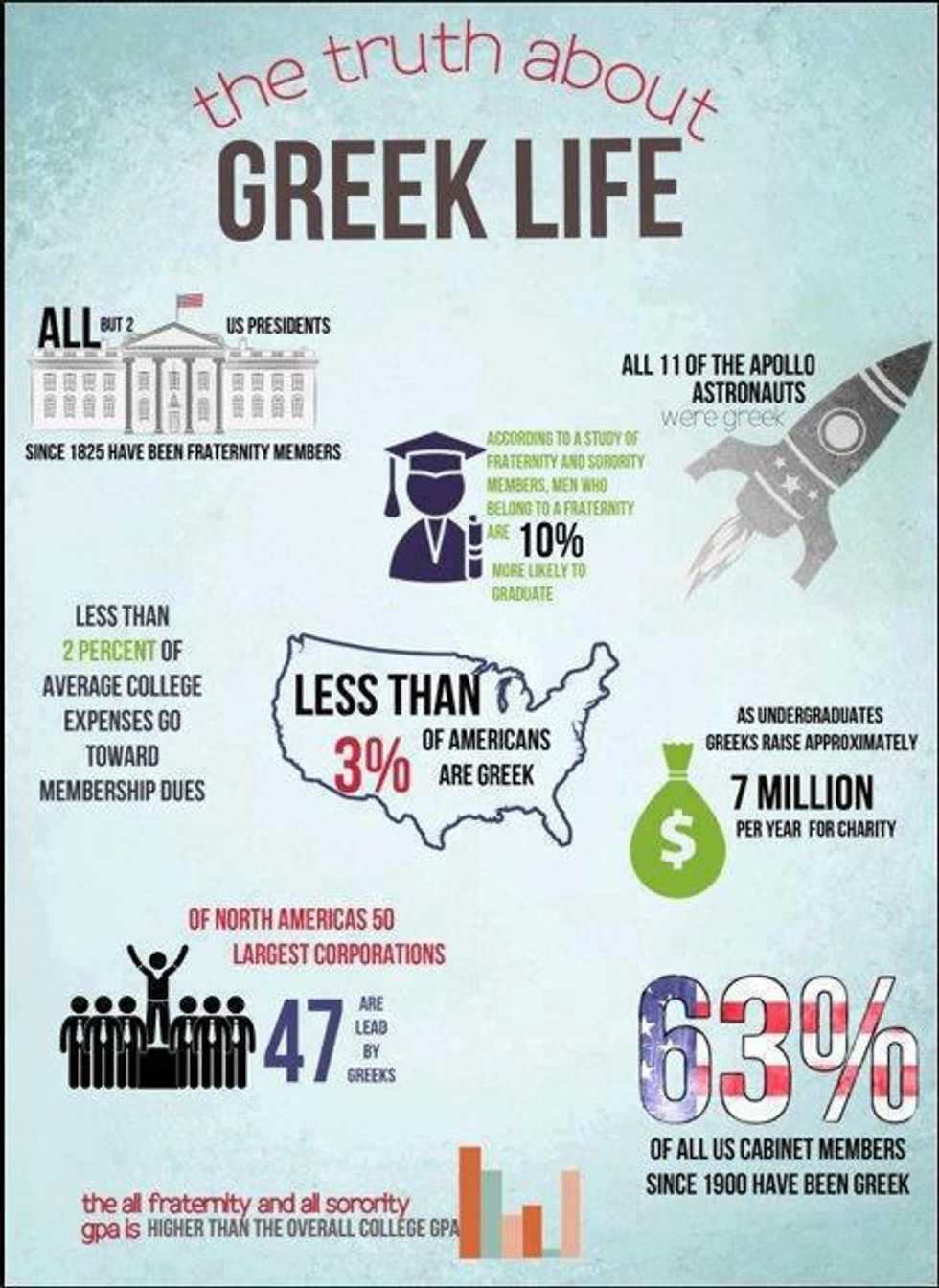
I saw this infographic a lot when I was going through recruitment, and at the time, I found it impressive. Looking back, I’ve noticed a lot of issues with it -- and not just the factual errors.
Three of those statistics (president, Apollo, and the 10 percent) deal solely with fraternity men. The one regarding cabinet members is mostly about men. I don’t know when this infographic was created, but in the Forbes Fortune 500 list today only 23 women are CEOs; four of them are in the top 50, and one woman hails from a sorority. That leaves four statements that relate to sororities along with fraternities. None of them relate solely to sororities.
So why does any of this matter? Glad you asked.
Beyond the keggers and tailgates, fraternities still keep the reputation of being business-world and networking centered. That’s fine. My issue is that sororities sell the same thing, but I don’t think our culture believes that anymore. And the problem is internal.
Who makes the recruitment videos where sorority women are frolicking in jean shorts and fake laughing? We do! Who are those videos for? Isn’t it the women going through recruitment? Why do we want them to know we’re super hot?
What’s the most popular online community and social platform for sorority women? Total Sorority Move. They have written some great, challenging, and powerful articles. But those articles tend to get buried under stereotype-fulfilling pieces, like their top trending right now: “Guys Tell All: Biggest Turn-ons,” “Crazy Girl Jumps Into Random Uber And Destroys Car,” “This Is The Number Of People You Should Tell Your Partner You’ve Slept With,” “Top 10 Frattest Colleges In The Country,” and “The Lazy Girls’ Guide To Getting Skinny.”
Chapters are quick to congratulate a sister when she is crowned a Miss State, but why aren’t we also blowing up social media when a sister is elected senator?
Women are smart. Women attend and graduate college more than men. With college getting more and more expensive and student loans getting higher and higher, tacking on dues has to be worth the expense. Recruitment is hard. A lot of times, recruitment is hard because some women won’t put up with the reputation. This kills me. My chapter president could be the actual President of the United States someday. That is not a joke; she is by-and-large the strongest woman I have ever met. She also laughs, has a social life, and once in a blue moon wears sweatpants, but she is never going to skip around in a bikini for a recruitment video so fraternity men will think our chapter is cool and sexy. When I look around my chapter, I see women who will kick major booty up and down the globe. I turn on the TV and there’s Katie Couric, Tri Delta. I flip open a poli-sci book and there’s Condoleezza Rice, the first African American and second female secretary of state and oh yeah, an Alpha Chi Omega.
Pop culture says we are shallow, appearance-based sex toys obsessed with partying and fraternity men. I know that smart women go Greek. Strong women go Greek. Wild women go Greek. Beautiful women go Greek. It’s possible to be all of these things. It’s also possible to only be one, or two. So why is everyone, including us, usually focusing on the last two? And what are we doing to say anything otherwise?

















