


I recently watched a Presidential debate and a couple of days later, bought a book about a certain well-known director. In my mind, I somehow welled these opposite situations together and found a link between them. The two subjects have occupied two separate compartments of my mind over recent weeks, and the close proximity of these two events happening has formed a sort of open corridor between these compartments. I decided I wanted to explore this corridor.
The Presidential debate was obviously the much hyped verbal bout between Donald Trump, and former Secretary of State, Hillary Clinton that happened on Monday 26th September. The aforementioned book is a large coffee table publication entitled The Wes Anderson Collection. It’s a fantastic book, and highly recommended for any film enthusiasts out there. Even if Anderson’s films are not to your taste - which wouldn’t be unheard of - it’s an in-depth, interesting and informative guide into the imagination, technicality and the overall fascinating procedure of filmmaking.
So, I hear you ask, where does the connection come in between two so very different events that took place in my life? Well, bear with me.
Wes Anderson’s films are self-aware. The critic, Matt Zoller Seitz, who compiled the book, draws attention at numerous points throughout, to the director’s inclination to create his own little worlds within the confines of the story. It is glaringly obvious that his films are films; constructed for our viewing pleasure. The characters live inside a perfectly decorated existence, a world that could not possibly be reality, despite the very real themes running through his films. It is the tragedy and comedy of life, condensed into Anderson’s unique, idiosyncratic vision. Performances are charmingly dull, deadpan personalities prevail, and the plots usually amble along carelessly, with style taking center stage. Not that this is a negative observation. The style is so immaculate, the sets so symmetrically constructed, they complement the inventively odd plots. There’s a polish to it, a sense that we are watching a live performance; that the actors and crew are presenting their stories specifically for us.
Anderson’s style announces that artificiality can create a great film. There’s a substance to the evident presentation. People long for films of the past because, rather than spending millions to best replicate reality by digitally creating it, they reveled in the possibility of physically building it to tell a story. They allowed us to physically notice the work that went into it. This then emotionally distracts us, and makes us aware of the story and it’s themes, and reflect upon their impact on our own personal lives. The German dramatist, Berthold Brecht called it Verfremdungseffekt, or the distancing effect.
So where does this lead me?
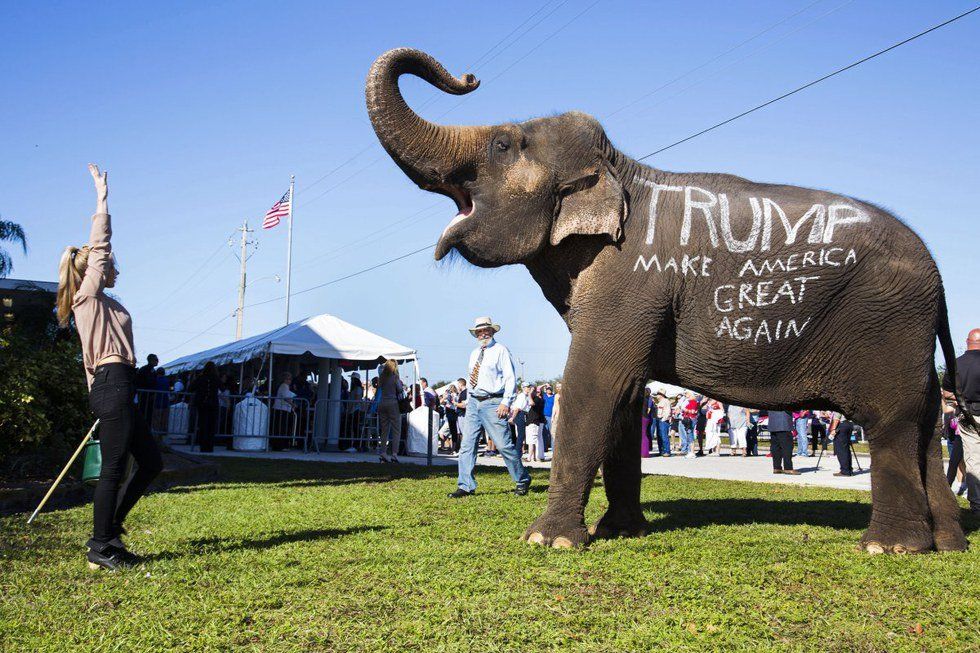
Trump is who he is; that’s word for word what people love about him. They love his honesty. His brusque qualities. His defiance of political correctness. Yet, there’s no restraint; there’s no attempt to hold it together. There’s no sense of preparedness or rehearsal. It’s like there’s no desire to perform well; it’s just an addiction to perform and bask in the attention. He’s like the kid in the school play who got the part because he’s loud. And of course we give him the attention. He holds our gaze because we’ve seen him before. On The Apprentice. I personally love him on that show. His smug persona, sitting on that powerful businessman chair, behind that vast desk, casually bantering with the roster of celebrities his name attracts, sometimes blatantly toying with them for laughs and for our entertainment. That’s where I love to see Trump, that’s where he belongs. Not behind the podium.
There’s a reason the Greeks invented the concept of performance. They needed to find a popular and entertaining way to address important topics and question society - and theatre proved to be the answer. Politics is theatre. It’s the most perverse type of theatre, because it has real and direct consequences on everyone’s lives. But it is theatre nonetheless. In An Unfinished Life, Robert Dallek’s biography of JFK, he pointed out that one of Kennedy’s winning points as President was to create a public image that people found reassuring. His boyish looks, calm demeanor and his courageous restraint instilled a sense of pride and hope in Americans. Despite many personal setbacks and obstacles, his performance as President was superb. Imagine Donald Trump handling the Cuban Missile Crisis.
However, it seems hypocritical to pose this argument against Trump when he is the epitome of public image. The hair, the tan, the suits, the plane, the gigantic letters of his name, sturdily overlooking the Chicago river. But to repeat a point, what you see is what you get. This isn’t a performance. This is a larger-than-life person, who has a lot of money, a lot of influence, and a lot of ego, who happens to find himself at the center of an important and serious decision. And he’s loving the attention. He realizes that just being himself, not worrying about appearing intellectual or presidential, is kind of what some people want right now. President Obama has created a great public image, but people don’t see how that image provided any progress in his eight years. They want something different.
Not that we have great options. This is not an endorsement of Hillary Clinton. The upcoming decision is not going to be an easy one. But just as Anderson’s style calls us to appreciate and admire the practice, and craft, of filmmaking, perhaps we should recognize the same in politics. The American people should think about what kind of President they want. The personality. The experience. Think about the figures of the past who held that office - Washington, Lincoln, Roosevelt, Eisenhower - and the respect and dignity that clings to such a position. Having money should be no credential for this job. Having restraint and having poise should be.
Anderson’s films are self-aware. Trump is not.

















