
Everyone is familiar with October being Breast Cancer Awareness Month. I’m sure plenty of readers have either been to, been detoured around, or have friends and family that have been involved with Pink Outs and any other events that raise awareness and funds for Breast Cancer. I can completely support this. However, I feel like Breast Cancer also is constantly having fundraisers and raising awareness every other time of the year. Again, I can support this because I don’t think you can just stop fighting for a cause because the month ended.
My main issue with this is the fact that a majority of people don’t know of any other month completely dedicated to cancers or know that October is also known as Domestic Violence Awareness Month. There aren’t as many months in a year as there are different types of cancer, let alone any type of disease or illness. Take ALS, for example. I know a majority of the people on my social media accounts only know about ALS because of the Ice Bucket Challenge, and it was basically done for the video and just passing along the challenge. Ultimately, this worked. It got the word out.
But where is the national rally behind any other disease? We can’t only focus on breast cancer or ALS. And I’m not asking for anyone to constantly support every single fundraiser or raise awareness for every illness that is around them. It just isn’t realistic. However, all I’m asking is for you to find something that actually means something to you and fight for it. For me, my fight is to raise awareness of pediatric cancer and it just happens to be September which is Childhood Cancer Awareness Month.
Now, if you know me personally, you would probably know that I have dealt with cancer in my family. And you might also wonder why I didn’t choose to fight for one of those types of cancer, seeing is how it is so close to me. I lost my grandma to pancreatic cancer in 2006. My grandpa had been diagnosed with prostate cancer, beat it, and then lost his battle to leukemia in 2009. My dad had a part of his lower lip removed where they found skin cancer cells, and I constantly worry that the cancer will, or has, come back. My uncle had cancer of the throat along with other complications and passed away a few years ago. There are so many different areas that I could personally focus on, but at the same time I feel like I couldn’t do each of my family members justice by picking just one. So, I didn’t pick any of them to fight for.
Instead, I chose to fight for pediatric cancer, any cancer that inflicts a child. This would mainly focus on those ages birth to 14, but it can also include those from 15 to 19. Any cancer. Pediatric cancer does not focus on one specific kind. It looks at an age range; an age range where they don’t have the ability to legally make a choice on their medical procedures. These are children who have not had the chance to live the same way adults have. They didn’t go to school the same way. In and out of hospitals and treatments is how they can spend their time. And I can’t even imagine what the families go through, trying to make the best decision for their child to give them a chance at the rest of their life.
And what even makes this worse is the fact that if they do beat cancer, they have a higher chance of it coming back of getting a different kind later in their life.
I first started learning about pediatric cancer during my senior year in high school. Since that year, I have made an effort every single year to spread awareness in any way that I can. I know that I’m not an expert, but I do know the loss of a family member and I have personally watched a family in my community lose their son to brain cancer. I remember reading the news on Facebook and crying. I had made him a scarf in his favorite colors and earned money to help the family with his treatment. I had spoken with his parents, worked with his older sister during a pageant, and I had seen him give out community hope. I saw this little boy show his strength and pass it on to all of those that knew him or heard of his story. Every September, I work with Alex’s Lemonade Stand and dedicate my Million Mile Team in memory of this incredible child.
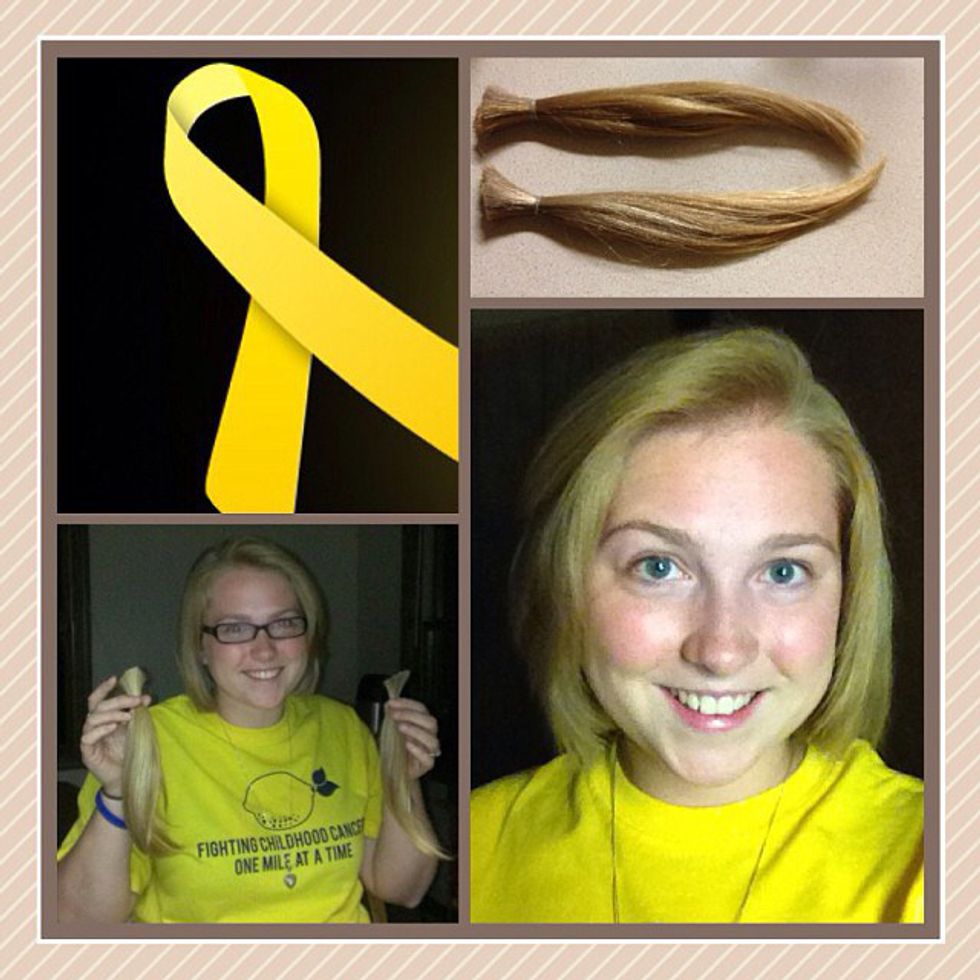
Photo of me after cutting off over 10 inches of my hair to donate
Every September, I go gold in honor of Childhood Cancer Awareness Month. However, if you look at my car keys, I have a gold ribbon on there that goes with me everywhere that I go. I often find myself in discussions with people about pediatric cancer and what I do to raise awareness. I even have a small Facebook page called Knitted Comforts where I make knitted items and a part of the price goes towards the Pediatric Cancer Fund. I encourage everyone to consider checking out my page and/or my Million Mile Team. Anything you do to raise awareness is greatly appreciated.
And I fully encourage you to find the cause that is true to your heart and fight for it. You don’t have to follow a crowd. Trust me—fight for what you have a passion for, and you will find your own crowd that shares your same enthusiasm.
I’m going to end this quick article with some facts from Alex’s Lemonade Stand Foundation on childhood cancer that can put things into perspective. Maybe you haven’t been affected by this in your life, but a lot of people have and these numbers will help portray that.
- Every year an estimated 263,000 new cases of cancer affect children under the age of 20 worldwide. That’s 720 new kids affected every day.
- Every day, approximately 250 kids around the world die from cancer, and 91,250 lose their life to the disease every year.
- Childhood cancer is not just one disease. It is made up of a dozen types and countless subtypes.
- Childhood cancer is the leading cause of death by disease in children under the age of 15 in the U.S.
- Two-thirds of childhood cancer patients will have long lasting chronic conditions from treatment.
- Childhood cancer occurs regularly, randomly, and spares no ethnic group, socioeconomic class, or geographic region. In the U.S., the incidence of cancer among adolescents and young adults is increasing at a greater rate than any other age group, except those over 65 years.
- The causes of most childhood cancers are unknown and are not strongly linked to lifestyle or environmental risk factors, unlike many adult cancers.
- One in 330 children will be diagnosed with cancer by the time they’re 20 years old.
- Less than 5 percent of the Federal Government’s total funding for cancer research is dedicated to childhood cancer each year.
Despite these facts, childhood cancer research is vastly and consistently underfunded.
You can help make a difference here. We often use phrases that say “Our future is in our youth.” Well, their future could very well be in our hands. Put your hands to good use, make the social media account mean a little something more, and always make sure your heart is behind your actions. It is in this way that we can help and save one another as a society.