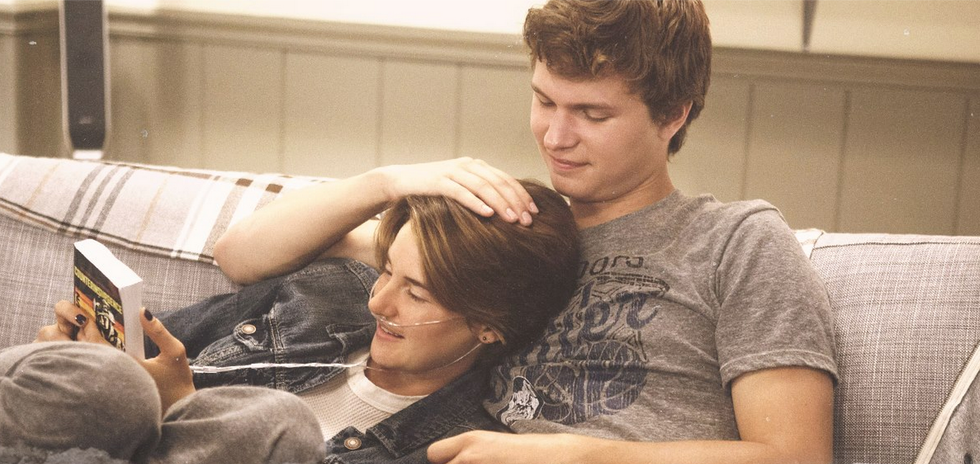
Yes, I read, "The Fault In Our Stars" and saw the film version. Yes, I remain male. Yes, I am expecting you to judge me, right now.
In the interest of transparency and keeping my strong journalistic backbone in tact, I will admit that I did enjoy the book and that I was moved by the story, but slow down – not to tears. And, I'd like to make one thing absolutely clear – Augustus Waters kind of sucks. He is selfish. He showboats. He cares about himself, above all else. The coolest thing about the guy is that he wears a Rik Smits jersey for part of the novel, and that Smits nickname in the NBA was “The Dunkin’ Dutchman,” which is close enough to The Flying Dutchman to seem cool to me.
Waters
makes several grand gestures throughout the novel to display his affection for his
girlfriend, Hazel Lancaster. He starts out hot from the very beginning of their
tangled, star-crossed teen love by relentlessly staring and smiling at Hazel
until she smiles back at him—something I did not realize girls found
irresistibly romantic until I read the book. Waters later makes Hazel read his
favorite book, which also happens to be a textual adaptation of his favorite
video game about defeating a zombie apocalypse. It seems that if there is anything
that lights the romantic candle of teenage female desire, it is definitely PS3
conquests transcribed on paper.
Waters refuses to call his girlfriend
anything other than by her first and middle names, Hazel Grace, despite the fact
that she politely asks him, multiple times, to call her only by her first name. I
also did not realize – until I read the novel – that women love it when you ignore their polite requests and, instead, do whatever you want.
Worst of
all, Waters appears to take a sickening amount of pride in each of these
gestures, like he has just swept Hazel off of her feet and solidified his place
as best boyfriend in the history of the world by doing things that only he has a real interest in. He seems to do everything for the sake of the gesture, not for the sake of her happiness.
I could be an idiot, but that seems a little selfish to me.
It would be
impossible, however, not to appreciate the grandest Waters gesture of them
all—the trip to Amsterdam. Taking his girlfriend to Europe for several weeks, as his dying wish, is actually pretty top-notch romance stuff. I’m sure Billy
Shakespeare would not mind seeing his star-crossed lovers theme played out in
this way.
Obviously, the kids-who-fall-in-love narrative does not
appeal much to me. However, "The Fault In
Our Stars" is terrifically moving in its depiction of the love between
parents and children, and in its commentary on what it is like to die – in
general and, specifically, from cancer. By far, the most moving love story of
the novel exists between Hazel and her parents. The Lancasters relentlessly love
their dying child. The whole world expects that to be the case. Yet, somehow,
it is incredibly moving to see it played out in the novel on a day-by-day basis over time. The ups, downs, triumphs and close encounters
with death as Hazel's parents care for her with a sense of hope and
unconditional love is as powerful as it gets. It is not the growing
bond between child and child, but the omnipresent bond between parent and child
that drives the plot of the novel.
Throughout "The Fault In Our Stars," Hazel repeatedly
unleashes quips about the process and side-effects of dying. It is uncomfortable,
sad and difficult to read. No one wants to think about children dying. Hazel
lives that thought every day. The reason the text is both so difficult to read, and
so valuable, is that Hazel – through all of her romance and exploration of
what it really means to be in love – never loses touch with her reality. She is falling head-over-heels in love while also acknowledging that she
very sick and that will eventually die. The great beauty of the text is not
that the love story exists, it's that the love story unfolds while Hazel and
Augustus are slowly overcome by
the disease that ties them together.
Cancer, explained biologically, is
a rapid and uncontrollable reproduction of cells. The body makes so many cells, so quickly that a sort of overload takes place, and that overload shuts
down the body. It is a crazed whirlwind inside the body. Cancer is chaos. The novel intentionally reflects the way cancer operates. Augustus
swiftly enters Hazel’s world, twists and turns her life around with grand
gestures, creates a powerful and uncontrollable emotional chaos that sweeps
everyone off of their feet and then he dies. Every part of their relationship
happens at hyper-speed, similar to the way cancer cells reproduce. Perhaps, the
greatest value of the Augustus-Hazel narrative is not in its illustration of
the teenage love story, but in its illustration of what it is like to die from
cancer, but live on relentlessly.
"The Fault
In Our Stars" is an extended, drawn-out and wonderful metaphor. You put the
cancer in your love story, but you do not give it the power to kill you.