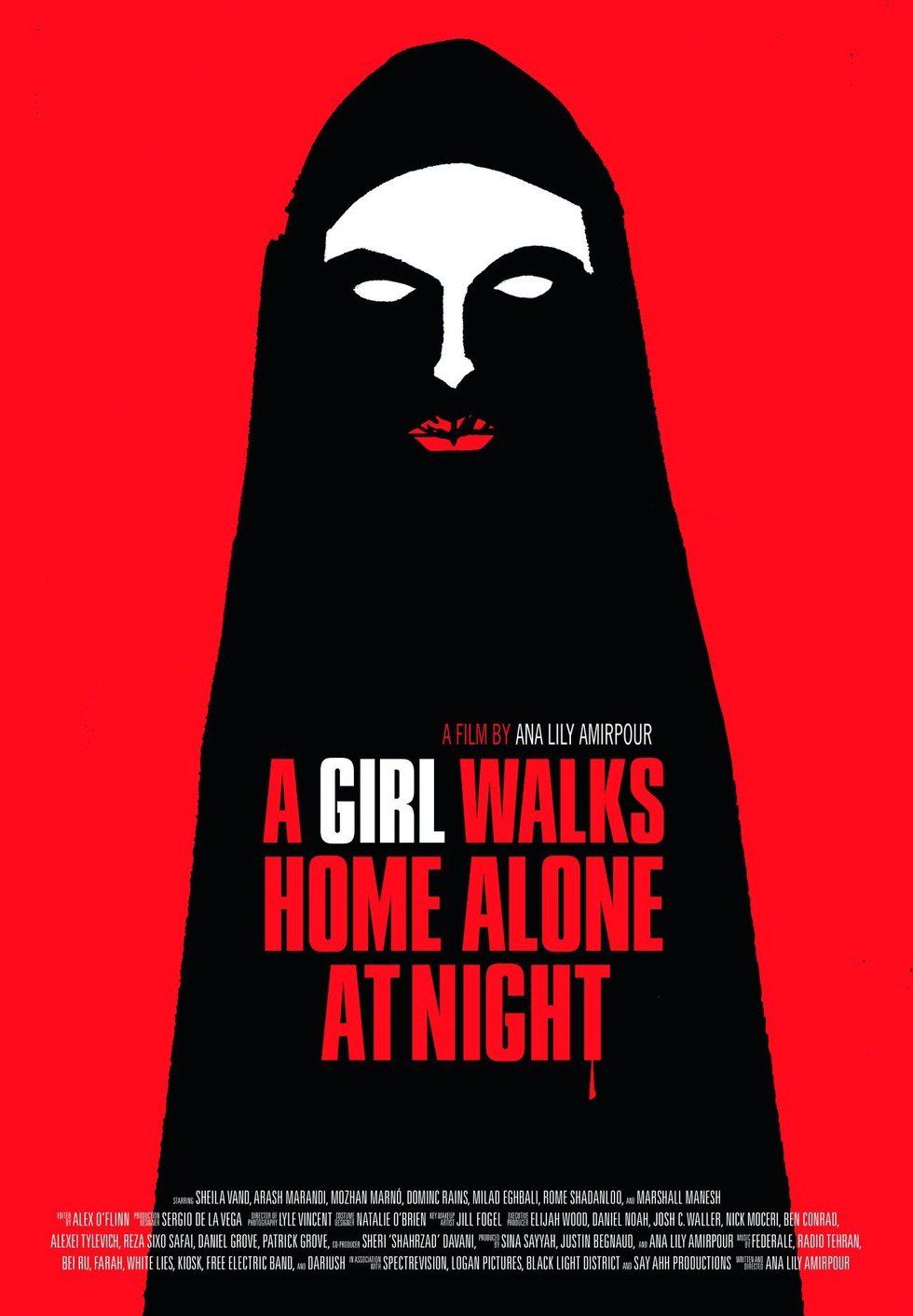
Shot in black-and-white and filmed entirely in Iranian-American director Ana Lily Amirpour’s choice of Farsi, the 2014 horror-thriller-“spaghetti western” A Girl Walks Home Alone at Night doesn’t seem to be a candidate for the most applicable movie for standard late-night Netflix viewing, but there’s something magic to this movie.
This movie is effortlessly cool. Like a feminist Tarantino less enamored with violence and more interested in the tiny little moments of life that make violence so disruptive to living.
There’s no intricate plotting to the story, the film is dead-simple in its conceit. This is Bad City, an Iranian ghost town. There are drugs and sex traffickers and all kinds of hypocritical, faux-religious moralizing. There is also a girl who is a vampire. This vampire hunts down her victims. A man named Arash tries to fight off the vices in his life and find his place in a dying ecosystem. The two meet. From there, it’s a revolving door of little vignettes about the lives each Arash and the vampire live and the ways they come together. There’s exactly as much as substance as there needs to be to chewed on, and enough style to let the world know that for the next 101 minutes we are only guests in the world of Amirpour.
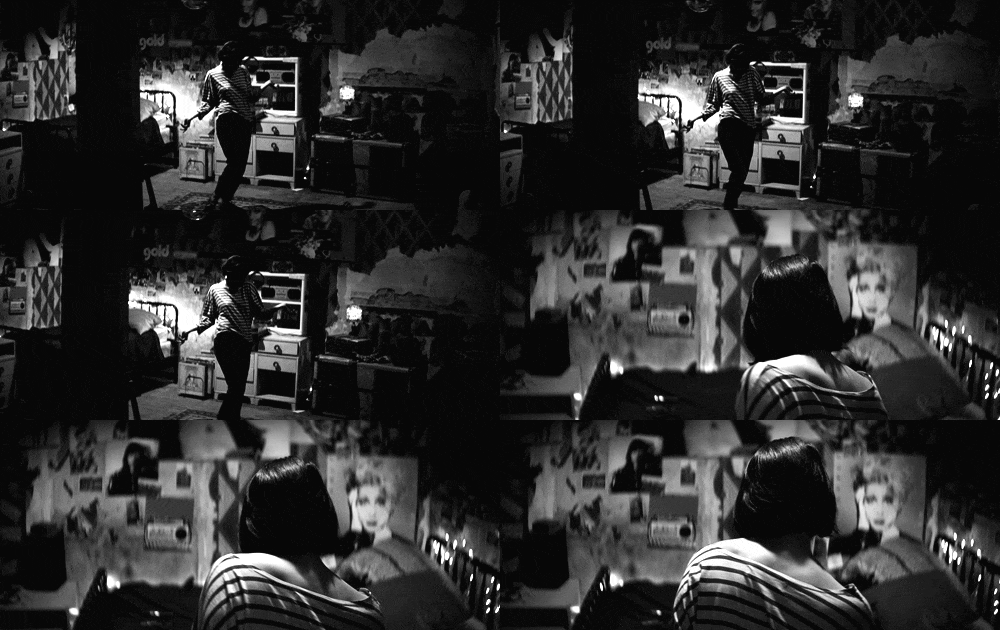
But the vampire, played by Sheila Vand and named only “The Girl” never comes off as entirely menacing, which feels by design. Throughout all of the stalking and devouring of the human flesh and yadda yadda, the movie never positions The Girl as someone to be feared. Nearly every shot with The Girl wandering the streets and homes of Bad City portrays her in her isolation. Dressed in simple hijab, standing without assumption in the corner of someone’s living room or in the back alleys or just on the sidewalk, The Girl is almost always center-frame, encompassed by vast and perfect use of white space and emptiness in the shot’s composition. The vampire of A Girl Walks Home isn’t some pontificating ancient evil or blood-crazed feral creature; she’s a representation of humanity, a smart and never overbearing symbol of femininity in Iran. Her victims are either men perpetrating misogyny or women collaborating in their own undermining. Her nature is defined by loneliness as a girl of sensitivity and self-reflection pushed aside by a culture that wants none of it.
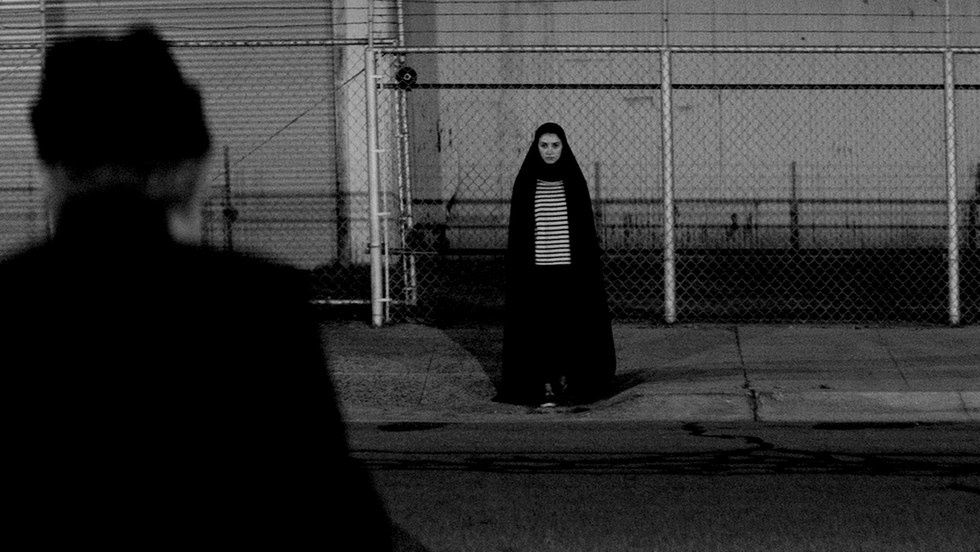
The Girl in all of her loneliness and power.
The movie is billed as a horror, among other things, but it’s never outwardly scary. It is unsettling though, and in a way that doesn’t need to be outrageous and over-the-top to accomplish what it’s setting out to do. Whereas films like Hellraiser or Saw revel in the traditionally scary or creepy (or gross or schlocky) to whip their audiences into a frenzy, they tend to fail because they set themselves up into a constant game of escalation. If you flay a man alive for the spectacle of flaying a man alive, you’re going to have to flay at least two men alive in the next scene if you want to the audience to be anything but bored. A Girls Walks Home succeeds because it coopts the best parts of horror—the darkly serious fantasy, the tendency to be speaking to issues larger than the monster in the closet, the love of all things ironic—and eschews the dead weight that bogs down most genre exercises, such as the aforementioned nuclear arms race of all that is bad and gory and evil. Amirpour maintains the tone of the movie in the same way Keith Richards maintains a high: by achieving a consistent buzz that’s comfortable at the level it’s at without ever having to reach new heights to impress itself. What works from scene one of the movie until the closing credits is the same: the male-dominated society living on the assumption of its own righteousness being turned upside-down by one girl. The ideas of Bad City where sexual cowing and repression go hand-in-hand with an aimless population of youths ready to take this concept down, and The Girl is there to give it all a clear point of reference. It works because it has the confidence to see that it only needs to show a story of vampires and never get bogged down in the explicating and moralizing--it knows the audience will do all of the heavy-lifting on its own.
Amirpour’s next film, The Bad Batch, has been described as the director as “a post-apocalyptic cannibal love story set in a Texas wasteland” and like “Road Warrior meets Pretty in Pink with a dope soundtrack.” I’m sold.