It all began on July 31 in Hilton Head, South Carolina, the site of the 2015 United States National Rubik’s Cube Competition. Hundreds of competitors, mostly kids still in middle and high school, have flocked to the Hilton Head Island Beach and Tennis Resort to compete against each other with an unusual skill they have all developed: speed-solving the infamous Rubik’s cube.
And I am right there with them.
With the help of a couple YouTube videos, I learned how to solve the puzzle back in 2009. After practicing for a few years and learning different techniques from the world’s fastest solvers (again on YouTube) and competing in the 2013 World Championships in Las Vegas, I had gotten my solve times consistently below 20 seconds. Now, going into this tournament, I average about 11 seconds.
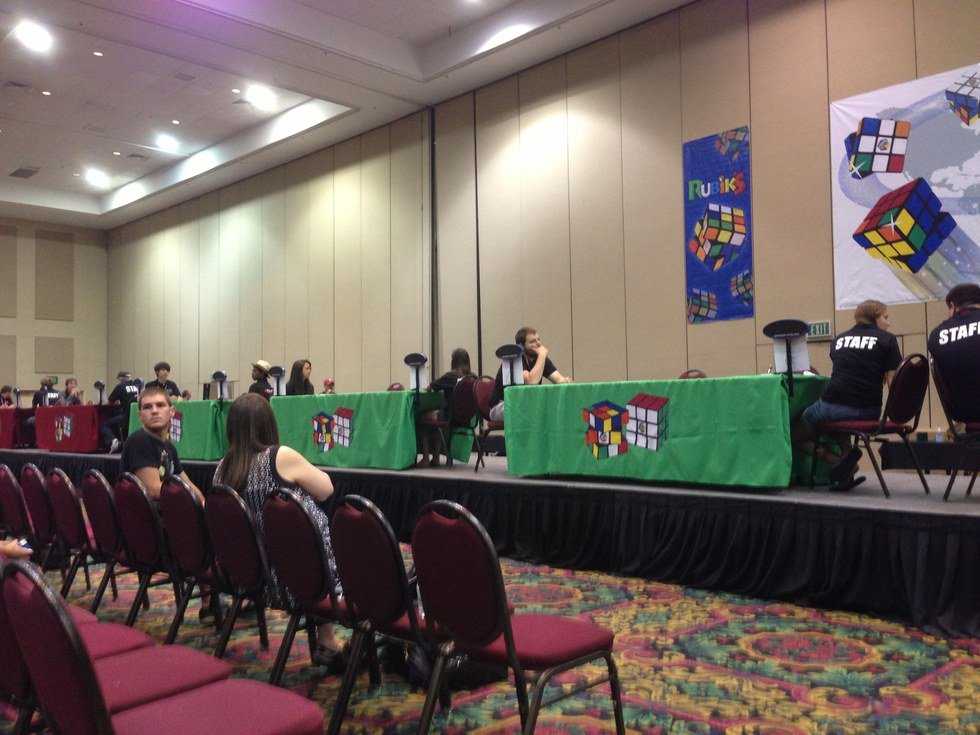
I walk into the Resort to sign in. The main competing area is a giant open conference room right in the front of the hotel, so big that a small building could easily fit inside. Several tables have been set up on a stage for competitors to record their solves, with timers set up for the audience to see; a giant leaderboard projects the current leaders on a wall. The sound of clicking from hundreds of cubes overwhelms the room, so much so that I have to go outside a few times throughout the day to get it out of my head.
I take a seat at one of the chairs lined up in front of the tables, practicing with my own Rubik’s cube, waiing for my assigned group to be called to compete. It doesn’t take long to notice how seriously everyone takes this event; at least half of the people solving are wearing helmets with GoPro cameras attached (no, I was not one of them). A few even go as far as to wear customized jackets with their names printed on them.
Needless to say, it’s an intense atmosphere.
The rules for the competition are simple: each competitor gets five solves, and the best and worst solves thrown out. The three remaining solve times are then averaged together, resulting in an official “solve average.” The fastest averages, not the fastest individual times, are used to determine who moves on in the tournament and who doesn’t.
I feel confident I can at least make the second round - lots of people are getting solves in the 20-40 second range, which I know I can beat if I solve well. In the cubing world, though, I know I’m not anywhere near record-breaking pace. The best of the best can average eight or even seven seconds, which I have never been able to do before. The competitor who won last year had an average of 8.32 seconds.
As cheers erupt, I quickly look down to my left to one of the last tables. A kid who couldn’t have been older than 14 has just clocked a seven second solve.
That’s not quite cube-celebrity worthy (the world’s fastest recorded solve is 5.25 seconds), but he’ll surely be towards the top of the leaderboard now.
Suddenly an announcement is made: “Calling Heat 1 to the back!”
That’s my group.
I take two cubes with me, one to practice with and one to use when I officially compete. I head over to the competitor’s area in the back of the room to start my average.
I hand my cube to an official judge, who will scramble it for me (every competitor gets the exact same scramble) and put it in a small box to be carried to one of the competing tables. I stand around, fiddling with my practice cube, waiting for my name to be called.
After a few minutes I hear: “Mitchell Fariss?”
I follow the voice to one of the tables, climb up, and take a seat next to one of the judges. She is there to make sure I follow all the rules and write down my official time.
She slides the box containing my mixed-up cube in front of me.
“Ready?” she asks.
I nod, and she quickly takes the box away. I now have 15 seconds to look over the cube before I have to start solving it. I quickly try to find the best possible solution in that time, but I’m not seeing anything too helpful yet…
“Eight seconds!”
I decide to just go for it. I set the cube down and place my hands on a Stackmat timer, which will start once I move my hands away to begin solving. I see the light on the timer turn green a couple seconds later, indicating I can start solving. I move my hands away and start turning the cube as fast as I can.
I’ve practiced the moves so many times that they’ve become ingrained in my muscle memory, so I’m not worried about forgetting anything. I’m mostly concentrating on avoiding lock ups and jams with the cube, which can waste a lot of time when every second matters.
When I finally set my solved cube back down in what feels like an eternity later, I see my solve time: 14.25 seconds.
Not too bad for a first solve. I climb down from the stage and await my next turn.
The next four solves go more according to plan; I end up recording a 11.77 second average. I check to see where that places me overall, knowing that the fastest 100 solvers move on to the second round.
The results come later that afternoon. I’ve placed 50th out of 434 places, comfortably ensuring my acceptance into the second round of the event. At this point, even if I don’t make it any further in the tournament, I can leave satisfied. Making the second round was my personal goal, and I had achieved it.
I leave the building and the clicking behind for the day, ready to begin the process anew tomorrow.
Ultimately, I placed 72nd in the next round, which wasn't enough to go on to the third round. The champion of the tournament won with an 8.33 second average. I don't plan on competing in another Rubik's Cube competition again, so I guess I'm officially "retired" from the cubing scene. I still solve my cube every now and then, though.