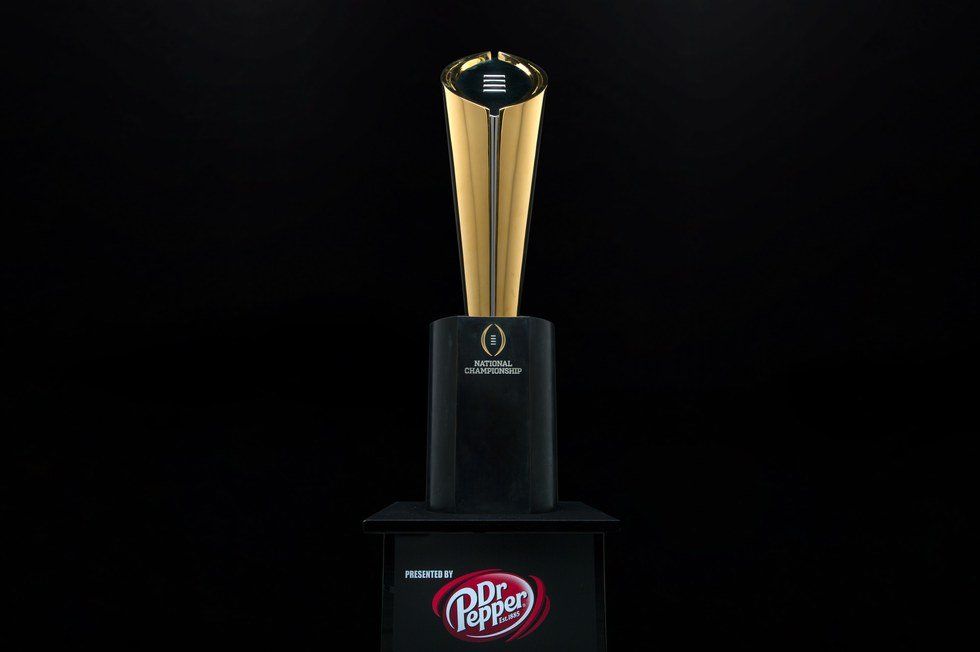
At the end of the 2013 College Football Season, the NCAA had made a change from the Bowl Championship Series (BCS) System to the College Football Playoff (CFP) System where a 13-person committee composed of Athletic Directors and former coaches would choose the four "best" teams to compete for the national championship instead of the top two teams in the final BCS standings to play for the right to be called the national champion.
The College Football Playoff Semifinals has had a Big Ten team shut out in each of the last two seasons and the games have more or less been landslides. These particularly include the semifinals between Florida State and Oregon from the 2014 season, Michigan State and Alabama from 2015, and the game between Ohio State and Clemson on New Year's Eve 2016. Even the national championship game between Oregon and Ohio State or the semifinals between Oklahoma and Clemson in 2015 were blown wide open by the fourth quarter.
The 2016 playoff semifinals showed that there is too much controversy with the BCS and even just four teams to be selected for the playoff. But if there were ten teams instead of just four, we would have the following field: the no.7 team plays the no.10 team and no.8 plays the no.9 with the rest of the match-ups dependent on those two results, but the match-up between the no.3 and no.6 and between no.4 and no.5 would be guaranteed. Essentially, the teams ranked 1 and 2 would wait to see whom they would face with eight teams remaining. All games would be played in the New Years's Six bowl game venues with as neutral of field advantage as possible and there would be no advantage of being a power 5 conference team over being from a group of 5 conferences such as the American Athletic Conference (e.g. University of Houston) or Mid-American Conference (e.g. BGSU).
Here is what it would look like with the 2014 top 10 in the CFP rankings:
We know that the top two teams were Alabama and Oregon, and the teams ranked 7 through 10 were Mississippi State, Michigan State, Ole Miss, and Arizona (in that order). In a ten-team system, Mississippi State would play against Arizona and Michigan State would play Ole Miss. The lowest remaining team of those two games would have played no.1 Alabama and the other one would play no.2 Oregon. TCU would have played Florida State (no.3 against no.6) and Ohio State would have played Baylor (no.4 vs. no.5). Standard NFL playoff format would have continued from then on where the lowest remaining seed plays the highest remaining seed.
2015:
Top two teams were Clemson and Alabama, and 7 through 10 is Ohio State, Notre Dame, Florida State, and North Carolina (in that order). Again, the no.7 seed would play the no.10 seed and no.8 faces the no.9, so Ohio State would have played North Carolina, and Notre Dame would have played Florida State. Clemson would have played the lowest remaining seed and Alabama would have play the other remaining team from those two games. Michigan State would have played Stanford (no.3 vs. no.6) and Oklahoma would have played Iowa (no.4 vs. no.5). Continue with standard NFL playoff format .
2016:
Top two teams were Alabama and Clemson, and 7 through 10 is Oklahoma, Wisconsin, Southern California, and Colorado (in that order). Oklahoma would play Colorado and Wisconsin would play Southern California, with Alabama playing the lowest remaining seed and Clemson playing the other team remaining from those two match-ups. Ohio State would play Michigan (no.3 vs. no.6) and Washington would have played Penn State (no.4 vs. no.5). From here, the standard NFL playoff format would be implemented where again, the lowest remaining seed plays the highest remaining seed.
The advantage of this is we get match-ups we don't normally see or haven't seen before, but we also get to see match-ups that have been entertaining in the past or re-matches of other games. We also get teams that haven't played in as big a stage before. Just like in March madness, we have a larger potential for crazy games and exciting shootouts or slug-fests. There are a few that are heads and/or shoulders above the rest, but one team might just spoil them as a big underdog.
Because we have the match-up set for the 2017 CFP National championship already, let's look back at what might have been if there were 10 teams instead of just four.
I think USC and Oklahoma would advance to play Alabama and Clemson, respectively, where I still think Alabama and Clemson would advance, but they would not have as easy of a time winning like they did on New Year's Eve 2016. I think Michigan would have upset Ohio State and Washington would edge Penn State. That leaves Alabama to play Michigan and Clemson to face Washington, with the winners playing for the national title. I would love to see Michigan unseat the Tide, but the Wolverines aren't there yet so I would think in this situation, Alabama advances to play Clemson where Clemson would prevail.
One thing that does present a challenge is the venues being used for multiple games, but I believe it is doable considering the fact that the Russell Athletic Bowl and Buffalo Wild Wings Citrus Bowl are played just a few days apart in the same stadium, so grounds crew would have enough time to re-lay the turf for the proceeding games.
Don't get me wrong, I'm excited for this year's national championship game, but I think the NCAA should reconsider choosing just four teams to compete in a playoff for the national championship. There are at least 800 Division I programs in men's college basketball, and only 68 are picked for the NCAA tournament to determine the national champion. Why not consider similarly for college football? There are 128 teams in the Football Bowl Subdivision, so having 10 teams in the playoff would be a better number than having just four.