


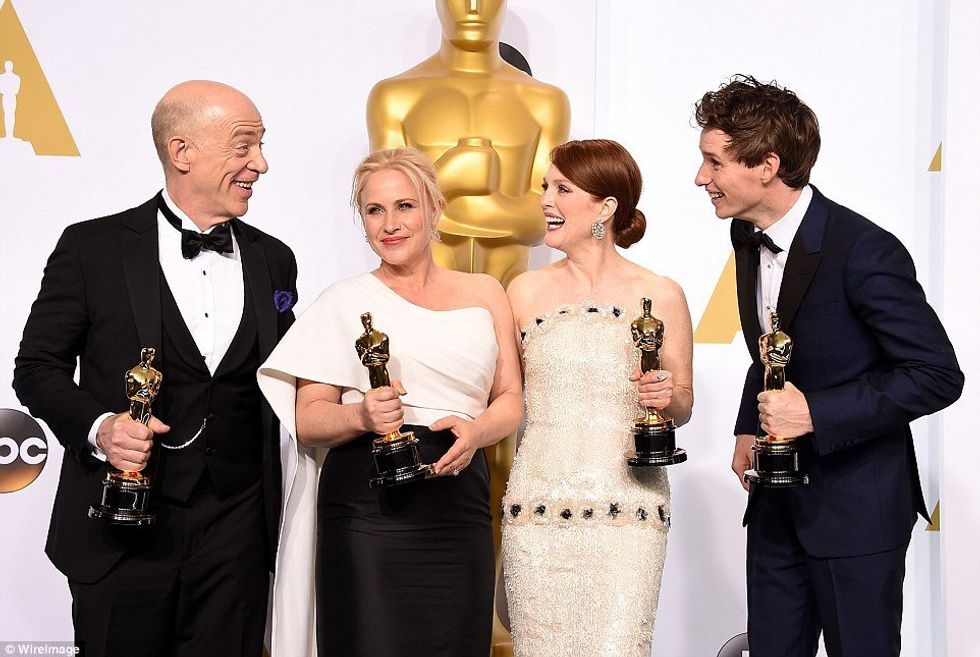
On Thursday, the Academy revealed their nominations for the 88th Academy Awards and they were, exactly like last year, mostly white and mostly male. All 20 acting categories were full of white actors like Leonardo DiCaprio and Jennifer Lawrence while most other categories were full of white male artists (with a few exceptions such as “The Revenant” director Alejandro Gonzalez Iñárritu). The hashtag #OscarsSoWhite immediately began trending again, signifying the public’s outrage at the lack of diversity in the nominations. Academy president Cheryl Boone Isaacs (an African-American woman herself) stated to Deadline that she was “disappointed” by the lack of diversity. This is obviously not a new phenomenon but analysis of the situation makes it much less surprising.
Academy members are invited to join based on even the smallest contributions to the film industry (Beyoncé was invited to join for her occasional acting performances) and yet, after 88 years, it still consists of an overwhelming majority of white members. In 2012, the Los Angeles Times conducted a study that revealed the shocking (or perhaps not shocking) fact that 94 percent of the voting members of the Academy are white. Only 2 percent of them are black, 2 percent are Latino, and 2 percent are other ethnicities. This shows that the voting process is extremely biased toward minorities, thus projecting idea to the viewers that black artists are not worthy of proper recognition. It is facts like these that explains why Halle Berry (who won in 2002 for “Monster’s Ball”) is still the only African-American woman to win the Oscar for Best Actress since the first award was given in 1927.
Still, amidst the criticism, it should be pointed out that the Academy does not necessarily sit at a table and say yes or no to certain films. As explained by Sean Hutchinson in Mental Floss, a film is eligible when it fits certain criteria (including a minimum length of 40 minutes) and is submitted by its producer. When a list of eligible nominees is created, Academy members are asked to create a list of 5 (in Best Picture’s cast 5-10) nominees in order of preference. The ballots are counted by hand and then official nominees are announced. While this doesn’t discount the idea that Academy members are purposely choosing White-led projects over Black-led projects, it also highlights the fact that no voter is visibly affected by the next voter: it is all a matter of opinion.
This leads us to the fundamental problem. The relative Whiteness of the Academy Awards is not necessarily the fault of the Academy, but the fault of Hollywood as a whole. While it is surprising that this year’s biggest Black directed films “Straight Outta Compton” and “Creed” were overlooked, the bigger issue is the fact that those films were arguably the only two real chances. If more Black-led (and female led) films had been produced and created over the years, there would be more eligible names on the ballot and, therefore, a higher chance of being nominated. Movies have been around for a little over 100 years and started out, like many other trademarks, as a “white man’s game.” Though there have been a few notable African-American filmmakers throughout the history of film (i.e. Oscar Micheaux, Spike Lee, Tyler Perry), as well as female filmmakers (Kathryn Bigelow, Sofia Coppola) the problem is clear and simple: minorities are not and have never been equally represented in the film industry. Hollywood tends to “justify” this underrepresentation with excuses involving the lack of financial success that these films bring. However, these excuses can be very obviously disproven. “Star Wars: The Force Awakens” is well on its way to becoming the highest grossing film of all time, “regardless” of the fact that its two leads are a Black man and a young woman.
Jada Pinkett Smith (whose husband Will was snubbed on Thursday for his portrayal of Dr. Bennett Omalu in “Concussion”) recently suggested that if African-Americans are so often overlooked by the Academy, they should refrain from participating in the ceremony in general. Smith’s comments have been echoed by many disgruntled African-Americans, who believe that the Oscars should be ignored if they continue to ignore certain projects. Though this statement has merit, the best answer would perhaps be to change Hollywood in general so that the Academy Awards, if it continues to be the gold standard in film celebration, will more accurately reflect the audiences that view them.
















