Not too long ago, a proposed conference on New Orleans bounce music was rejected by the New Orleans Jazz and Heritage Association. It was pitched by Where Y’at, a foundation dedicated to the cultural documentation and preservation of bounce. The reasoning for the denial was that a spotlight on bounce would portray New Orleans in a negative light, musically and culturally. This decision was not a shocking one; the opinion on bounce music is polarized among the residents of the crescent city. If anything, its reputation can be quite negative in regard to the genre’s attempt to be included in the family portrait of New Orleans-rooted music, alongside jazz and brass bands.
But bounce is more than just a New Orleans-based music genre. Its recent incarnation “sissy bounce” is a gender ambiguous rap-dance culture phenomenon, raising eyebrows in areas other than Louisiana. But to New Orleanians, the idea of a transgendered rapper performing in a sports bar is not a phenomenon; it’s the mainstream norm, while to outsiders the idea of a gay rapper seems to be an alternative goldmine. Sissy bounce has started to spread nationally as more and more people become involved with the culture, and yet there are New Orleans critics who still wish to reject its popularity.
New Orleans Bounce wears its influence on its sleeves. Traditional songs sample from what is known as the “Triggerman Beat” which originates from the songs "Drag Rap" by the Showboys, "Brown Beat" by Cameron Paul, and also Derek B's "Rock The Beat". Stylistically, bounce is most closely related to early hip-hop call-and-response structured music. The lead voice is sampled and single vocal hooks are electronically repeated over the fast drum beat. While some mainstream hip-hop turned into more lyrical, listening music, genres like bounce stayed true to its club roots.
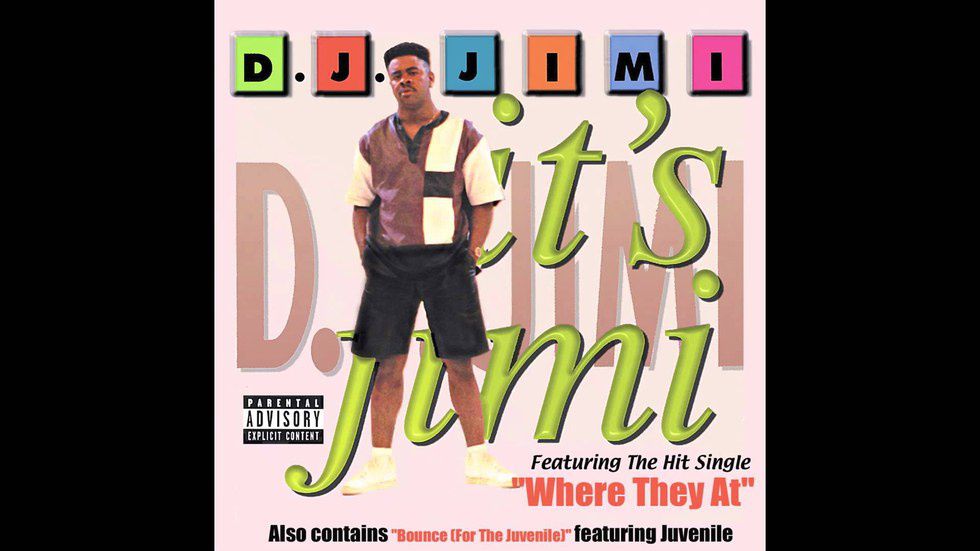
Bounce is unapologetically dance music, and the ass-shaking style that comes along with it is the cohesive. The style of dance is controversial for its hypersexual shaking of the behind. Sexually suggestive dancing is not uncommon in southern rap genres, but the bounce shake is the focus of the dancing. Some credit the first “bounce” song to be "Where Dey At" by MC T.Tucker and DJ Irv due to its use of the Triggerman beat and repetitious call outs by the MCs. Like old school hip hop, it established some classic bounce call outs, like “shake that thing like a salt shaker”. A cover version by DJ Jimi was also released with an accompanying music video featuring an early version of the bounce ass shake. As it caught on in New Orleans, a city fueled by dancing, it developed into the hard-hitting music it is today.
Today, modern bounce music can still sound like a time capsule from the early 90s. In general, newer bounce is faster, and sometimes more (or less, depending who you ask) exploratory in terms of lyrical content.
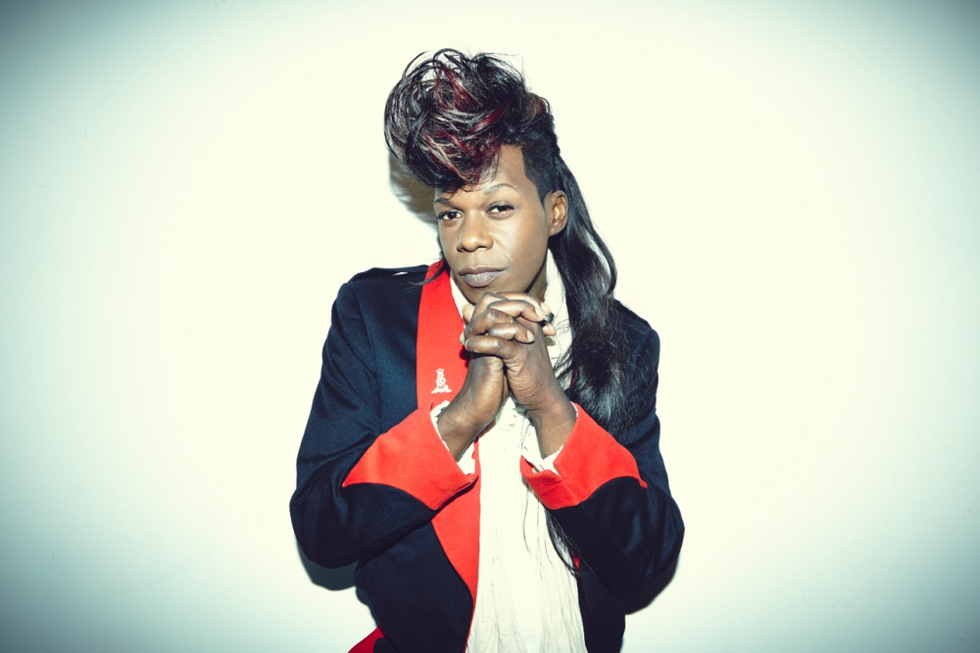
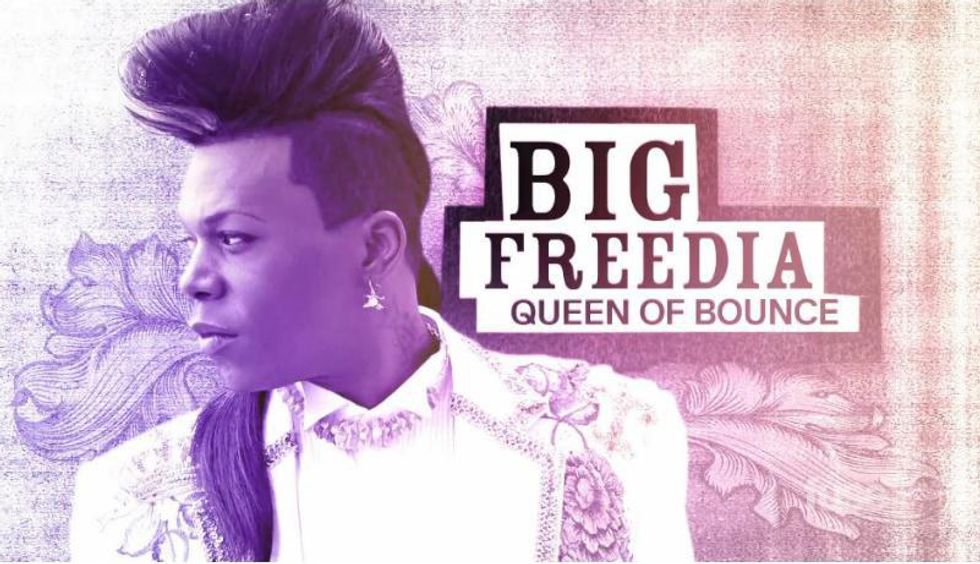
“It’s party music”, says Big Freedia, one of the most popular bounce artists in New Orleans today. Big Freedia is biologically male, but she identifies as female. Along with Katey Red, who is transgendered and considered the first sissy bounce artist in the game, Big Freedia has risen to a level of popularity previously unheard of in bounce. “I’m the hardest working artist in the bounce game”, she says. By day she works as an interior designer and usually performs at two clubs a night, running short sets of about three or four songs.
If you listen closely, you can hear subtle differences between sissy bounce and traditional bounce, one song being about a bad ex-boyfriend, for example. But in essence there is no stylistic difference between the two. The theme of most sissy bounce songs is about shaking one’s ass like a salt shaker, as per tradition. It’s no surprise that the term “sissy bounce” upsets some of the artists that are associated with that label. It was originally coined by Where Y’At’s bounceologist Alison Fensterstock, but has regrettably become the inescapable tag that the media uses to refer to gay bounce artists. “Ain’t no such thing as ‘sissy bounce’ ”, says Katey Red, interviewed by New York Times journalist Jonathan Dee in her home. “It’s bounce music. It’s just sissies that are doing it.”
But the ‘sissy’ element is what is propelling it to a national stage. Katey and a number of other bounce artists were invited to perform at the South by Southwest music festival in Austin for a showcase on bounce music. Big Freedia regularly makes appearances to other cities, already establishing a fanbase in New York. That still doesn’t help her land a major record deal though; executives have turned her down because they have no idea how to market her music.
 Big Freedia and Katey Red
Cassidy Henderson is a Tulane alum and a fan of bounce music. He is involved with the queer alternative culture of New Orleans, and took the time to talk to me about the significance of “sissy” bounce to him, and the city of New Orleans.
“I first got exposed to it my first year down here in New Orleans, so around 2008 or 2009.” he says. “It wasn’t until my second year that I started going to more shows and knowing more about it.”
His music library is pretty diverse with a lot of artists I’ve never heard of, and he enjoys David Bowie and bluegrass music, in particular. When asked where he sees shows, he replied, “I haven’t seen a lot of live bounce music, but I have seen Big Freedia open for another band at the Republic, which is in the warehouse district. I’ve seen Katey Red at Siberia, and I’ve gone to St. Roch’s Tavern where they have a DJ bounce night, which doesn’t have the live act so much. Also, the Hillel here at Tulane had Sissy Nobby come one time, which was kind of surreal.”
“What would you say the demographic is at the shows you go to?” I asked.
“It’s funny, because the demographic is so dictated by the venue.” he replied. “When I saw Big Freedia at the Republic, she was opening for another band. So you know, while there might have been people there like me who thought 'Oh boy, this is awesome. I also get to see Big Freedia!', nobody was there just to see her. Then Katey Red at Siberia...it’s part of this district on St. Claude Avenue, this area I really like. Places like Siberia, Hi Ho Lounge, Allways Lounge, and Cajun’s pub are all kind of like queer culture bars, but in a non specified way, so it’s not like going to a gay club or something, where you’re going to see dominantly white, male, mostly homosexual. It’s like pan-everything. So you can be straight and white and male and nobody cares. I really like that area, and Siberia has a clientele that reflects that. At the DJ shows at St. Roch’s Tavern, it’s populated almost entirely by - I guess what people would term ‘crust punks’ - people who are heavily tattooed, messy shaggy hair or dreadlocks, but almost all of them white. But I think it’s amazing how into the music and into that culture that population is because they are the most dedicated at doing the dance that I’ve seen in an audience. People really freakin throw down and you’ll see people there week after week every Saturday and they just get better and better and better, you know, just isolating that part of their body and getting into this whole thing with it, which I think is really awesome.”
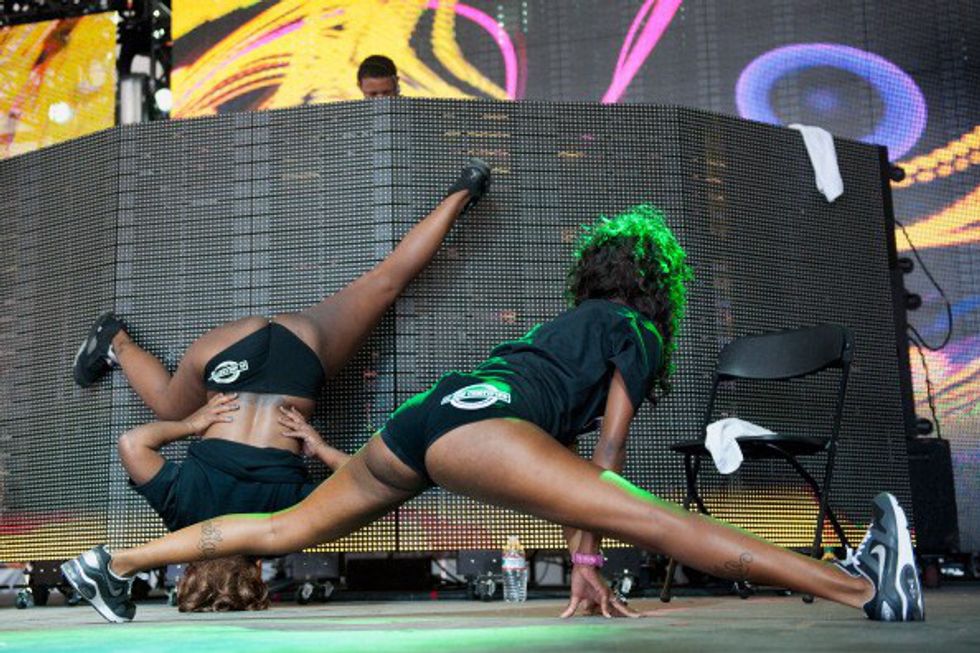
The dance he’s referring to is called “p-popping”. Maybe a more mainstream term would be "twerking". But like the musical context of bounce, the lingo seems to also be perpetually dancing in the year 1991. “Is that a big part of bounce?” I ask. “Getting really good at the dance?”
“Absolutely. You’re supposed to get into it to where the motion is pretty much self-perpetuating. You sweat your ass off if you try to do it for very long, so it’s a workout. It’s straight up physical and aerobic on one hand but then it’s sexual and musical on the other. It’s very body celebratory.”
Cassidy made a point here about p-popping that I think is lost on many people. The hypersexuality is a large criticism of bounce and many dance-rap genres, the kind of criticism that pushes it out of the circle of critically respected musical styles. But though the ass shaking is an entity of the culture of bounce, it is not inherently sexual or derogatory to females. Many of the attendees of bounce shows, after all, are female.

“I think the girls like the gay rappers a lot because they feel safer,” said Rusty Lazer, Big Freedia’s DJ. “You can get up in the front, you can dance for Freedia, you can work it for Freedia, but at the same time, if anybody comes up on you and gives you a hard time, Freedia’s gonna be the first one [to defend the girl]”. But to people like Cassidy, it’s even more than that. It’s a statement.
“There is definitely still this edge of the showmanship about it.” he says, referring to dancing at bounce shows. “...where if you bring someone on stage to shake their ass, more often than not, you’re going to bring up women. Unless the performer is transgender or whatever, generally the backup dancers are female. But I think that does little to mitigate that mostly it’s dissolved, because it really is about everyone doing it. Big Freedia shakes her ass constantly - I’m not sure if the stage personality is female or if she’s transgender, I don’t know exactly what it is. Katey Red on the other hand, she’s got long hair, she’s in heels and a dress, and she’s almost a little too prissy to shake her ass. Like, you know she could do it, but she doesn’t get down on the floor...she’s too fine. But she’s playing that. That’s the thing: Everything in it is played and performed subconsciously.”
Before interviewing Cassidy, I had only seen Big Freedia before, and only as an opening act, or at a festival. I decided to go see Katey Red for myself. I had never been to a true bounce show before, I am not a great dancer, and I dislike feeling uncomfortable on the dance floor. This show, however, was not representative of all bounce settings in New Orleans. It would be impossible to find one show that was - the setting where bounce is played affects the audience and type of show. The things that stayed consistent were the dancing and the nature of the performers.
“With Big Freedia taking bounce to the world, I think there’s more of a want to represent honestly, to not change it.” Cassidy told me. “Whether it’s playing at a different venue with a different clientele or going to New York City instead of New Orleans.”
The same must go for Katey Red, who was strutting back and forth in heels. She didn’t dance or move much, but the group of dancers that dominated the dance floor did. Despite the venue hosting a dance party, not everyone danced. Many stood off to the side, bopping their heads and sipping their drinks. Some stood around the perimeter of the dance floor, mostly those who wanted to dance but didn’t know how to pop it. The ass shakers gravitated towards the center, their movements so consistent it was trance-like. There didn’t seem to be segregation on the dance floor though; there were all kind of dancers everywhere and everybody was there to have a good time. At one point, Katey took a long, long break, which gave the DJ the opportunity to fill the air with random dance music. I saw her mingling around, but I was too intimidated to approach her, as she was very tall.
 Katey Red at the Stone Fox - 9/14
“It’s very drag” I said, referring to bounce as a whole during the end of my talk with Cassidy. I was surprised how enthusiastically he responded to that comparison. “Oh my God, that’s a really good way to think of it.” he says. “It’s like you’re in drag as a wealthy person, so you super-over-perform it to the point where you’re ridiculous.” He explained how in his own research, he found the point of drag was to point out that gender is performative. That by performing the gender to such a ridiculous degree, the performance aspect could no longer be ignored.
Before I had decided to muster up the courage to talk to her, Katey Red had taken up the mic again. Maybe I have regrets about missing this opportunity to talk to her for real, but maybe it’s all an act anyway.
Robert Fink in his book Repeating Ourselves stresses the importance of not dismissing minimalist music as culturally irrelevant. If anything, he argues that repetitious or minimalist music is a reflection of the post-modern society that we have “repeated” our way into. But bounce is maximalist, if anything. The music is unrelentingly loud and fast and does not breathe. And like the brass band songs that pulled New Orleanians out to the streets to dance, bounce is designed to be played until the party is deemed over. This is why there is no difference between “sissy” and “normal” bounce, fundamentally. Sissy bounce doesn’t have a point unless it’s given one.
But does that mean bounce is designed to stay a New Orleans genre? Not necessarily. “People in Dallas like to shake they ass, too”, says Katey Red. But it’s still the music that has been repeated in New Orleans for over twenty years, and that deserves some credit.Author's note: Statements from Big Freedia and Katey Red are credited to Jonathan Dee writing for The New York Times