
As I pondered what I wanted to write about this week, I found myself jumping back to an incredibly relevant topic, one that affects millions of women and men every day. It’s one of the most common issues among college aged students—one that goes unnoticed frequently.
Body Image.
Body dysmorphic disorder (BDD) has similarities with eating disorders; however, they are not the same. Essentially it is an illness where one has an obsessive focus on perceived flaws. It presents itself in numerous ways, but the general idea is that there is hyper attention to one’s appearance. Sound familiar? Probably.
In our culture, people seem to have this idea, this notion, that hating yourself is normal. That we’re simply designed to beat ourselves up. The reality is that body dysmorphia is real, body dysmorphia affects an enormous amount of people, and body dysmorphia is NOT something to accept or laugh about. I chose to write on body image this week as opposed to eating disorders for two reasons.
1) I find that more people can relate to body image issues than full-on eating disorders.
2) It seems to be one of the most misunderstood aspects of eating disorders, one that must be understood in order to fully understand the other.
I don’t love looking at myself in the mirror. I find flaws, I obsess and I have to have loved ones pull me away from the mirror in order to prevent hours from being wasted on tears. I recognize that it is much easier to say these things than it is to do them. I have spent years in treatment for numerous disorders. I have spent years mentally and physically abusing myself to achieve an impossible perfection. Only now, in the last year or so, I have begun to notice my own distorted self-view, but with that, I will still say: body dysmorphia disorder is not simply vanity. And it is not something you need to compromise with.
I have the most beautiful friends and family. I could spend hours telling them how lovely they are, how fit they are, how great their makeup looks. No, this isn’t all that they are, and it is not the fix to everything. But when my gorgeous friends criticize themselves, tell me how they can’t wear something, I can’t help but set them straight, though I cannot possibly understand how someone could tell me the same.
We are all guilty of it, some of us more so. We tell ourselves that we CANNOT wear those shorts/bikini/crop top until we diet and consistently workout for a few weeks. I know that this won’t go away, not tomorrow. Not when it is ingrained in our brains, not when the media tells us that we need to have flat abs, youthful skin, and zero cellulite. I don’t think that this is a reason to avoid fighting it, though.
I’ve overheard girls talking about other girls with eating disorders, commenting on their appearance and mindset. “Like, they’re just too skinny,” “how do they think that looks good,” “she went too far, now she’s just scary,” “she should start eating again now.” Maybe it’s because I’ve been surrounded by the correct education for years, but I am mind blown each time I hear this. How can you, I ask myself, not know that you are scary. That it’s scary that you, a female, who should be supporting other females, thinks that they can see themselves how you see them. That you should break them down, not build them up.
The majority of us get a zit and obsess about it. Cover it with four different products, wear our hair down, and still assume that everyone sees it. Body dysmorphia is that on steroids. It may begin as one flaw—thick thighs, a crooked nose, uneven eyes—but soon after, the worst part of a twisted self-image sets in. It expands. Soon, we find a flaw with every part of our body and face, and we spend hours assessing it. We buy new makeup, we commit ourselves to excessive, unrealistic regimes—we even contemplate surgery. I’m not saying these things are necessarily wrong (aside from unhealthy diet and exercise plans, which are harmful), but I think we need to consider how we view them. Will fixing this one thing actually stop the thoughts? Or will it simply open doors for new negativities?
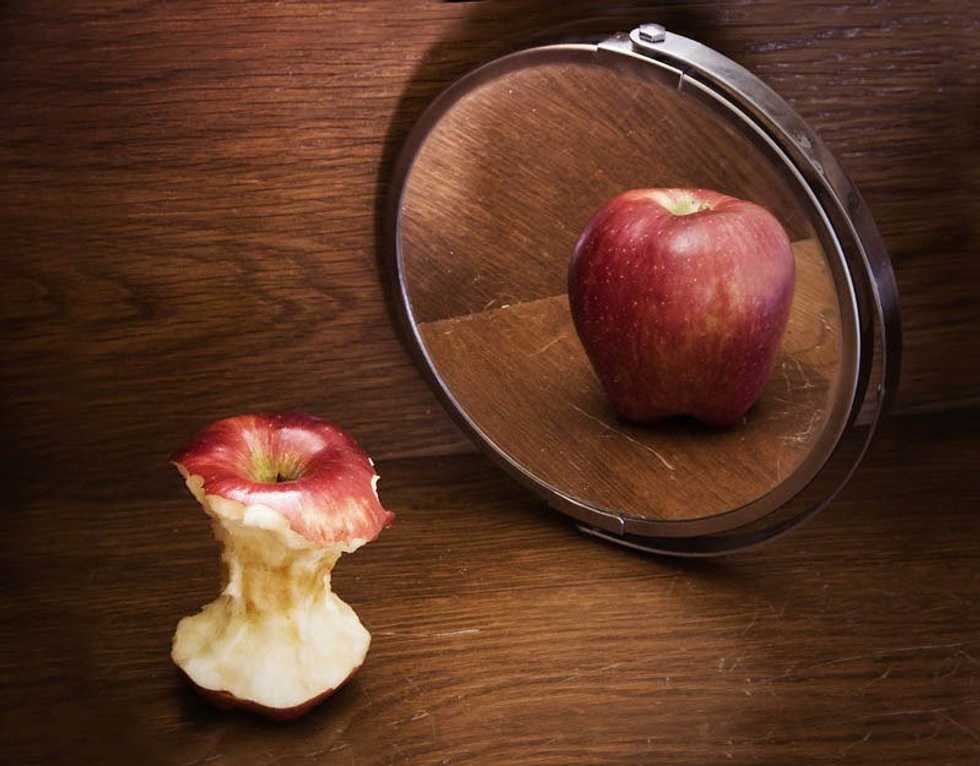
When someone suffers from body dysmorphic disorder, or a distorted self-image, they legitimately do not see their true self in the mirror. It is a mental trick, one that I personally cannot explain. When an emaciated young girl or boy still sees fat, still sees a full stomach and chubby cheeks, they are not seeing reality. It’s time for the world to admit that they are not vain, they are not “stubborn,” they do not simply have a different idea of beauty. They don’t think they look gross because they are too skinny, they think they are gross because they are too fat.
Working in retail, I hear girls every single day comment on how they “can’t wear __,” or need to lose 5 pounds before wearing “___,” and this breaks my heart. 99% of the time I look at them and think they are absolutely rocking the item. I usually tell them this, but I know they won’t believe me. I know that in my “sickest” days, as a mid-teen girl at 5’3” 80 pounds, I did not believe I could wear a swimsuit, I was too fat. I personally know how this struggle feels. And I wish, I hope, that by reading this, someone can learn to recognize their own mental block, and other people can learn to see the reality of this condition, of this society.
It won’t resolve itself overnight. You won’t think, “Oh I do have great legs!” just because you said it once. The idea is to start by at least recognizing it. By saying, “No one has ever told me that my smile is crooked. People love my smile. I might not see it, but maybe, just maybe, I’m not viewing myself correctly.” Simply identifying your perception is a major step in overcoming your self-loathing.
All I ask is that for one day, you think about this concept. You try to wear that “fear item,” and recognize that no one judges you like you judge yourself. Recognize that telling someone that they are skinny is not the end all solution. And, ultimately, recognizing that no matter what you or they see you for, you are perfectly you.