The investigation and eventual trial against Shannon Wayne Agofsky was a circus, with no shortage of clowns, magicians, and sideshow attractions. I will seek to prove this with a thorough analysis of the evidence given against Shannon at his Oklahoma trial. Though it proved to be quite a show, in the end I hope you will see that's indeed all it was--a manufactured production.
THE CLOWNS
First and foremost, I feel it's pertinent to establish that the State presented no eyewitnesses to Dan Short's abduction or murder, or the robbery of the bank. The prosecutors relied solely on circumstantial evidence, questionable witness statements, and the testimony of jailhouse snitches. The parade of fools began with several persons who said they saw or heard suspicious activity in Noel around the time of the crime.
Janice Houston lived on Highway 59 in Noel. Sometime after she retired to bed on the evening of October 5th, the sound of something hitting her chain link fence woke her. She said she looked out the window and saw two men engaged in some sort of scuffle. She described a shorter man, around five-foot-nine, wrestling with a much taller man who had his hands tied behind his back. Neither one of these men, according to her statement, resembled the Agofsky brothers. Houston did not report this sighting to the FBI until over two years after the incident, though she had spoken to police officers in the days immediately following the crime. Defense motions to strike Houston's testimony from the record for irrelevance were denied.
Shirley Butler testified at trial that at 3:45 am on October 6th, she saw a truck and a van parked on the Number 10 bridge, near the place where Mr. Short would have been thrown to his death. As she got closer, she saw activity to the right of the vehicles, but was unable to make anything out clearly. Butler did not report this sighting to the FBI for over six months after the crime, and even then she did not give a specific time or date. Those specifics emerged only after the grand magician Special Agent Ladell Farley joined the show--but you'll hear more about his act later.
A truck driver named David McNeely testified at trial that he saw a brown two-toned van and a small pickup truck driving down Main Street Noel in the wee hours of the morning of October 6th. He said that the two occupants, who he described as white males, turned left onto King's Highway. However, when McNeely first spoke with the FBI (five months after the bank robbery) he described the van as plain in color and was unable to describe the occupants at all.
Buddy Mills testified despite intense and vehement defense objection after the prosecutors introduced a hypnotist as their special guest. Mills had his memory "hypnotically refreshed" in preparation to take the stand. The doctor who administered the hypnosis said that he had "turned hypnotic control" over to an FBI agent who participated in the exercise and subsequent questioning. Mills said that he saw three vehicles at a traffic light heading out of Noel around 3:00 am on the morning of October 6th. The first vehicle resembled Dan Short's. Mills did not pay attention to the other vehicles, but said as he continued South, a small blue Chevrolet Luv pickup with Oklahoma plates passed him. The driver, Mills said, had sandy hair and a reddish-brown beard. Despite thorough hypnosis, he was unable to remember the license plate number.
Carol Dryden Carnahan surprised the defense mid-trial when she identified Shannon Agofksy as the driver of a blue pickup truck that turned around in her driveway a few days before Mr. Short was abducted and killed. However, in the eight years preceding Shannon's Oklahoma trial, Carnahan never made such an identification despite being interviewed multiple times. Upon cross-examination, her story continued to change. She admitted that when she initially spoke with FBI agents, she described the driver of the blue pickup as a man of about thirty wearing a baseball cap--Shannon was only eighteen at the time of the crime.
Wayne Boutain, the man who testified that the chain hoist recovered with the body had belonged to him, was next to pile out of the clown car. Boutain said he could tell the hoist was his because of a chip in the gear, and that he had called and reported the hoist stolen to "someone named Robert" several days before the bank robbery. He also said he suspected the Agofsky brothers of the theft, and indicated as much at the time. However, the only police report that could be found was taken by one Officer John Wilson, dated several weeks after the crime. Boutain, who had several prior convictions, had fled to Noel to avoid probation violation proceedings in his native Minnesota. After he gave his statements against Shannon, he returned to his home state. I'm sure you'll find it no coincidence that immediately after, Boutain was discharged from probation and began work as a drug informant for Minnesota authorities.
Gant Sanders (who was discussed in a previous article) was originally contacted by the FBI immediately after the murder. They were interested in learning more about his father Frank--who had been convicted for kidnapping and robbing a bank president several years before. During Sanders' third FBI interview, he was living with Shannon, and denied that Shannon or Joe had any ties to the crime--as he had done in two previous interviews. It wasn't until Agent Farley broke protocol and decided to interview Sanders on his own that the story changed. In exchange for implicating the Agofsky brothers for the crime, Sanders received probation for a string of burglaries, received money for a new apartment, an additional $500 to aid with relocation, and had his first month's rent covered.
Wayne Pennington, who was serving time for postal robbery, was the next clown slated to perform. He met Shannon's acquaintance in 1990 while they were incarcerated together. It didn't take long for him to learn exactly why Shannon was in jail, and that the trial was sure to be high profile. Pennington wrote a letter to the FBI, saying that he was interested and willing to provide information to them. It's important to note that Pennington had previously testified against other participants in a bank robbery in exchange for five years off his sentence. Pennington even acknowledged that his friend, also an inmate, had told him after Shannon arrived that if he testified against him, he would probably get a "first class ticket home." Pennington also acknowledged that he later wrote to Joyce Short, Dan Short's ex-wife, attempting to extort money from her and threatening to recant his testimony. He did the same with one of the prosecutors from the Oklahoma case.
It's important to mention again that no matter what was said at trial, Shannon did in fact have a strong alibi. Shannon's karate teacher, Gerald Edmondson, had records and a signed roll sheet indicating that Shannon had been in class on the evening of October 5th. Shannon stayed after the class was over to chat with Edmondson, and left for home around the same time Dan Short was supposedly being abducted. Later that same evening, Buddy Cousatte saw Shannon at home in bed, fast asleep, when he stopped by to visit Sheila Agofksy around 11:30 pm to see about some work she had had done to her bathroom.
THE MAGICIANS
Over the course of the investigation and subsequent trials, an overwhelming amount of evidence was mishandled, damaged, lost, and at times just plain falsified. Taking that into account, along with all of the witnesses who quite suddenly and miraculously recovered memories about the crime that hadn't previously existed, one would have to agree that the local police and federal agents had a certain knack for sleight of hand--among other things.
Before the FBI's evidence collection team decided to process Dan Short's house for evidence, countless people had been allowed to tramp through. There were muddy footprints throughout the home, and the authorities even allowed Short's ex-wife and daughter to spend the night there. Because the crime scene had been so obviously compromised, eventually the FBI decided that any evidence that may have existed there had most likely been obliterated. They did dust for fingerprints, but not until over a week after the bank robbery.
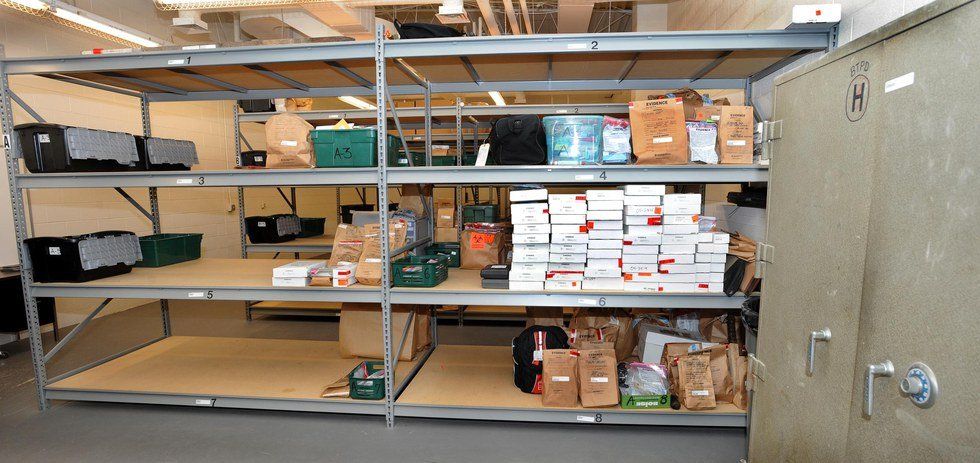
That would not be the first or last time that potential evidence was to be grievously mishandled by the FBI. The key piece of evidence used against Shannon at trial was subject to such gross and blatant mishandling that I can scarcely wrap my head around why it was even admissible. The prosecution held onto the "duct tape evidence" like a ravenous dog with a bone. This was despite the fact that the duct tape from the scene (pulled from Short's body, the chair itself, the chain hoist, and the cinder block) was thrown into the back of Special Agent Lawrence Nolan's car--without placing them into any sort of evidence bag or protective covering. Nolan wrote his initials directly on the sections of tape, on the reverse side where the patent fingerprints appeared.
Once back at the FBI field office, Nolan, Farley, and one Special Agent Edwards--none of whom was trained as an evidence analysis specialist--disassembled and reassembled the chair in several configurations--unable to figure out how to make the pieces fit. During this process, the agents put several sections of the duct tape on the carpet--sticky side down, effectively tainting important evidence.
An additional piece of duct tape would be used to tie Shannon to the crime--a piece of duct tape that was found nearly two weeks after the robbery. A man named Rowdy Foreman lived in a mobile home near Grand Lake, not far from where Short's body surfaced. He testified that on the afternoon of October 18th, he saw a piece of duct tape by the shore, but claimed he did not pick it up then because there were people around. He went back at dusk and picked the tape up with a pencil. He said a partial, greasy fingerprint was visible on the tape, which he put up on a shelf. During the trial, it was unclear when exactly the tape was found and when Foreman alerted the authorities, because both he and the federal agents had different recollections of the event. No clear records of the find had been kept, despite the apparent importance of the evidence. What is clear, is that Foreman received a cash reward for testifying at trial.
Enter Russell Davey--a self-proclaimed expert fingerprint analyst for the FBI. Davey destroyed every single patent print on the sections of duct tape by washing the tape with gentian violet--a dye that is sometimes used to raise prints where none are visible to the naked eye. The dye completely dissolved the adhesive and any print impressions that existed. Davey made his comparisons--and ultimately his "positive identification" of Shannon's prints--solely from photographs of the duct tape.
During his initial comparisons, in the spring of 1990, Davey used the photographs to check for similarities against the prints of multiple suspects, including Shannon Agofsky's. No match was made. At a later date, after the urging of Agent Farley, Davey examined the photographs again and said that he found seven points of comparison that were similar to Shannon's prints. Keith Fairchild, an independent print analysis expert, reviewed the fingerprint evidence and the FBI's methods on behalf of the Defense. Fairchild said he could think of no legitimate reason why an experienced and qualified analyst would use gentian violet to look for prints on a section of tape where visible patent prints already existed. Fairchild also said his analysis of the print evidence was hampered, because the FBI couldn't produce the original photos taken of the tape. Print comparisons were being made from photographs of photographs--comparisons which sent a man to jail for life.
When Fairchild compared Shannon's prints to the photographs, he only found four points of comparison--not the seven Davey reported. Four points is not enough to make a positive match. Fairchild also observed foreign marks on the print photographs, which were unidentifiable and skewed the ability to make a clear print comparison. Taking this into account, along with the obliteration of evidence due to the use of gentian violet, Fairchild said the print evidence was virtually unreliable.
Agent Ladell Farley proved to be a more capable magician than either Nolan or Davey. He was able to make fourteen sets of prints appear out of thin air. At the beginning of the trial, the Defense was told that there were no prints from the scene at Short's home. However, the night before Davey was supposed to testify, there suddenly were. After the trial, Davey is on record as saying,
"During an overnight recess in my testimony at the Oklahoma trial in 1997, I was asked by Special Agent Farley to compare the fingerprint card of Shannon Agofsky with a set of unknown prints that, I was told, had been lifted from the home of bank president Dan Short. I had never seen these prints prior to this time. Agent Farley explained that they had been misplaced and were now available. I made the comparisons and found no matches between Agofsky's prints and any of the unknowns."
This is significant because in contrast to what the Defense was originally told before trial, the print cards were "lost." The fact that Davey covered up Farley's mistakes on the witness stand during the trial should be seen as a deliberate move, meant to prevent anyone from comparing the house prints with the known prints of other potential suspects--which could have eliminated Shannon as a suspect. Had the Defense had access to these print cards before trial, they could have had their analysts make comparisons against alternative suspects. Furthermore, if the cards were in fact lost, just to be found in the nick of time for Davey to analyze them, then Farley's conduct casts doubt on the reliability of the FBI investigation in general.
Wayne Oakes and Robert Webb were the next performers at the circus, magicians of numerous yet questionable skills. They compared Shannon's hair samples with every single hair of relevance to the investigation but were unable to produce any matches. Similarly, a van belonging to Sheila Agofsky (that the State was so desperate to tie to the crime) was gone over with a fine-tooth comb, to no avail. Not a single fiber, hair, stain, or print was found. But, as you can imagine, that did nothing to quell the FBI's determination. Webb then turned to a forensic method called "end-matching," which is no longer admissible in modern cases due to its unreliability. He testified that he had been able to positively "match the ends" of the sections of duct tape found at the scene with the piece of duct tape discovered randomly nearly two weeks after the robbery--proving in his mind that they were from the same roll of tape. Webb used the highly scientific method of heating the tape in question with a hair dryer, flattening out the ends with his hands, and then sticking them together to perform his match.
SIDESHOW ATTRACTIONS
Michael Dean, an acquaintance of the Agofsky brothers, came forward to reveal that Agent Farley harassed him for nearly a year due to his association with the Agofsky family. He said that Gant Sanders had told him that Farley had threatened to prosecute Sanders for the Noel bank case if he didn't change his story to cooperate with the prosecution.
A crook by the name of William Embrey, an admitted bank robber, contacted federal authorities soon after the robbery and murder of Dan Short. He said that Frank Sanders had spoken to him about a plan to rob the State Bank of Noel and asked if he would be interested in participating. This version of events certainly seems possible when given the fact that Frank Sanders was involved in the construction of the bank and had access to the floor plans, not to mention his previous criminal history. This also supports Gant Sanders' willingness to comply with Farley's coaching to give fabricated and incriminating testimony against the Agofsky brothers--in order to divert well founded suspicions away from his own family.
Drusilla Kothenbuetal came forward with an interesting addition to our little circus. Agent Farley had asked her to secure a bail bond for one Kenneth Fitzpatrick, a man who had testified in the Missouri federal trial against Shannon's brother Joe. She found the request highly unusual, as Fitzpatrick was already out of custody. Farley explained that Fitzpatrick was a material witness but also had a pending prosecution for drug charges. Farley was evasive with Kothenbuetal's questions, and it soon became obvious to her that Farley had employed unauthorized and even illegal means to free Fitzpatrick--and he was seeking a bail bond to cover his tracks. He asked her to exempt Fitzpatrick from the traditional reporting requirement, and then paid half of the man's bond fee. When Kothenbuetal met with Fitzpatrick to discuss the conditions of his "bail," she said that he seemed to be exceedingly nervous. She recounted the conversation as follows:
"Kenneth said he was testifying against these boys [the Agofskys] who were on trial for murder and bank robbery. I asked him if he was involved with them. He said no, he didn't know them. So, of course, I asked how he could testify if he didn't know them... ...He said that while in Greene County jail [at the same time as the Agofskys] on the drug charge, the FBI approached him and told him that he was going to testify for them in this case, and more or less told him what to say. They told him that if he did this, his drug charges would go away, and if he didn't, he would not live long enough to get out of prison. I asked him why he thought that and he said it was because that's what he was told by Agent Farley."
Please, welcome yet another colorful character to the sideshow--Cliff Everhart. Everhart was an investigator assigned to the case by the Oklahoma Indigent Defense System. He was a former police officer who was secretly working as the sheriff of Binger, OK at the same time he was working for OIDS. Though he was supposed to be working to help the Agofskys' defense, he would prove to be entirely abysmal at his job. In fact, a few years after the brothers' trial, he was prosecuted for gambling while on duty. While working the Agofsky case, months would pass by without progress. He embellished facts, fabricated information, and ignored the attorneys' requests and directions. Instead of focusing on necessary tasks, Everhart would investigate low-priority matters simply because he found them more interesting. For example, he spent valuable time exploring the theory that the victim's body was really that of an unidentified black woman, although no valid information known to Shannon's attorneys corroborated such a theory.
There were rampant rumors that Everhart had drawn guns on people he was meant to be interviewing. A story traveled around OIDS that he was involved in a murder at a motel. Attorney James Rowan, who worked for the Capital Trails Division during the Agofksy trial, recalls that Everhart had lied to him about witness interviews he was supposed to have conducted for another case. When Rowan had a second investigator check in on the witnesses, he learned that they had never even heard of Cliff Everhart. It's entirely possible, and even probable, that Everhart and his parade of questionable "work" practices damaged the Defense's investigation, impeded their quest for pertinent evidence, and weakened Shannon's case.
The rest of the evidence is, unfortunately, under seal. It remains so in order to protect innocent witnesses involved in the case. What I can tell you is that in the years since the Oklahoma trial, several people have come forward with compelling information. Some have confessed to the crime in question, and deny that the Agofsky brothers had any part in it. Others are innocent bystanders and witnesses whose testimony corroborates these facts.
In summation, the State's case rested on evidence that was dubious at best, and conjured up by agents that consistently relied on unauthorized, unethical, and illegal methods of investigation. The fact that the Agofskys had supposedly confessed their involvement to fellow prisoners was also extremely important to the jury when considering their verdict. Had they known all of the relevant facts--including the bribery and favors extended to the snitches by the FBI, the FBI's suppression and mishandling of evidence, the witness coaching and heavy-handed tactics employed to secure cooperation--the jury would have rejected these highly damaging, and altogether false, testimonies. Based on these facts, I truly and most sincerely believe that Shannon Agofsky is entitled to a new trial. There is a reasonable probability that, if the State had been forced to disclose all of the information it purposefully withheld, the cumulative effect would have changed the outcome of the trial.
Joseph Agofsky was an innocent man. He died in prison, without ever finding justice--without ever being reunited with his family. There is still time for Shannon, but it is running out. All he can do is place his faith in people. In the lawyers who have been battling so tirelessly to secure a new trial. In a young writer from Oklahoma, who has stood by him for years and fought, often unsuccessfully, to share his story and make his voice heard. And now, he puts his faith in you, dear reader--to hear his story. To see the evidence for what it is. To recognize that justice has not been served, that it cannot be served until the whole truth is heard. The circus is far from over. But we can change the acts.
If you have any questions, comments, or if you think you are able to help Shannon's cause, please contact theblackswanbooks@outlook.com.