
Ever since the day I made my decision, I’ve faced the same question from everyone I’ve met. “Why would you become a vegetarian? How could you give up meat just like that?”
Growing up, I always knew that there was something off about eating animals. I always had a strong sense of sympathy for those less fortunate than me. As a kid, I was always taught to root for the underdog and disdain privilege, which I extended to the relationship between humans and animals. There was always something about omnipotent man killing millions of helpless animals every year, to satisfy his pallet, that didn’t sit right with me.
I’ve been a vegetarian ever since I
was a kid, but it took me until I was 17 years old to, officially, take the
leap and give up meat. Although I always had these feelings that eating
meat wasn’t ethical, I always avoided the issue because I enjoyed meat too much
to give it up. During the summer of my junior year of high school, I began to
do more research into the meat industry. In the local book store, I came across "Animal Liberation" by Peter Singer. Singer argues that animal life
deserves to be thought of in the same regard as human life and the only reason
we don’t is because of an innate “speciesism.” Singer defines “speciesism” as
putting the menial concerns of humans over animals simply because they are not
the same species. He maintains that this is the same mind set as racism.
Whenever I
bring up this point, people always respond the same way, maintaining that it’s
okay because humans are smarter and stronger. Singer’s and my answer to this is simply, “all the arguments to prove man’s
superiority cannot shatter this hard fact: in suffering, animals are our
equals.”
Several studies on animals have found that animals perceive pain very
similarly to humans. Knowing this, I consider it hard for compassionate human
beings to continue the factory farming system that inhumanely treats and
slaughters animals.
In order to
provide meat for a swelling population, companies have shifted to a factory
farming system. Gone are the days of small family farms caring for their crops
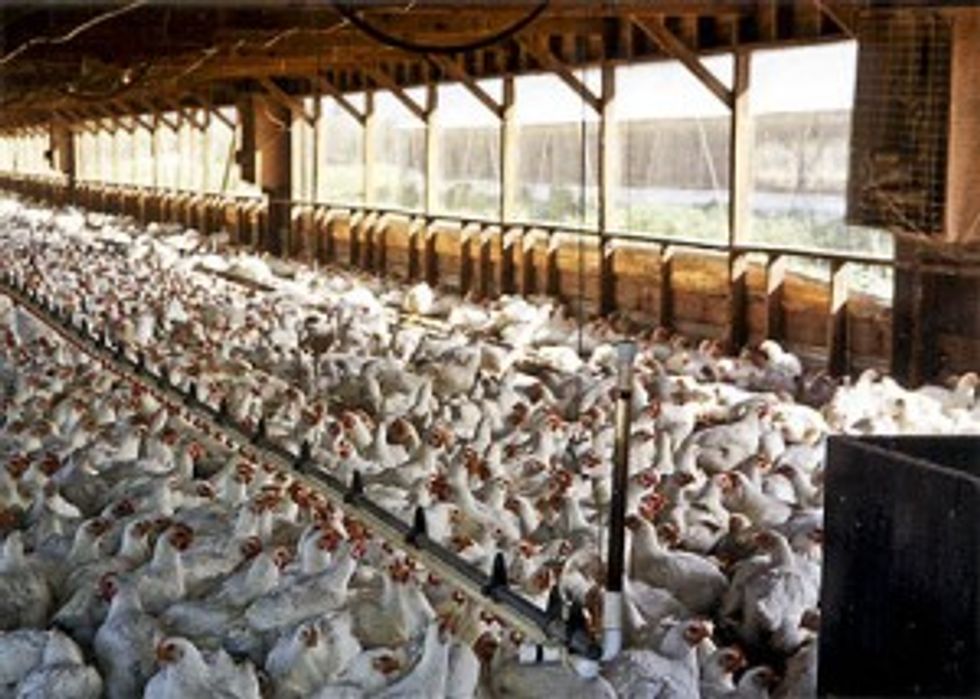
and livestock. Today, we have massive farms with giant chicken coops holding
thousands of chickens crammed inside. These coops have no access to grazing or
the outside world. Typically, the only time many animals will see the sunlight
is the day they are shipped off to the slaughterhouse.
In addition to these
horrid living conditions, livestock are stuffed with antibiotics and subjected
to genetic mutations, which cause them to grow well beyond their natural size. This
translates to many animals not being able to walk and some getting trampled to
death in their closed quarters. The horrific practices of the meat
industry are too many to cover in depth, here, but this gives a general view of the
conditions on factory farms. For more detail, I recommend the documentary film, Food Inc..
For me, these aspects of meat eating were too much. One day I chose to quit eating
animals. I chose to take it one day at a time and, now, it’s turned into two years.
The largest challenge isn’t internal; at this point, turning down meat
is more of a reflex. The challenge is finding meals in a world ruled by
meat-eaters. Finding a vegetarian meal on a college campus -- especially one in
the south -- can be difficult and it becomes even more challenging when I know
that I can easily go to Chik-Fil-A, Taco Bell or various other fast food
restaurants that mainly deal in meat slinging. The social awkwardness of refusing meat is obvious to
any vegetarian who as ever been invited to dinners -- the mom of one of my friends referred to me as the difficult one.
So, why become a vegetarian? I mean, one person not eating meat isn’t going to change the world. I’ve never held the illusion that by not eating meat I would end the meat industry, but I also couldn’t allow myself to continue to participate in a system that I considered morally abhorrent. Even if my efforts don’t change much, I want to be able to say, when I die, I did everything I could to make the world a better place.













