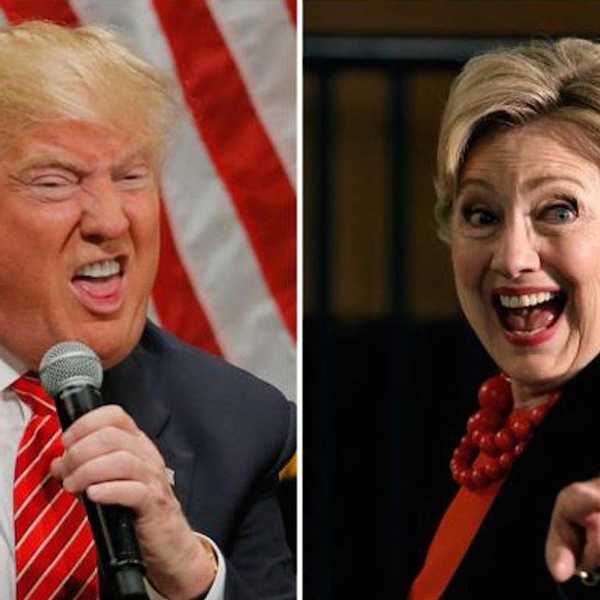
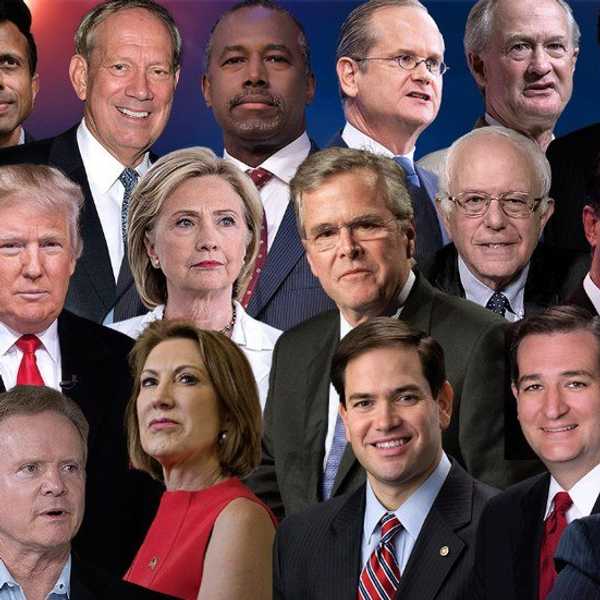
I know I’m not alone in dreading the upcoming presidential election. Both parties have managed to prove themselves nearly identical by selecting destructive autocrats who each promise to nominate an extremist Supreme Court that will take away our rights as Americans, to bring chaos to the already fragile global order, to cozy up to dictators, and to further drag the economy into the gutter. Their main appeal, amusingly enough, is that electing one stops the other; yesterday, a Reuters poll stated that, of all Clinton voters polled, 48.2% are only choosing her because they can’t stand Trump. A similar poll of Trump voters found that 56.8% of them are choosing him to stop Clinton.
Some may wonder how we got into this mess. The answer is, of course, that they were democratically chosen (depending on your definitions of fraud and democracy) by their respective party’s members in the lengthy primary process earlier this year. But, if one is so generous as to define the primaries as having been conducted in a fair manner—for the purposes of this article, we’ll assume that they were—the process cannot be called democratic in any sense. The New York Times reported recently that only 60,000,000 people voted in the primaries—about 30,000,000 for each party—and overall, only 14% of eligible voters, or 9% of the adult population in the country, voted for either Trump or Clinton. Hardly a democratic result.
I can hear the Trump voters and CTR interns banging at their keyboards now. “But the primaries don’t have to be fair! It’s not the real election! The parties have a right to choose their nominees! This isn’t even a democracy, anyway!” Well, Mr. Strawman, I’m glad you mentioned all of those things.
The fact of the matter is that, no matter how one looks at it, the President will, due to the way the system currently operates, be either the Republican or the Democratic nominee. The fact that these two private organizations have so much power over the public electoral process mandates changes; the current setup erodes the democratic process we like to harp on so much. The current electoral system must be reformed if we truly value democracy; such a process lacks a definite starting point, however. We could eliminate primaries, but they would be nigh impossible to replace, and forcibly opening the primaries to all voters would raise a whole myriad of other issues.
I should mention that, of course, reforming the electoral system is the very definition of a political pipe dream. I recognize this, and anyone who knows anything about politics knows this too. However, to discard an idea, not because it is impractical, but because adopting it seems impractical, never made much sense to me. I would imagine that the formation of the United States itself seemed fairly impractical at the time, but the idea itself was not. With such "pipe dreams," the first step is to raise awareness of the idea and hope that it spreads. I don't think this article is going to spark some sort of political revolution that will culminate in a Constitutional convention in two years' time (wouldn't that be nice?), but the idea of reforming the electoral system has always been floating around in this country. How many times have you heard people calling for the abolition of the Electoral College? These things aren't impossible, and I find it important to spread the idea to as many people as I can.
In any case, the most effective way to reform the broken electoral system is to remove our First Past the Post (FPTP) voting system. Certainly, the election of George Bush in 2000 due to Ralph Nader’s campaign in Florida comes to mind with this topic, and leaves a sour taste in many peoples’ mouths when the prospect of voting for a third party comes to mind. If it were easier for third parties to acquire electoral votes (or better yet, if we abolished the Electoral College altogether), the dominance of the big two parties would wither away fairly quickly.
However, the spoiler effect is not limited to Presidential elections, and indeed, the impact of abolishing FPTP would revolutionize Congressional elections just as much as it would the Presidential elections, if not more so. Currently, the system is set up in most states so that a simple plurality is needed to win elections. An example of this occurred in New York’s 23rd Congressional District, in which Democrat Bill Owens won with 47.5 percent of the vote, compared to Republican Matthew Doheny’s 46.4 percent of the vote. However, had Conservative Party candidate Doug Hoffman run and received 6.1 percent of the vote, it is almost certain that those votes would not have gone to Rep. Owens, and he thus would have lost the election.
First Past the Post is the most intuitive electoral system, and it is the simplest to understand. The voter sees a list of candidates on the ballot and picks one; the candidate who receives the most votes wins the election. The benefits of the system are in the simplicity of it, but it has many disadvantages; namely, that people will be afraid to vote for the candidate that best represents them, in fear of an even worse candidate winning the election. In those polls I mentioned earlier, Trump and Clinton voters only want to vote for them because they agree on policy at a rate of 31.9 and 39.7 percent respectively. Less than half of eligible voters actually want them in office; they just really don’t want the other in office. Many people, presumably, agree more with smaller parties, such as the Libertarian and Green parties, perhaps not a majority, but it can be safely assumed that many potential third-party voters are instead voting for the perceived lesser of two evils. "But do you want (opponent) to win?!" is the angry reply of both Republicans and Democrats when confronted with the idea of voting third-party. Furthermore, the fact that these parties are effectively ignored keeps them from reaching a broader audience, introducing a feedback loop.
There are, however, numerous alternative voting systems which are not plurality-based such as First Past the Post. Of them, one that is true and tested is the Single Transferable Vote system, or STV. In this system, the ballots have a list of candidates on them, just as with FPTP. Voters would rank the list by preference. When ballots are tabulated, if no candidate has a majority, the candidate with the fewest votes is eliminated. Their votes are distributed to other candidates based on the voters’ next choice. If no candidate still has a majority, the process continues until one of the candidates has a majority of votes. In each stage of the election, each vote counts, ensuring that one’s voice is always heard throughout the election until the majority of voters have spoken.
This allows the smaller parties’ supporters to safely choose their first preference without fear of a worst-case candidate winning the race. Even if those smaller parties lost the election, as they very well might, their initial showings would be far higher than usual, and the larger parties might take heed of what the people want. Tactical votes cast for the larger parties would not be a part of the equation any longer, leaving those parties with a smaller share of the votes, thus weakening the hold they have over the system. They will be shown that people have long clung to them out of fear, rather than any actual support, and they will be held accountable once again, lacking the ability to use their main rival as a boogeyman during the election season, and in so doing, attempting to absolve themselves of their wrongdoing over the past term. The end result of a national STV system (combined, presumably, with the abolition of the Electoral College) would be a multi-party democracy with several different parties holding seats in Congress. The two main parties would most likely retain the largest numbers, but would not be strong enough to govern without building coalitions with the smaller parties, forcing them to compromise, rather than blame the opposition for gridlock and hope that the voters buy it in two years' time.
The STV system is currently in use throughout the world; the Republic of Ireland is the only one, however, to use it at all levels of government. Northern Ireland and Malta also use it extensively, and it is used for various lower-level elections in India, Pakistan, Scotland, Australia, New Zealand; Cambridge, Massachusetts also uses STV for local elections, and Minneapolis uses it in certain local races.
Naturally, the universal adoption of STV in the United States would require amending the Constitution, which is no small feat when one considers that doing so requires extensive effort and cooperation on the parts of politicians who stand to lose a great deal from such a thing. However, amending the Constitution is, though a difficult and arduous process, possible if the people truly want true and lasting change. The benefits of STV over the current system are, in my opinion, too great to ignore because the change appears impractical. Raising awareness of the system is the natural first step in making such a change.