
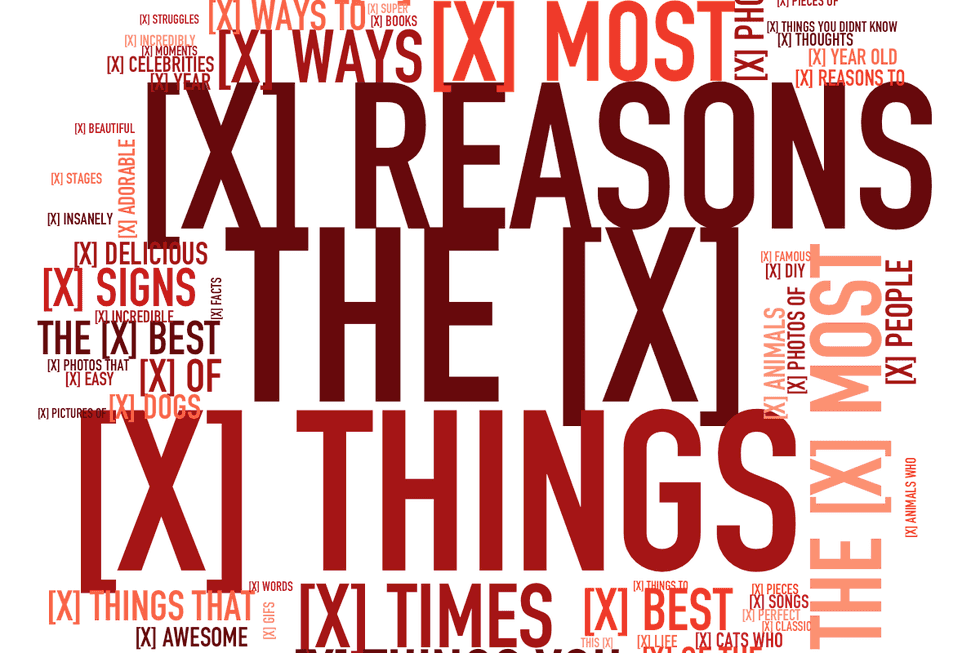
You're scrolling through your favorite social media site and suddenly it falls into view: "10 Ways to Brighten Up Your Day." So you click it, hoping for something fulfilling and interesting to help you, the reader, brighten up your day. Unfortunately for you, you're looking for light in a listicle. A listicle is an article that is also entirely a bullet-ed list, and they're a garbage form of media. Here's why:
1. They don’t provide you with much information.
Each point may contain only a single sentence of description, leaving the reader wanting more and getting none.
2. They are designed to make you want to click on them.
Writers on the Internet generally measure their success based on the online shares. Therefore, the listicles titled like “9 Things To Make Your Summer Vacation Incredible” are designed to pique your idle interest. The reader wants to make their own summer vacation incredible, so they click the link, not realizing numbers 1 through 6 are some variation of “go outside and eat somewhere with friends.”
Ex. 9 Things to Knock Off Your Summer Vacation Bucket List
3. They rarely contain any worthwhile information.
More often than not, listicles will provide information that is some kind of common knowledge or fun fact. They suggest things akin to “this location is a known spawning location for salmon.” This kind of information is similar in nature to small talk. It is quick, doesn’t matter to you, and you’ll forget it the second you’re no longer directly engaged. Arguably, listicles are meant to mildly entertain, but what sort of reaction does one give a listicle? A laugh? A head nod? Perhaps a brief exhalation?
4. They take up your time.
The average person can read approximately 200 words per minute. If we assume the average person is reading an average article of, say, 600 words, then the average person takes about three minutes to read a listicle. The information provided by the listicle is slight and fleeting, leaving the reader without any new knowledge and a loss of three minutes. This means that listicles are worth literally less than nothing.
5. Relatability is subjective.
A lot of listicles are designed to relate to the reader. The issue with relatability is that a lot of people do a lot of things, but a lot of people also don’t do a lot of things. Relating to one group alienates another. Generally, entertainment is meant to appeal to a specific group, but the larger the group, the grander the reaction. For a medium that is meant to garner as many clicks and shares as possible, relatable listicles are hardly more than ego stroking.
Ex. 23 Struggles Only People With iPhones Will Understand
Ex. 18 Things Only Weird People Will Understand
Ex. 16 Real Problems Only Lazy People Will Understand
6. Location-based listicles are basically cheap brochures.
Each outlining of “[Number] Reasons You Should Visit [Location]” provides a very small piece of information regarding a small aspect of a place. Yeah, the White Cliffs of Dover and Stonehenge are beautiful, but they’re also 170 miles apart. How is one supposed to visit all 25 locations in your list of reasons to visit England? You aren’t. These listicles can be boiled down to “[Number] Things In [Location].” On top of that, the information provided by the listicle is essentially a half-paragraph descriptor.
Ex. 25 Things That You Must Visit If You Ever Visit England
7. Information is repeated to fill space.
Sometimes thinking of new ideas is hard. In those trying times, taking the same information from other points and changing a word or two will change “Go out on a picnic” to “Go out to a barbeque.” For further example, this listicle basically says “listicles don’t tell me anything new or interesting” 11 times.
8. The number-based list is completely arbitrary.
Numbers are used in order to list or rank things. However, in the case of the listicle, naming a number of “reasons” or “ways” or “things” does not require numbering. Sure, if the numbering has to do with ranking of importance or chronological sequencing, then maybe the numbered points are necessary. The fact of the matter is that the numbers are used to add space in between singular points. The numbers allow for clickbait-y headlines and streamlined intake. On top of that, the actual numbers themselves are completely arbitrary. The writers chose four or seven or 11 "reasons to quit smoking" because that's the number of points they decided they wanted to write about, not any kind of number that has any sort of meaning or reasoning.
9. Listicles are splattered across the Internet.
“I’m going to jump into an informal first person perspective for this point. I have linked six listicles in this listicle so far alone. Do you know how long it took me to find those? Twenty seconds each. I wrote the point I was trying to make first, then googled my hypothetical headline, and found a matching listicle. “9 Things to Make Your Summer Vacation Incredible,” was something I made up. I looked that up after I wrote point number two. Turns out that article actually exists. That isn’t even a joke. It happened. They’re not hard to find, because there’s a hundred thousand of them.”
10. Sometimes the points listed don’t pertain to the topic.
When a listicle advertises itself as “12 Things You Can Do With An Egg” and point numbers five, 11, and 12 are “baking,” then you’re misusing the listicle. Variations aside, that listicle is a series of recipes, and the form is unnecessary.
Ex. 12 Things You Can do With an Egg
The numbered list can be useful in determining a ranking, such as a list of college track records from longest time to shortest, illustrated with the runners and their impact on their school. The listicle was designed with numbers being the important factor. For a lot of listicles, taking down the numbers leaves a few short bursts of loosely connected information. The bulk of which is only barely capable of holding coherent thought. Or worse, the list is actually a well-written discussion on the reasons a certain law should be considered unconstitutional.
However, these worthwhile listicles that would have made incredible articles are instead spooned out into this meaningless list for the sake of grabbing attention. The formula seems to work to the less attentive and suddenly the majority of listicles without the numbering are unable to stand alone as menial blog posts. The form is not being used the way it should: with the numbering being as significant as the content.
11. Everyone knows they’re terrible.
The worst thing about listicles is that everyone understands what they are. There is an oversaturation of sarcastic or ironic listicles much like this one. Yet they still come by the hundreds, funneled out of Buzzfeed’s maw.
Ex. 10 Reasons I Don’t Read or Write Listicles (And You Shouldn’t, Either)
Ex. 9 Reasons Why Listicles Totally Suck
Ex. 8 Reasons to Avoid Listicles
Ex. 7 Reasons Why Listicles Are Killing Modern Media
Ex. 6 Reasons I Hate Listicles
Ex. 5 Reasons Listicles are Bad For You: So Stop Reading Them!