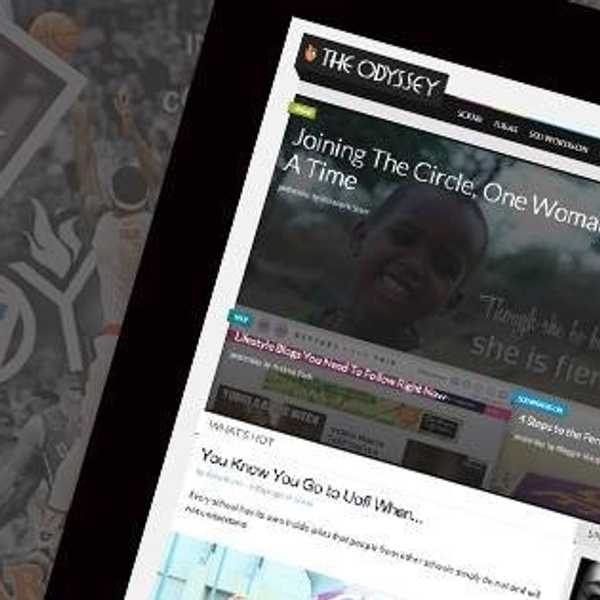


Scrolling through my newsfeed, I have seen some recent criticism of Odyssey's mission statement, the quality of writing being published, and the professionalism with which certain subject matter is being explored. Some have likened Odyssey to a glorified blog, claiming that some pieces would be more appropriately published on someone's Tumblr than on a website such as Odyssey. Others have attacked Odyssey's mission statement, asserting that the platform's proclaimed openness to all voices is a.) not actually that open and b.) allows for disagreeable opinions to be published.
From my experience, Odyssey is, in fact, very open to publishing a wide variety of work from writers of different backgrounds and experiences. My position as Editor-in-Chief at Vassar has revealed to me the ways in which Odyssey's core values are implemented at all levels of the publication, from recruiting to writing to editing to publishing. As an editor, I am careful not to change the writer's voice, but to allow them to express their opinions freely. Obviously if I felt that something being published was going to be triggering or offensive to certain people, I would talk to the writer and explain why their piece is problematic; however having the freedom to express one's opinions is an important part of finding a voice as a writer. If writers do not put themselves out there and take risks, making themselves vulnerable to criticism and different opinions, they may never discover what they truly believe in. It is all part of the learning process.
In terms of recruiting, there is very little personal criteria for being hired as a writer. If applicants are clearly passionate about writing and the ideas they want to express, I will want to work with them. Obviously I wouldn't hire just anyone; however, I do not believe that every writer on staff needs to write like a Pulitzer Prize winner. The Odyssey is not the New Yorker, and no one has ever tried to make this claim. The whole point of Odyssey is to provide a platform that is just as accessible to writers as it is to readers, particularly for the millennial generation.
So why do I write for Odyssey? Because I love writing. Because Odyssey has provided me with an amazing opportunity to publish at least one article per week, as well as a set schedule of deadlines to serve as a motivational framework. Not only am I building up a portfolio of works that I have published at Odyssey, but I am also networking with other writers, both at Vassar and beyond. Odyssey is a community that includes hundreds of colleges and universities across the country; what other platform accomplishes this?
Finally, Odyssey has provided me with an affirmation: yes, I can make a difference through my writing, and I do have the power to affect people through my words. Due to the way Odyssey is so dependent on social media to ensure that articles are being noticed and read, so many people have mentioned my writing to me just in the past five weeks of being at Odyssey. I have always been an English major and a writer, but it was not until I started writing for Odyssey that people really started to recognize my work, and that is largely due to the structure and overall concept of the platform itself. I can't say I have ever felt more satisfied than when I received the flood of messages from close friends as well as relatives and classmates that I haven't been in contact with for years about one of the articles I wrote. I felt validated not only as a writer, but also as a thinker, as a producer of ideas. I have been told that I have articulated thoughts that people often have, yet cannot put into words. To me, this is the ultimate goal of a writer anyway; therefore, what does it matter if the article sounds more like a blog post than a New York Times piece? People need to start to accept the fact that society is changing, and with it, the arts, literature, and people's modes of expression are changing too. So please don't hate on Odyssey, because for me and so many other writers who are a part of this community, this platform has given us purpose, inspiration, and validation.