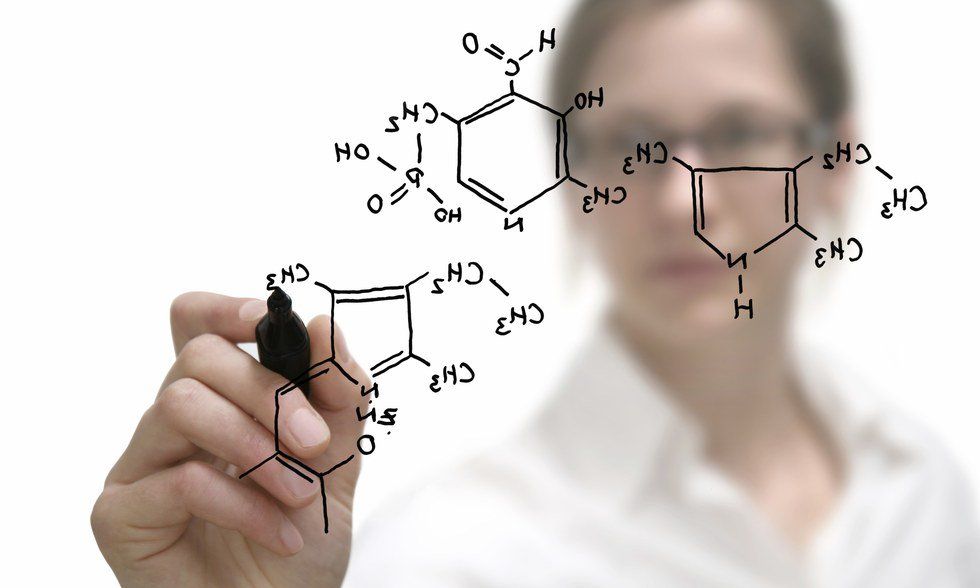
The lack of women in STEM fields has been a problem for a large number of years and has still yet to get better. Even though there are multiple programs, including Science Cheerleader that shows famous NFL cheerleaders who work in STEM fields, encouraging young women and girls to join their ranks there are still people who try to discourage and denounce these movements as arbitrary and unnecessary. “What have women ever done for science anyways?”
Take a seat and let me tell you.
Ada Lovelace, first Computer Programmer
Ada Lovelace was a woman who lived London, England in the 19th century. In her teens, she was found to be incredibly talented in math and these talents lead her to have a working relationship and friendship with British mathematician Charles Babbage, a.k.a. “The Father of Computers." While working on the Analytical Engine together, Lovelace took notes on the engine and in these notes included what is recognized as the first algorithm intended to be carried out by a machine. Her program was never tested but her work laid the foundation for more programming to come.
Margaret Hamilton, Programmer for the Apollo 11 mission
For example, Lovelace’s program set the way for the space program to finally send a man to the moon. During the Cold War, Hamilton worked on the SAGE Project to track military aircraft use and defend against potential Soviet attacks. She later joined the Charles Stark Draper Lab at MIT and eventually led a team that created the software for Apollo and Skylab that included algorithms that sent Apollo 11 to the moon. Her system also alerted to the potentially fatal errors that the program ran into and made the mission a success.
Mary Jackson and Katherine Johnson, African-American Computers
These two women were a part of a team of computers who figured out complex mathematical algorithms used to help flight engineers in NASA. The women also worked to help other women and minorities advance their careers and helped inspire the desegregation of NASA’s computers. Johnson was the person to calculate the trajectory of Alan Shepard’s trip and used geometry backwards to get it right. She was later requested by John Glenn personally to recheck calculations a computer originally did. They are the inspiration behind the up and coming movie “Hidden Figures” to be released in 2016, which chronicles their hardships and their rise to fame.
Chien-Shiung Wu, Nuclear Physicist
In World War II, Wu joined the Manhattan Project at Columbia University to develop the atomic bomb. She was the one to develop a process to enrich uranium ore to produce large uranium quantities as fuel for the bomb. Wu is recognized as the “First Lady of Physics” and stayed on as a research assistant after the end of the war, when she discovered that there is a preferred direction of emission, disproving what was, at the time, widely accepted as a “law” of nature. This discovery was worthy of a Nobel Prize, that was given to two other male doctors who worked with her instead because her discovery was “not recorded.”
Rosalind Franklin, Molecular Biologist
Franklin is the woman responsible for the discovery of the DNA structure. She worked in John Randall’s laboratory at King’s College, London in the 1950’s. From 1951 to 1953 she worked on a DNA project that had at one point been all but abandoned for months but she refused to give up. In this lab she crossed paths with Maurice Wilkins whom undermined her constantly as a technical assistant. Yet, it was her X-ray photographs of DNA that Wilkins and his colleagues used to back and publish their “finding” on the double helix structure of DNA. The Nobel Prize for this discovery was given to Crick, Watson, and Wilkins in 1962, four years after Rosalind Franklin’s death.
Jocelyn Bell Burnell, Astronomer
Burnell was a young girl who grew up in Ireland and worked at the University of Cambridge in 1965. She helped contrast a massive radio telescope designed to monitor quasars in two years and was asked to analyze the data it collected. In her analysis, she noted anomalies that didn’t fit with the patterns produced by quasars, which lead to a huge scientific study of the radio pulses, referred to as “Little Green Men”, which were found to be caused by neutron stars that spin fast and collapse too small to form black holes. The team’s findings were published in February of 1968, which did give Burnell credit for her work and yet in 1974 Hewish and Ryle, the astronomers she worked under, were awarded the Nobel Prize for Physics for the work and not Burnell.
Hedy Lamarr, Actress and Inventor
Hedy Lamarr was a Silver Screen starlet during World War II and became a pioneer in the field of wireless communication after her emigration to the US. She and her co-inventor, George Anthiel, developed a “Secret Communications System” by manipulating radio frequencies at irregular intervals between transmission and reception. This system helped combat Nazi forces in World War II and the invention formed an unbreakable code to protect classified information. She and Anthiel received a patent in 1941 but it wasn’t until decades later that their discovery’s significance was realized. This was implemented on naval ships during the Cuban Missile Crisis and the “spread spectrum” technology she invented served as the backbone for cell phones, fax machines, and other wireless operations made available to us today like Bluetooth and WiFi.
So, let’s recap. Women are responsible for computers, sending astronauts out into space safely, the discovery of the DNA helix, atomic bombs, our understanding of neutron stars, and WiFi. Please, tell me again how women have contributed nothing to science.